The sirens start as a low hum in the distance, a sound so ubiquitous in the city that most people barely register it. It is the background noise of urban life, the frantic heartbeat of a metropolis that never sleeps. But for some, that sound represents the thin line between a routine evening and a tragedy that echoes through courtrooms for years to come.
In Eltham, South London, the air on a specific October evening wasn't just cold; it was heavy. Adrienne Parry was moving through her life with the quiet anticipation that only an expectant mother knows. She was carrying a daughter. She was twenty-eight. She was exactly where she was supposed to be, navigating the familiar streets that should have been a sanctuary.
Then, the world shattered.
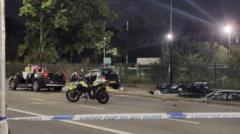
A police car, responding to an emergency, collided with her vehicle. The physics of such a moment are brutal. Metal crumples. Glass turns into a thousand glittering shards. The silence that follows a crash like that is often louder than the impact itself. Adrienne and her unborn child did not survive.
We often talk about "incidents" or "collisions" in the detached language of a police report. We weigh the variables of speed, blue lights, and sirens as if they are entries in a ledger. But these are not just variables. They are choices made in split seconds under immense pressure. Now, those choices have led to a moment of legal reckoning that forces us to look at the human cost of the systems designed to protect us.
The Weight of the Badge
Two officers are now facing the justice system they once served. One is charged with causing death by dangerous driving; the other with misconduct in a public office. These aren't just legal definitions. They represent a fundamental break in the social contract.
When an officer gets behind the wheel of a high-performance vehicle and activates those lights, they are granted a terrifying level of power. It is the power to bypass the rules that govern the rest of us. We trust them to use that power with a level of care that exceeds the average driver. We expect them to be the masters of the machine, navigating the chaos of traffic with a surgical precision that keeps the public safe even as they rush toward danger.
But what happens when the pursuit of one emergency creates another?
Consider the psychological landscape of a high-speed response. The adrenaline is a physical weight. The tunnel vision sets in. Every second feels like a minute. The officer is focused on a goal—a crime in progress, a life to save, a suspect to apprehend. In that state of hyper-arousal, the peripheral world can become a blur. The "invisible stakes" here are the lives of every pedestrian, every commuter, and every woman driving home to start a family.
The Independent Office for Police Conduct (IOPC) spent months dissecting the telemetry, the radio transmissions, and the wreckage. Their decision to refer the case to the Crown Prosecution Service wasn't a snap judgment. It was a slow, agonizing crawl through the data to determine if the line between "necessary risk" and "criminal negligence" had been crossed.
A Community in Mourning
The grief following Adrienne Parry’s death wasn't contained within the walls of her home. It bled out into the streets of Eltham. Flowers leaned against cold brick walls. Notes were written to a child who would never take a first breath.
This is the emotional core that dry news reports often miss. They mention the charges, the court dates, and the names of the accused. They rarely mention the nursery that stayed empty. They don't talk about the way a family has to learn to breathe again after the air has been sucked out of their world.
When we discuss police accountability, we often get bogged down in the politics of it. One side shouts for total immunity for those in the line of duty; the other demands immediate and harsh retribution. The truth, as it usually does, sits in a much more painful place. It sits in the realization that even when someone is trying to do their job, the consequences of a mistake can be permanent.
Justice, in this context, is a heavy word. It doesn't bring back the life lost. It doesn't heal the trauma of the witnesses who watched the scene unfold. What it does, ideally, is provide a framework for truth. It asks the hard questions: Was the speed justified? Were the protocols followed? Did the desire to reach a destination outweigh the duty to protect the people along the way?
The Mechanics of Accountability
The legal proceedings ahead will be clinical. There will be maps showing the trajectory of the vehicles. There will be expert testimony on braking distances and reaction times. The defense will likely speak of the pressures of the job, the urgency of the call, and the inherent risks of emergency response. The prosecution will speak of a young woman and her child, and the laws that apply to every citizen, regardless of the uniform they wear.
But beyond the courtroom, there is a broader conversation about how we train our first responders. Is it enough to teach them how to drive fast? Or do we need to do more to teach them when to slow down? The "holistic" approach—if we dare use a word so clinical for something so visceral—must involve a culture where the safety of the public during a pursuit is given as much weight as the pursuit itself.
We have seen this pattern before. A tragedy occurs, a community reels, and the wheels of justice turn slowly. But each time it happens, the trust between the public and the police is tested. That trust is fragile. It is built on the belief that those who carry the authority to break the rules do so with the highest level of responsibility. When that trust is broken by the sound of twisting metal on a London street, the repair process takes decades.
The Invisible Ripples
The impact of this case reaches far beyond the two officers and the family of Adrienne Parry. It affects every officer who starts their shift and wonders if today is the day they will have to make a choice that changes their life forever. It affects every citizen who hears a siren and feels a flicker of anxiety instead of a sense of security.
There is a specific kind of silence that exists in a neighborhood after a tragedy like this. It’s a silence that carries the weight of "what if." What if she had left five minutes later? What if the light had stayed green? What if the call the officers were responding to had been handled differently?
These questions don't have answers. They only have echoes.
The upcoming trial will be a search for a specific kind of truth—a legal one. But the human truth is already known. It is written in the loss of a mother and a daughter. It is written in the lives of two men whose careers and identities are now defined by a few seconds of motion.
The city continues to move. The sirens continue to wail. But for the people of Eltham, and for those who follow the story of Adrienne Parry, the sound will always be a reminder of the day the background noise of the city became the soundtrack of a nightmare.
There is no "moving on" from a loss of this magnitude. There is only moving forward with the weight of it. As the case moves toward the Old Bailey, the eyes of the public will be on more than just two defendants. They will be on a system that is being asked to account for the lives it failed to protect while trying to serve.
The final image isn't one of a courtroom or a badge. It is of a quiet street in South London, where the skid marks have long since faded, but the memory of a woman driving toward a future that never arrived remains etched into the pavement.