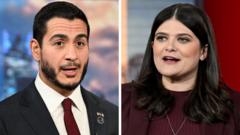
Abdul El-Sayed won the Michigan Democratic U.S. Senate primary, defeating Representative Haley Stevens after a brutal, cash-drenched intraparty slugfest that exposed the ideological fault lines tearing through the opposition party. This primary battle was never merely about replacing retiring Senator Gary Peters. It was a referendum on whether the left flank can dictate the national playbook in a must-win Rust Belt battleground.
With more than fifty million dollars poured into the contest by outside entities—including a record-shattering investment by political action committees aligned with the American Israel Public Affairs Committee—the race transformed into a proxy war. Establishment stalwarts backed Stevens, banking on her suburban moderation and manufacturing credentials. The progressive wing rallied behind El-Sayed, a former public health official carrying the endorsement of Senator Bernie Sanders.
The math of the general election is unforgiving. El-Sayed now moves on to face Republican former Congressman Mike Rogers in a state that Donald Trump captured in 2024.
Anatomy of an Insurgency
Money talks in modern American politics. Sometimes, however, a grassroots mobilization manages to deafen it.
Stevens enjoyed the backing of the institutional hierarchy, including outgoing Governor Gretchen Whitmer and Senate leadership. Her campaign leaned heavily on her background steering the federal auto rescue, projecting a pragmatic, corporate-adjacent competence designed to court independent voters and moderate Republicans. She was the safe bet on paper.
El-Sayed ran from the left, hammering away at a three-pronged populist message: getting money out of politics, lowering household costs, and passing universal health care. He took no corporate PAC money. He leaned into contentious foreign policy debates, calling for an end to military aid to Israel at a time when traditional party leaders desperately wanted to avoid foreign policy fractures.
The strategy worked, but barely. When the dust settled across Wayne and Oakland counties, El-Sayed scraped past Stevens by a razor-thin margin of less than one percentage point. It was an earthquake delivered by a few thousand votes, proving that the progressive base in Michigan is organized, angry, and unwilling to defer to Washington power brokers.
The AIPAC Factor and the Foreign Policy Rift
You cannot analyze this primary without examining the financial tidal wave that crashed over it.
Super PACs spent historic sums, transforming local cable broadcasts into a relentless loop of attack ads. The intervention by pro-Israel groups was designed to blunt El-Sayed's momentum by highlighting his foreign policy positions and associations. Yet, rather than sinking his candidacy, the heavy-handed outside spending energized his base. It turned the contest into a David versus Goliath narrative that resonated deeply with younger voters and Arab-American communities across metropolitan Detroit.
For the national party, this creates an acute dilemma. The coalition required to win a general election in Michigan relies on stitching together disparate factions. Progressive activists who spent the summer walking precincts for El-Sayed expect ideological purity. Meanwhile, suburban moderates who voted for Stevens may recoil at a platform that challenges core party orthodoxy on defense and corporate partnerships.
Facing Mike Rogers
The general election landscape offers zero room for error. Republicans nominated Mike Rogers unopposed, giving him months to build a war chest and define his opponent before El-Sayed could even catch his breath from the primary brawl.
Rogers lost a nail-biter to Senator Elissa Slotkin in 2024, meaning he enters this cycle with high name recognition, established donor networks, and an active campaign infrastructure. He has already begun framing El-Sayed as an unviable radical out of step with mainstream Michigan values.
Party unity is no longer a polite suggestion; it is an absolute survival requirement. Following her concession, Stevens offered her support to the nominee, warning that a fractured electorate hands the Senate seat directly to the GOP. Whether bruised moderates will follow that lead into November remains the single biggest unknown in national politics.
The progressive movement secured its trophy in Detroit. Now comes the hard part of keeping it.


