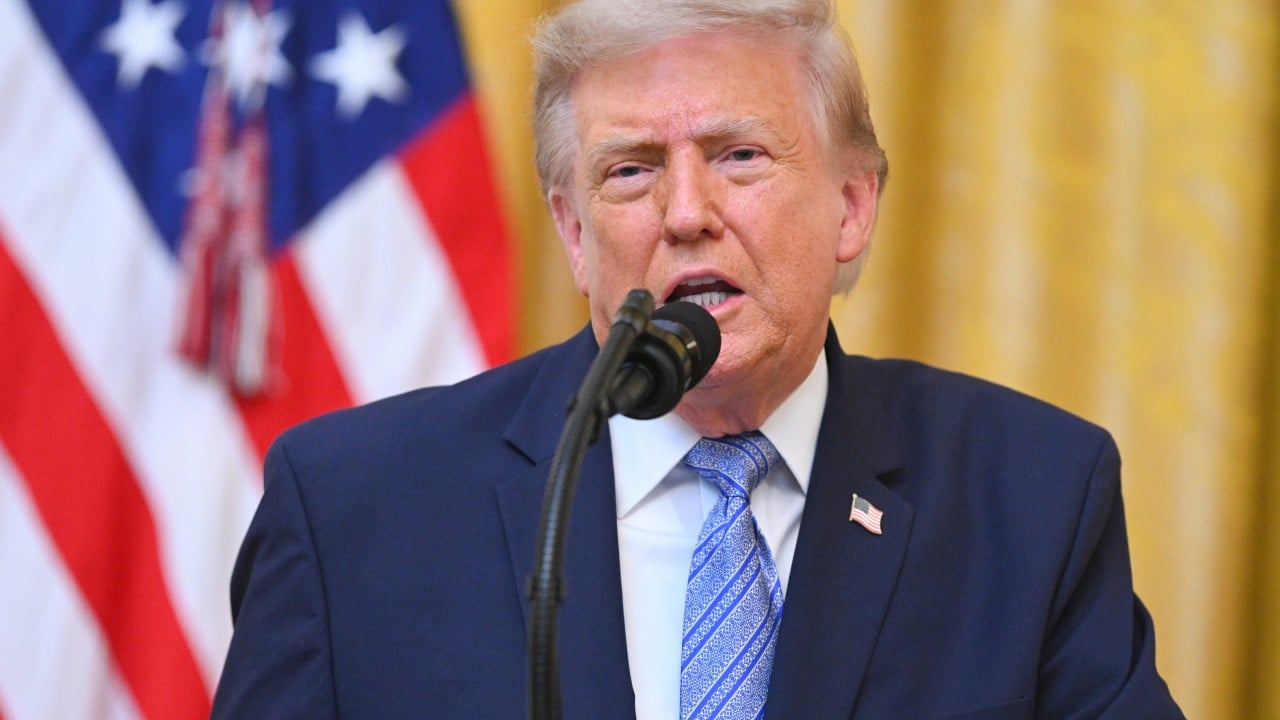
When President Donald Trump took to the podium in the East Room of the White House for a late-night national address, the political establishment braced for a seismic shift. Administration allies promised an unprecedented reveal of classified intelligence, a document dump capable of rewriting the history of recent American presidential elections and proving foreign sabotage on a massive scale.
What delivered instead was a masterclass in political maneuvering, selective intelligence disclosure, and calculated distraction.
In a 25-minute televised presentation, Trump alleged that China had orchestrated a historic election breach, claiming Beijing illicitly acquired 220 million American voter files in 2020. He pointed to newly posted White House documents as proof of a broad intelligence cover-up by unnamed officials. Yet an examination of the declassified files, coupled with assessments from election security experts and lawmakers on both sides of the aisle, shows a stark disconnect between the White House narrative and the raw reality of the data. Far from uncovering a compromised vote count, the address served a far more immediate tactical purpose: shifting public attention away from a prolonged military conflict with Iran, rising living costs, and difficult political terrain ahead of the 2026 midterm elections.
The Declassified Files That Promised Fire and Delivered Smoke
For weeks, White House staff teased a major announcement on voting integrity. When the documents finally hit the official administration portal during the broadcast, researchers and national security analysts rushed to verify the central claim that Beijing had altered or compromised the foundations of American voting.
They found nothing of the sort.
The primary CIA assessment released by the executive branch dated back to August 2020. That document explicitly noted that while Beijing sought to influence public opinion against the administration and possessed broad data-gathering capabilities, Chinese operatives had not attempted to alter technical voting infrastructure, change vote tallies, or manipulate registration databases. Another document confirmed that intelligence agencies found no evidence of any foreign power successfully modifying a single cast ballot.
Raw intelligence reports often contain unverified tips, low-confidence field observations, and intercepted chatter. When military and civilian spy agencies process these reports, analysts filter out noise to build actionable intelligence. By releasing unvetted raw files directly to the public without context, the White House bypassed standard analytical filters, presenting preliminary notes as absolute proof of foreign election manipulation.
This maneuver mirrors historical intelligence missteps where unverified field notes were presented to the public as absolute certainty. The danger lies in blurring the line between a foreign nation collecting open-source information and a hostile actor changing election outcomes.
Public Voter Rolls Repackaged as Foreign Espionage
The centerpiece of the president's address was the claim that China had compromised 220 million voter files, an event characterized from the podium as an unprecedented security breach.
The actual nature of American voter data tells a different story.
In the United States, voter registration records are not top-secret government files. State election authorities routinely sell or share voter lists containing names, addresses, party affiliations, and voting histories to political campaigns, academic researchers, commercial vendors, and media organizations. States like North Carolina make extensive voter demographic files available directly on public websites for download by anyone with an internet connection.
Foreign intelligence agencies collect publicly available information on foreign populations as standard practice. Acquiring open-source voter records allows foreign government analysts to track political trends and target public messaging. It does not provide access to air-gapped voting machines or allow an external actor to change votes inside localized precinct counting systems.
To claim that obtaining public voter rolls is equivalent to stealing an election conflates marketing data with operational control over voting hardware.
A Distraction from Economic Drag and Foreign Conflict
Understanding why this speech occurred at this exact moment requires looking beyond the East Room podium to the broader geopolitical and economic backdrop facing the administration.
Approval ratings have felt the weight of ongoing military operations in Iran, alongside persistent consumer frustrations over energy prices, food costs, and housing affordability. Opposition figures, led by former Vice President Kamala Harris, immediately criticized the primetime address as a deliberate effort to pivot away from domestic economic pressures and an unpopular foreign conflict.
During the speech, the president mentioned the conflict in Iran only briefly, asserting that the nation was winning, before pivoting rapidly to claims about election security and foreign meddling.
When a government faces tough questions on high gas prices and overseas military commitments, controlling the national narrative becomes an urgent priority. Re-framing public debate around election integrity allows political strategists to energize core supporters while forcing political opponents onto the defensive.
The speech also served as an opening salvo against major television networks that declined to carry the address live, sparking renewed executive branch calls for regulatory scrutiny of national broadcasters.
The Legislative Push to Reshape Midterm Rules
Beyond the headlines and immediate political commentary, the White House address carried a clear legislative objective: building public support for sweeping national voting legislation ahead of the 2026 midterms.
Republicans face difficult congressional races this fall, with control of both the House and Senate hanging in the balance. The president used the platform to press lawmakers for immediate passage of strict voter identification bills, mandatory citizenship verification rules, and severe restrictions on mail-in balloting.
Yet even within the president's own party, the path forward remains messy. Conservative and moderate senators have raised logistical concerns regarding federal mandates on state-run election systems. Senator Thom Tillis has repeatedly warned that rushing complex federal voting overhauls through legislative reconciliation without clear implementation mechanics risks overwhelming local election administrators who must execute these rules on tight schedules.
Meanwhile, intelligence leadership on Capitol Hill offered stark pushback. Senate Intelligence Committee Vice Chair Mark Warner flatly rejected the assertions made during the speech, noting that the intelligence community remains unanimous in its assessment that foreign adversaries did not alter vote totals in 2020.
Federal law places the administration of elections squarely in the hands of local and state officials across thousands of individual jurisdictions. That decentralized system makes a nationwide technical hack virtually impossible, as counting machines are not connected to the central internet and rely on physical paper audit trails.
By casting doubt on technical voting infrastructure, the national address aimed to mobilize voters around legislative overhauls. Whether those proposed overhauls can clear a divided Congress before voters go to the polls this November remains an open question. The administration has laid down its tactical marker, ensuring that the debate over voting rules will remain central to the upcoming midterm battles.