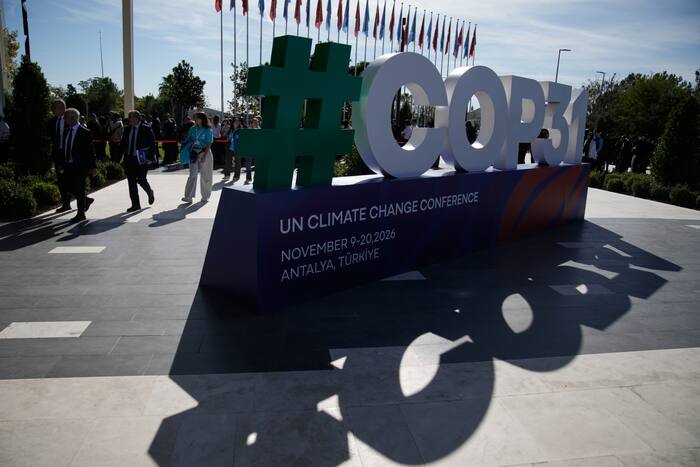
The UN climate summit opening in Turkey arrives on the heels of a year defined by relentless weather disasters, yet the diplomats gathering in the convention halls are still arguing over accounting rules rather than emergency survival. While headlines frame this annual Conference of the Parties (COP) as humanity's last best chance to curb warming, the brutal reality on the ground tells a different story. Nations are converging in a country straddling Europe and Asia—one that acts as both a major fossil fuel transit hub and a victim of severe Mediterranean drought—to negotiate voluntary pledges that physics has already outpaced.
If you want to understand why these summits consistently underdeliver, stop looking at the speeches on the main stage. Look at the mechanics of consensus diplomacy. For an alternative perspective, consider: this related article.
Every single decision at a UN climate summit requires unanimous agreement from nearly 200 nations. One holdout can veto a single word in a final communiqué. That structural flaw guarantees that ambitious proposals get watered down until they satisfy the lowest common denominator—usually petrostates and major industrial emitters whose economies depend on the exact commodities driving the crisis.
The Anatomy of a Broken Diplomatic Machine
To grasp the friction inside the negotiation rooms, you have to understand how the UN Framework Convention on Climate Change (UNFCCC) actually operates. It is not a global parliament with enforcement powers. It is a consensus-driven forum built in 1992 for a geopolitical world that no longer exists. Related coverage on this matter has been published by Al Jazeera.
Back then, the world was neatly divided into "developed" nations (Annex I) responsible for historical emissions, and "developing" nations (Non-Annex I) that were largely exempt from binding cuts. Three decades later, that binary classification has become the single biggest stumbling block in climate diplomacy. China is now the world's largest annual emitter and a manufacturing superpower, yet under UN rules, it still sits in the developing bloc alongside small Pacific island nations facing literal submersion.
Wealthy Western nations refuse to sign blank checks for climate finance unless major emerging economies contribute to the pot. Emerging economies refuse to pay until the West fulfills past promises that have repeatedly fallen short or arrived as high-interest loans rather than grants.
The result is predictable. Delegates spend two weeks fighting over brackets in draft texts, trading technical concessions on carbon market registries while atmospheric greenhouse gas concentrations hit record highs.
Why Turkey Changes the Geopolitical Math
Hosting the summit in Turkey introduces a distinct set of pressures that previous venues lacked. Unlike wealthy Gulf states flush with sovereign wealth or European capitals bound by strict regional green mandates, Turkey occupies a complicated middle ground.
- Energy Transit Leverage: Turkey sits at the crossroads of pipelines carrying oil and natural gas from Russia, the Caspian Sea, and the Middle East into European markets. It is actively expanding domestic coal power while simultaneously scaling up solar and wind capacity.
- Climate Vulnerability: The eastern Mediterranean is warming faster than the global average. Turkey has endured catastrophic wildfires along its southern coast, severe agricultural droughts across the Anatolian plateau, and devastating flash floods in the Black Sea region.
- The Finance Tightrope: Having ratified the Paris Agreement relatively late, Turkey fought for years to be reclassified so it could access international climate finance rather than be forced to provide it.
This dual identity mirrors the broader global stalemate. Nearly every nation wants cheap, reliable energy to fuel domestic growth right now, even as the physical bill for extreme weather comes due in real time.
Follow the Money Not the Pledges
When extreme weather wipes out harvests, shatters power grids, and displaces millions of people, abstract targets for the year 2050 lose all meaning. The central battleground at this summit is cold, hard cash—specifically, the New Collective Quantified Goal (NCQG) on climate finance and the operationalization of the Loss and Damage fund.
For years, the benchmark for international climate aid was $100 billion per year—a figure pulled out of thin air during the 2009 Copenhagen summit with zero grounding in actual economic need. Even that modest target was missed for years, and when donor nations finally claimed they had met it, independent audits revealed that much of the money was repackaged development aid or market-rate loans that pushed vulnerable countries deeper into debt.
Actual adaptation and transition costs for developing nations run into the trillions of dollars annually. Yet finance ministers from Washington, Brussels, and Tokyo face domestic inflation, voters angry about energy costs, and rising defense budgets. They cannot—and will not—extract trillions from their taxpayers to hand over to UN-administered funds.
The Private Sector Mirage
To bridge that gap, summit organizers inevitably pivot to "mobilizing private capital." The theory sounds clean on paper. Public money from development banks absorbs the initial risk, encouraging institutional investors and asset managers to pour billions into solar farms, grid upgrades, and resilient infrastructure across the Global South.
In practice, private capital flows where returns are safe and predictable. Building a utility-scale battery storage facility in a country with volatile currency, high sovereign debt, and unstable grids carries massive financial risk. Investors demand double-digit interest rates to offset that risk, making clean energy projects prohibitively expensive in the exact places that need them most.
Consider a hypothetical example to see how this plays out. Suppose a coastal nation needs $500 million to build sea walls and upgrade its storm drainage after back-to-back cyclones. Sea walls do not generate revenue streams. There is no electricity to sell, no toll to collect, and no return on investment for a private equity firm. Adaptation projects rely almost entirely on public grants, which remain chronically underfunded because donor countries prefer financing energy projects that offer commercial returns.
The Carbon Market Shell Game
When governments cannot agree on direct taxes or strict bans on fossil fuels, they turn to Article 6 of the Paris Agreement—the rules governing international carbon markets. Proponents argue that letting wealthy nations and corporations buy carbon offsets from forest preservation or clean energy projects in developing nations channels money where it is needed most.
Veterans of the industry have watched this movie before, and the ending is rarely pretty.
Under the Kyoto Protocol's Clean Development Mechanism, lax oversight allowed companies to claim massive emissions reductions for projects that would have happened anyway, or worse, created perverse incentives for factories to manufacture potent greenhouse gases just to get paid to destroy them. Today's voluntary and compliance carbon markets suffer from the exact same structural vulnerabilities:
- Additionality Failures: Proving that a forest would have been cut down without offset funding is largely guesswork, leading to inflated baselines that generate "phantom credits."
- Permanence Risks: A forest protected today by carbon credits can burn down tomorrow in the very wildfires fueled by a warming atmosphere, erasing the stored carbon while the buyer keeps the credit on their balance sheet.
- Double Counting: Without airtight national registries, both the host country and the buying corporation can claim the same emission reduction toward their respective targets, creating net-zero math that exists only on spreadsheets.
If negotiators in Turkey finalize weak Article 6 rules just to declare a diplomatic victory, they risk flooding the global market with cheap, low-integrity offsets that allow major polluters to delay real industrial decarbonization.
The Physical Reality Outrunning the Negotiators
The most glaring disconnect at any UN climate summit is the gulf between diplomatic timelines and atmospheric physics. Negotiators operate on five-year review cycles, debating reporting methodologies and transparency frameworks that will not take full effect until the late 2020s or 2030s.
The atmosphere does not read policy papers.
Over the past year, extreme weather events stopped behaving like statistical outliers and started acting like a baseline condition. Prolonged heat domes buckled rail lines and overwhelmed power grids across multiple continents. Atmospheric rivers dumped months' worth of rain onto cities in a matter of hours, exposing the fragility of drainage systems designed for a twentieth-century climate. Ocean surface temperatures shattered records, supercharging storms and bleaching coral reefs at scales that stunned marine biologists.
Insurance markets are reacting far faster than politicians. Major underwriters are pulling out of high-risk flood and wildfire zones from California to coastal Europe, leaving homeowners and municipal governments holding uninsurable assets. When the private insurance sector decides a region is too risky to cover, that is a clear market signal that physical climate risk has crossed from a future projection into a present-day balance sheet liability.
The Fossil Fuel Elephant in the Room
Every COP final text undergoes forensic scrutiny over how it describes fossil fuels. Getting the phrase "transitioning away from fossil fuels" into a previous agreement was hailed as a historic breakthrough, even though the text carefully avoided binding timelines and left massive loopholes for "transitional fuels"—industry shorthand for natural gas—and carbon capture and storage (CCS).
Global demand for coal, oil, and gas has not fallen. Renewable energy deployment is booming, particularly solar and battery storage, yet total global energy demand is growing so fast—driven by industrial expansion, cooling needs during heatwaves, and power-hungry data centers—that clean energy is mostly adding to the energy mix rather than replacing fossil fuels outright.
Meanwhile, carbon capture remains wildly expensive at scale, with the vast majority of operational facilities used to inject captured carbon underground to force more oil out of aging wells—a process known as enhanced oil recovery. Relying on unproven or uneconomic capture technologies to justify continued fossil fuel expansion is a gamble with steep odds.
What Actually Moves the Needle
If the formal UN summit process is structurally incapable of forcing rapid emissions cuts, why do tens of thousands of lobbyists, activists, executives, and ministers still descend on the host city every year?
Because the real action happens outside the plenary halls.
The main value of the summit is no longer the watered-down final communiqué. It is the bilateral deals, sector-specific coalitions, and regulatory signals forged on the sidelines. When major economies align on methane leak detection standards, shipping fuel mandates, or grid interconnection financing, they bypass the UN consensus veto entirely.
Real progress requires shifting focus away from distant net-zero pledges and toward immediate, measurable operational metrics:
- Grid Modernization Over Raw Generation: Installing gigawatts of solar panels means nothing if outdated transmission lines force operators to curtail power during peak sunshine. Permitting reform and high-voltage grid investment are the true bottlenecks of the energy transition.
- Methane Abatement: Cutting methane leaks from oil and gas infrastructure, landfills, and agriculture delivers immediate cooling benefits over a 20-year timeframe, buying critical time while slower industrial sectors decarbonize.
- Hardened Infrastructure: Municipalities must stop rebuilding flood-damaged roads and substations to twentieth-century engineering codes, directing public capital toward elevated grids, permeable urban surfaces, and heat-resilient transit.
The diplomats in Turkey will inevitably stage an all-night marathon session at the end of the summit, emerging exhausted to announce a hard-won compromise text filled with carefully hedged verbs. Watch what governments put into their national budgets and utility regulations the week after the cameras pack up, because ink on a UN declaration has never stopped a floodwall from breaching.