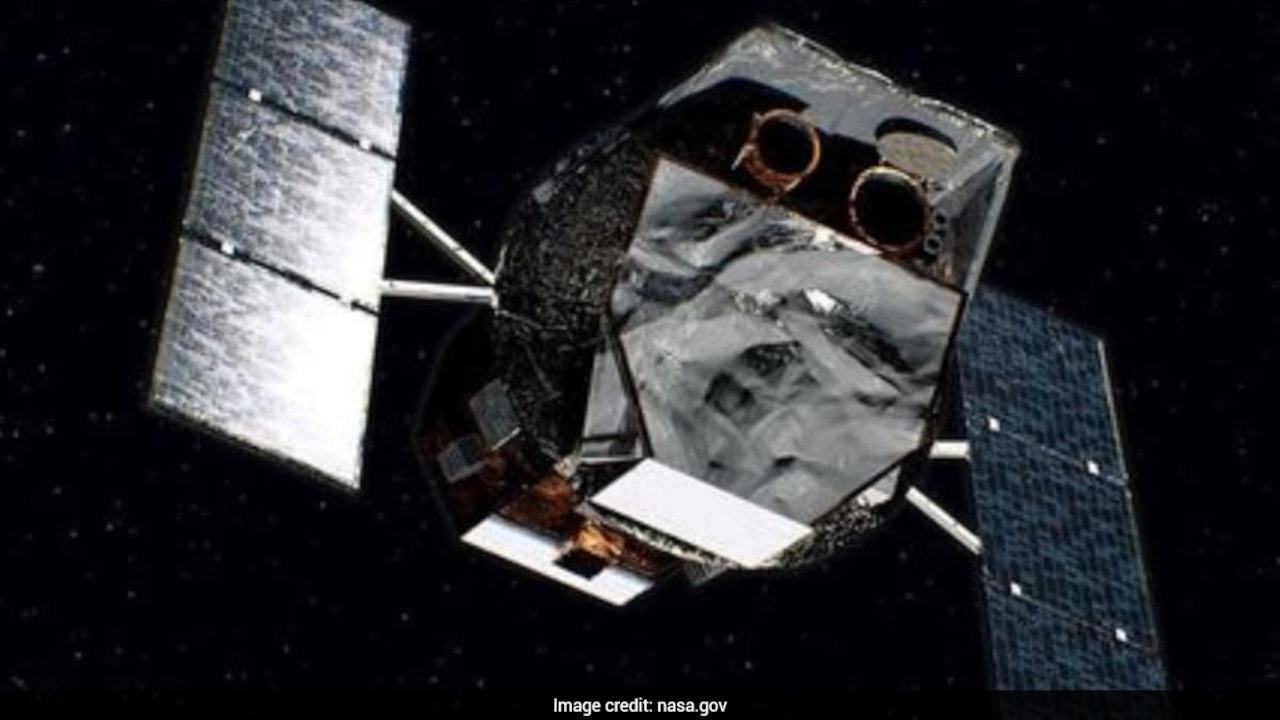
NASA is spending $30 million on a high-stakes, first-of-its-kind rescue mission called Swift Boost to save its 22-year-old Neil Gehrels Swift Observatory from crashing back to Earth. Intense solar storms have expanded the upper atmosphere, causing the 1.6-ton space telescope to drop rapidly toward a destructive re-entry. To prevent its fiery demise, a commercial startup named Katalyst Space Technologies will launch a specialized robotic servicing satellite this week to capture and push the telescope into a higher, safer orbit, fundamentally altering the future of orbital economics and science.
The crisis unfolding hundreds of miles above our heads highlights an overlooked reality of modern space exploration. Our orbital infrastructure is highly vulnerable to space weather, and the space agency lacks the financial resources to simply build replacements.
The Solar Storm Catch
Low Earth orbit is not an absolute vacuum. A thin shroud of gas persists at these altitudes, creating a drag force that gradually saps the kinetic energy of any satellite. For decades, spacecraft operators have accounted for this drag using standard atmospheric models.
The sun disrupted those calculations. The current solar cycle has proved significantly more intense than initial projections, bombarding the upper atmosphere with extreme ultraviolet radiation and high-energy particles.
When this energy hits the thermosphere, the gas heats up and expands outward. Spacecraft that once glided through a near-vacuum are suddenly plowing through a much denser medium.
For the Swift Observatory, which was launched in 2004, the consequences have been severe. The telescope has no onboard propulsion system to correct its trajectory. Originally placed in an orbit roughly 600 kilometers above the surface, it has been dragged down to an altitude of approximately 360 kilometers.
The physics governing orbital decay are unforgiving. As an object sinks lower, the air density rises exponentially. The telescope is losing altitude at a rate of eight kilometers every month. Left unchecked, it will drop below the critical 300-kilometer threshold by October, entering a terminal dive that would culminate in a brilliant, destructive fireball over the ocean before the end of the year.
To buy time, engineers at NASA Goddard Space Flight Center and Pennsylvania State University took the drastic step of powering down Swift's scientific instruments in February. This quieted the internal systems and allowed operators to orient the spacecraft in a configuration that minimizes cross-sectional area, slightly reducing the surface area exposed to the atmospheric flow. It was a stopgap measure meant to stretch the clock by a few precious weeks while a rescue plan could be materialized.
The Budget Math Driving a Desperate Salvage Job
Critics might ask why the space agency is risking millions of dollars to salvage a piece of hardware that has already far exceeded its original two-year design life. The answer lies in a mix of unique scientific capability and harsh fiscal realities.
Swift is not an ordinary telescope. While instruments like the James Webb Space Telescope or the Hubble Space Telescope offer peerless cosmic clarity, they are slow to move. They require hours, sometimes days, to reorient toward an unexpected target. Swift was built for speed.
The observatory acts as an automated first responder for high-energy astrophysics. When massive stars collapse into black holes or when neutron stars collide, they emit short-lived flashes known as gamma-ray bursts. Swift can autonomously detect these bursts and pivot its entire 1.6-ton bulk within seconds to capture the fading afterglow. No other instrument in operation can match this rapid reflex. Over its two decades in service, it has collected data on the universe’s most extreme events, including the historic 2022 explosion nicknamed the Brightest Of All Time.
Replacing this asset would require a massive capital investment. The space agency’s astrophysics budget is heavily constrained by overruns on flagship initiatives and aging launch infrastructure. The current financial atmosphere leaves no room for a clean-sheet replacement mission. Building, testing, and launching a successor to Swift would take close to a decade and cost hundreds of millions of dollars. Spend $30 million now on a risky rescue, or lose a critical scientific capability for a generation. The choice was forced by arithmetic.
The contract was awarded to Katalyst Space Technologies in September 2025. This left the Arizona-based startup with a timeline of less than a year to deliver a functional orbital mechanic. In the aerospace sector, where development cycles are typically measured in half-decades, this schedule is extraordinarily fast.
The Engineering Nightmare of Capturing Dead Weight
The mechanical reality of the mission is daunting. Swift was constructed in an era when satellites were viewed as disposable commodities. It has no docking rings, no magnetic capture latches, and no visual markers designed for automated rendezvous systems. It is an uncooperative piece of space hardware covered in delicate solar arrays and sensitive thermal blankets.
Katalyst developed a servicing spacecraft named Link to attempt the capture. The vehicle is relatively small, roughly the dimensions of a standard kitchen refrigerator, but it carries a highly specialized payload. It features three robotic arms extending just over one meter. At the tip of each arm sits a pair of small, opposing grippers designed to mimic a simple pinching motion.
The launch sequence bypasses traditional ground pads. A Northrop Grumman Pegasus XL rocket will be carried aloft by a Stargazer aircraft taking off from Kwajalein Atoll in the Pacific Ocean. At an altitude of 40,000 feet, the rocket will drop from the belly of the aircraft, ignite its solid-fuel motors, and carry Link into low Earth orbit.
Once deployed, Link will spend roughly a month executing a series of orbital maneuvers to match the altitude and velocity of the sinking telescope. The final approach will be entirely autonomous. Link must use optical sensors and onboard algorithms to track the tumbling telescope, match its exact spin rate, and position its robotic arms around structural components without striking the fragile solar panels.
+--------------------------------------------------------------+
|                   SWIFT RESCUE TIMELINE                      |
+--------------------------------------------------------------+
| Launch Phase       | Air-launched Pegasus XL from Pacific    |
+--------------------+-----------------------------------------+
| Rendezvous Phase   | 30 days of orbital chasing and matching |
+--------------------+-----------------------------------------+
| Capture Maneuver   | Autonomous 3-armed mechanical gripping   |
+--------------------+-----------------------------------------+
| Orbit Raising      | 60 days of low-thrust electric pushing  |
+--------------------+-----------------------------------------+
| Science Resumes    | Target date: September 2026             |
+--------------------+-----------------------------------------+
A single miscalculation during this phase would be catastrophic. If the servicing vehicle strikes Swift too hard, it could send both spacecraft into an uncontrollable tumble, accelerating the orbital decay or creating a cloud of high-velocity space debris that would threaten other assets in similar orbits. The margin for error is nonexistent.
If the capture succeeds, the hardest physical work begins. Link will engage its propulsion systems to slowly fight back against the expanded atmosphere. The plan is to spend two months gradually pushing the combined stack from its precarious position up to a more sustainable altitude of 600 kilometers. At that height, the atmospheric density drops enough to guarantee the telescope can operate for at least another five to ten years without requiring another boost.
A Blueprint for the Future of Orbital Servicing
The implications of this mission extend far beyond the survival of a single gamma-ray telescope. Up to this point, the capability to repair or alter satellites in orbit has been a luxury reserved for a handful of elite missions. The most notable examples were the Space Shuttle service calls to the Hubble Space Telescope, which required billions of dollars, custom tools, and human astronauts risking their lives. Globally, only China has demonstrated a fully robotic repositioning maneuver, using a service vehicle to push a dead navigation satellite into a distant graveyard orbit in 2022.
The Swift Boost mission represents a shift toward a commercialized fleet of orbital mechanics. If an independent startup can design, build, and execute a successful rescue mission within a nine-month window for a modest $30 million price tag, it changes the way satellite fleets are managed.
A long list of valuable but aging space assets could benefit from this development. The most prominent target is the Hubble Space Telescope. Like Swift, Hubble is steadily losing altitude due to the unrelenting solar cycle. Unlike Swift, Hubble is a massive, 12-ton instrument that sits in a highly visible public position. NASA previously reviewed and declined proposals from private space tourists to boost Hubble using crewed commercial capsules, citing the extreme technical risk to the historic telescope.
A successful demonstration by an unmanned, low-cost robotic vehicle changes that conversation entirely. Katalyst is already designing a larger version of its capture satellite capable of handling heavier hardware, with an eye toward a potential Hubble rescue mission before the end of the decade.
The broader commercial space market is watching this week's launch closely. Communication companies, weather monitoring operations, and defense agencies routinely abandon billion-dollar satellites simply because they run out of maneuvering fuel or suffer a minor mechanical failure on an otherwise functional platform. Moving from a throwaway model to an active servicing model could dramatically lower the cost of maintaining orbital constellations.
The immediate focus remains fixed on the Pacific test range. The Pegasus rocket is integrated, the automated flight software is verified, and the target is dropping lower with every completion of its 90-minute orbit. If the robotic grippers fail to hold, NASA loses its premier cosmic sentinel, and the dream of an affordable orbital repair industry faces a profound setback. If they hold, space exploration enters an era where the lifespans of our most valuable scientific instruments are no longer dictated by the whims of solar weather.