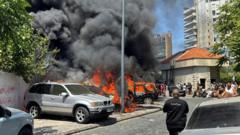
Israeli airstrikes and artillery barrages killed at least 12 people across southern Lebanon on Wednesday, flattening residential structures in Sidon and Tyre just days after a fragile, U.S.-brokered diplomatic framework collapsed. This latest surge in casualties is not an isolated border skirmish. It represents a systematic widening of the conflict into a war of attrition, with Israel issuing aggressive new evacuation orders for historic urban centers while Hezbollah increases its operational tempo using indirect fire systems and explosive drones against advancing ground forces.
The Western press routinely frames these events as repetitive, tit-for-tat exchanges. That perspective completely misses the underlying structural shifts. What we are witnessing in the ruins of Nabatieh, Tyre, and the coastal outskirts of Sidon is the violent disintegration of a diplomatic theater where local agreements are consistently broken by regional imperatives.
The Mirage of Separate Peaces
The fundamental flaw in current diplomatic efforts is the insistence on treating the Lebanese front as a localized dispute. On paper, delegations from Israel and the sovereign government of Lebanon met in Washington to hammer out a cease-fire framework. The core terms required a halt to hostilities and a structured withdrawal of armed units from the border zone.
The reality on the ground proved far more cynical.
Hezbollah is not a formal party to the direct talks between Beirut and Jerusalem. The group immediately dismissed the proposed framework as an ultimatum that would allow Israel to maintain an active security zone up to the Litani River while forcing a unilateral Lebanese retreat.
The Fractured Diplomatic Matrix:
[Washington D.C. Negotiations] -> Produces State-to-State Accord
   |
   +--> Rejected by Hezbollah (Demands absolute Israeli withdrawal)
   |
   +--> Complicated by Iran (Links Lebanese truce to broader regional leverage)
   |
   +--> Exploited by Israel (Expands ground operations during diplomatic pauses)
This structural disconnect became undeniable when the Israel Defense Forces pushed deeper into southern Lebanon, consolidating control over strategic positions like Beaufort Castle. Prime Minister Benjamin Netanyahu seized on the political deadlock to order an intensification of the campaign. The diplomatic track failed because it attempted to isolate Lebanon from a broader regional matrix. Iran explicitly conditions its own strategic posture on the safety of its primary proxy, making a separate peace for Lebanon an impossibility.
The Dahiyeh Trigger and the Escalation Loop
The true operational dynamics of this war were laid bare during a sequence of strikes targeting Beirut’s southern suburbs.
- The Salvo: Hezbollah launched a dense rocket barrage targeting northern Israel, testing defensive lines near Yiftach.
- The Retaliation: Israel bypassed the informal red lines established during the spring, striking a command facility in the densely populated Dahiyeh district of Beirut.
- The Regional Response: Iran intervened directly, launching a wave of ballistic missiles targeting the Ramat David Airbase in northern Israel to re-establish deterrence.
This sequence shattered the illusion that the conflict could be contained to the olive groves of the south. When an Israeli precision strike hits the capital, the response does not come from a southern valley; it comes via telemetry from hundreds of miles away.
A Scorched Earth Campaign by Evacuation Order
To understand how the IDF intends to secure its northern border, one must look at the nature of its evacuation orders rather than its ammunition expenditure. The military commands issued to residents of southern Lebanon are no longer tactical alerts designed to minimize collateral damage. They are tools of demographic and geographic re-engineering.
Entire clusters of villages have been systematically emptied. The recent inclusion of historic quarters in Tyre, alongside the total evacuation of Nabatieh, has forced more than one million people into internal displacement. When a population is barred from returning south of the Zahrani River indefinitely, the target is no longer the hidden rocket silo in a basement. The target is the human geography that sustains the insurgent infrastructure.
The Mechanics of Tactical Disruption
On the ground, Israeli engineering units have focused heavily on logistical interdiction. Airstrikes have systematically severed the main bridges crossing the Litani River.
By physically cutting the transport links between the deep south and the rest of Lebanon, the IDF has effectively isolated the primary combat zone. This isolation serves a dual purpose: it restricts Hezbollah's ability to resupply its frontline combat teams with fresh materiel from the Bekaa Valley, and it traps the remaining civilian population in an increasingly unlivable combat pocket where medical access is practically nonexistent.
The Insurgency Adapts
Despite losing senior leadership figures and vast stockpiles of equipment during the intensive campaigns earlier this spring, Hezbollah’s military apparatus is showing signs of tactical adaptation. Security data from the first week of June reveals a significant shift in how the group engages Israeli forces.
| Metric | Previous Operational Phase | Current Operational Phase (June) |
|---|---|---|
| Primary Weaponry | Heavy reliance on loitering munitions / kamikaze UAVs | Shift toward dense indirect fire, short-range rockets, and mortar salvos |
| Target Profile | Fixed infrastructure inside northern Israel | Mobile IDF armored columns and infantry staging areas inside Lebanon |
| Daily Tempo | Intermittent, high-profile precision strikes | Consistent, high-volume saturation fire to disrupt ground advances |
By pivoting back to low-tech, high-volume indirect fire systems, the group is attempting to counter Israel’s technological supremacy in electronic warfare and drone interception. A short-range mortar or a crude unguided rocket offers a minimal radar signature and gives air defense networks like the Iron Dome far less time to calculate interception trajectories.
The tactical cost for Israel is rising. Multiple soldiers have been killed inside Lebanese territory by these low-altitude, rapid-fire engagements. The group is intentionally confining the bulk of its fire to the occupied southern strip, trying to exploit the home-field advantage of familiar terrain while saving its remaining long-range ballistic options to deter another massive strike on Beirut.
The Sovereign Void
While the regional powers turn the south into an automated killing zone, the Lebanese state itself functions as little more than a bystander. Prime Minister Nawaf Salam’s public declarations that the country will no longer serve as a battlefield for foreign proxy wars carry an air of tragic irrelevance.
The Lebanese Armed Forces lack the air defense capabilities to challenge Israeli jets and the political mandate to disarm a heavily entrenched sectarian militia. The postponement of general elections out to 2028 is a systemic admission of state failure. The formal government in Beirut can sign all the provisional frameworks it wants in Washington, but it cannot enforce a single line of prose on the ground in Tyre or Sidon.
The conflict has settled into a brutal, predictable cadence. Diplomatic initiatives are launched not with the expectation of achieving peace, but to secure temporary tactical pauses or to provide political cover for the next phase of military operations. With every village reduced to rubble along the border, the prospect of a stable, sovereign Lebanon slips further out of reach, replaced by a permanent buffer zone defined exclusively by high explosives and mass displacement.