The United States is hitting its 250th anniversary, but the national mood is anything but celebratory. Recent data from the Associated Press-NORC Center for Public Affairs Research and Gallup reveals a stark reality: American pride has plummeted to a historic low, with only about 33% of the country identifying as "extremely proud" to be an American. This decline is not a simple byproduct of standard political bickering. It represents a fundamental fracture in the national identity, where the very definition of the American experiment has split into two irreconcilable, competing corporate and political marketing campaigns.
While the official congressional commission, America 250, pushes an inclusive, educational, and reflective narrative aimed at examining the nation's historical contradictions, the parallel Freedom 250 initiative focuses on muscle-bound displays of exceptionalism and military-grade spectacle. Instead of serving as a moment of cultural binding, the Semiquincentennial has turned into a ideological tug-of-war.
The War for 1776
The friction between these dual institutional efforts goes far deeper than a disagreement over fireworks or parade routes. It is a structural conflict over history itself. The congressional America 250 commission has spent years coordinating with local historical societies, museums, and educators to frame the anniversary around the concept of an unfinished revolution. Their approach seeks to balance the celebration of democratic ideals with a sober examination of historical failures, including slavery, indigenous displacement, and ongoing civil rights struggles.
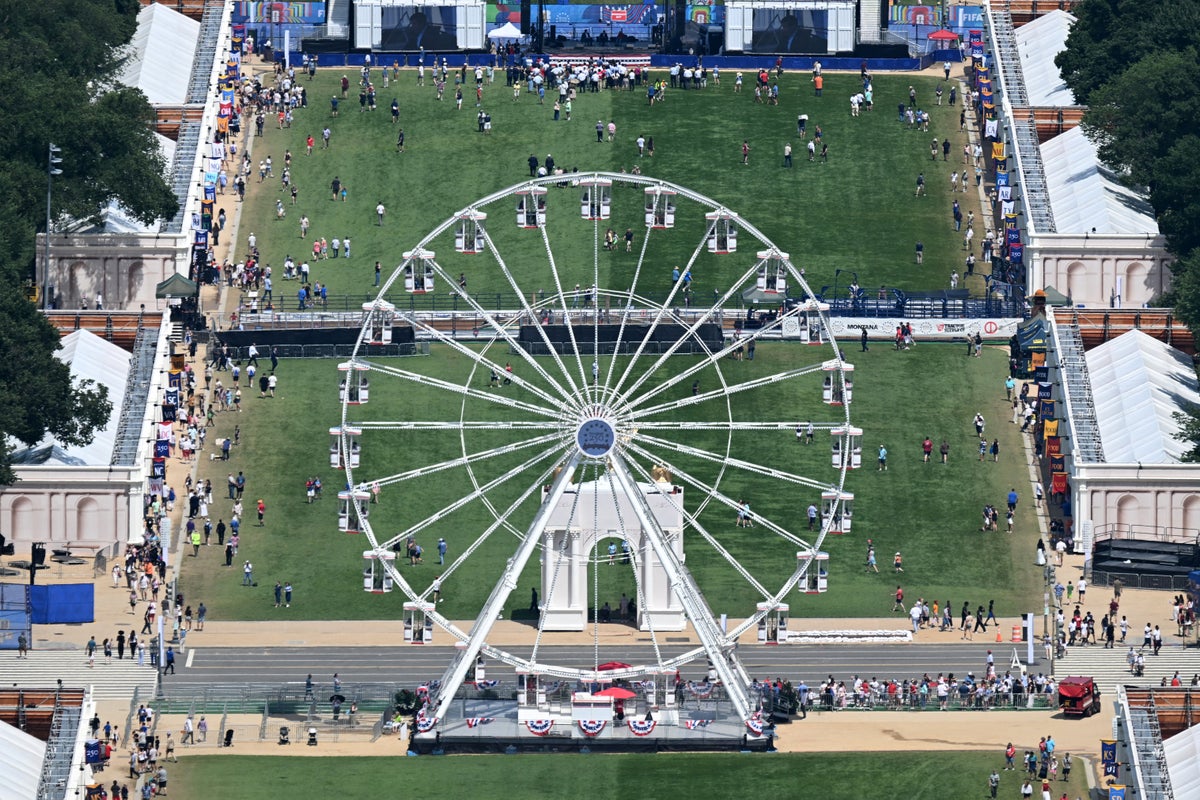
On the other side sits Freedom 250. This execution treats national identity as a brand rooted in strength, dominance, and unyielding exceptionalism. It is a top-down, high-spectacle endeavor designed to project power, featuring high-profile events like military flyovers and combat sports exhibitions hosted on the South Lawn of the White House.
This is not a debate between historians in a seminar room. It is a structural division between a civic patriotism that demands critical reflection and a nationalist patriotism that demands absolute alignment.
The 61 Point Canyon
The resulting fragmentation is clearly visible in recent polling metrics. The ideological divide is no longer a gap; it is a canyon.
According to NBC News polling, an astonishing 90% of Republicans report feeling extremely or very proud to be American. Among Democrats, that number has plummeted to just 29%. This represents a 61-point partisan canyon on the basic question of national pride. A quarter-century ago, more than 80% of Democrats expressed high levels of national pride. The collapse of this consensus has completely transformed the American political terrain.
| Demographic Segment | Extremely or Very Proud of the U.S. |
|---|---|
| Republicans | 90% |
| Senior Citizens (65+) | 75% |
| Adults Under 30 / Gen Z | 36% |
| Democrats | 29% |
The age metrics are equally alarming for the long-term prospects of civic cohesion. Only 36% of young adults between the ages of 18 and 34 express significant pride in the country. A separate Associated Press-NORC poll found that about 40% of Democrats and 30% of adults under 30 explicitly use the word "conflicted" to describe their emotional state regarding the 250th anniversary. This is a generational detachment. The youngest cohorts of citizens are increasingly viewing the symbols of the American founding not as shared heritages, but as hyper-partisan tokens.
Redefining the Holiday
This polarization has altered how everyday citizens plan to experience the milestone. A recent Reuters-Ipsos poll asked Americans whether the Fourth of July should be viewed primarily as a celebration of the nation or as a private opportunity to spend time with friends and family.
Two-thirds of Republicans chose national celebration. Conversely, a large plurality of Democrats chose the family option, effectively decoupling the nation from the holiday. For tens of millions of citizens, the flag is no longer a unifying umbrella. It is a complicated symbol.
Corporate America has noticed this shift and is treading carefully. Brands that once leaned into broad, star-spangled imagery are shifting their focus to local, community-driven narratives or apolitical themes of family and faith. Consumer insights from firms like Mintel indicate that marketing the Semiquincentennial as an aggressive, old-school nationalist event risks alienating younger, high-spending demographic brackets. The commercial sector is choosing to focus on shared humanity rather than shared nationality to protect its bottom line.
A Fragmented Legacy
The 1976 Bicentennial was marked by economic stagflation and the fresh wounds of Watergate and the Vietnam War, yet it managed to pull off a cohesive, nationwide series of tall-ship parades and local history projects. The 2026 Semiquincentennial enjoys no such luck. The infrastructure of communication has changed, trading shared television broadcasts for algorithmically separated digital feeds that monetize outrage.
The core vulnerability exposed by this milestone is that the United States no longer possesses a singular, consensus history. One half of the country views the founding documents as a blueprint for a continuous, messy journey toward justice. The other half views them as a flawless testament to an exceptionalism that must be defended against internal critique. When a nation cannot agree on what it is celebrating, the anniversary party becomes a mirror for its deepest anxieties. The fireworks will still go off, but they will illuminate two very different Americas.