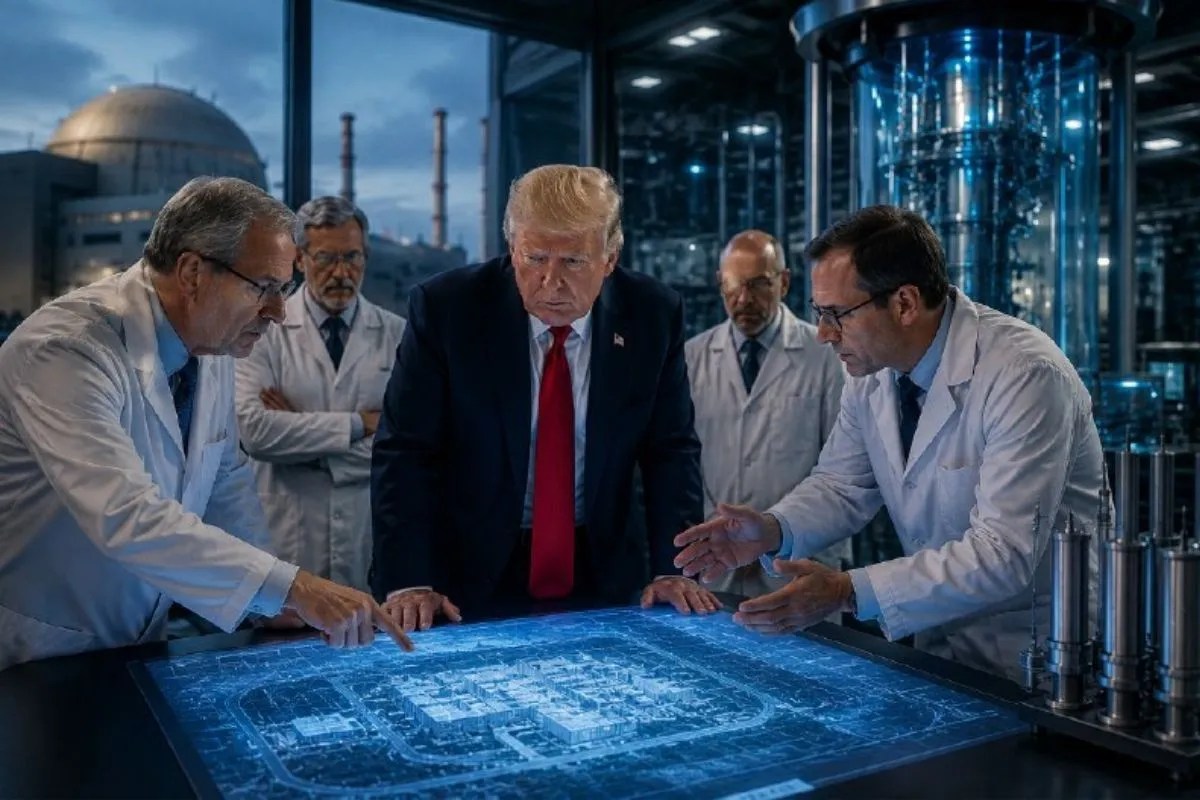
The Trump administration is attempting to engineer a diplomatic exit from a bruising regional conflict, and the road out runs directly through a classified facility in eastern Tennessee. On June 4, 2026, special presidential envoy Steve Witkoff and Jared Kushner slipped away to the Oak Ridge National Laboratory and the neighboring Y-12 National Security Complex. Their objective was not a vague political consultation. They went to brief a newly assembled team of roughly 100 nuclear scientists, uranium processing specialists, and centrifuge engineers on the granular mechanics of what the White House hopes will be a temporary Memorandum of Understanding (MOU) with Tehran.
Washington needs an escape hatch.
The ongoing war with Iran—now stretching past its third month after the administration's initial estimates predicted a swift four-to-six-week campaign—has stalled. The White House faces severe domestic blowback, mounting economic friction, and an increasingly independent Congress threatening to wield the War Powers Resolution. By dispatching his top enforcers to meet with the scientists who routinely handle global nuclear decommissioning, Donald Trump is signaling that he is willing to trade a partial pause in regional hostilities for hard, verifiable constraints on Iranian uranium enrichment.
Yet, the gap between political desire and engineering reality remains dangerously wide.
The Secret Hundred and the Lesson of Venezuela
The deployment of the Oak Ridge team reveals a fundamental shift in the administration's strategy. This is no longer just about "maximum pressure" rhetoric or punitive airstrikes. It is a logistical scramble. The group of 100 experts pulled into the project includes the exact technical specialists who successfully executed the quiet extraction of enriched uranium from a research reactor in Venezuela, routing the material safely to South Carolina for processing.
The administration wants that exact blueprint scaled up for Iran.
If the proposed 60-day MOU holds, this team will be tasked with drawing up the verification protocols, down-blending mechanisms, and compliance guardrails required to handle Iran’s formidable nuclear infrastructure. They are the only people in the American apparatus who actually know how to dismantle what Tehran has spent decades building.
But dealing with a single research reactor in Caracas is radically different from auditing a decentralized, hardened nuclear program scattered under mountains. The administration is essentially asking these scientists to prepare for a massive, high-stakes inventory collection while the ground beneath them is still smoldering.
60 Days Versus 90 Days and the Math of Enrichment
Behind the closed-door briefings lies a fierce logistical dispute over time and material. The White House and Iranian negotiators have traded drafts of a 60-day framework aimed at extending the current shaky ceasefire, reopening the blocked Strait of Hormuz, and allowing a controlled resumption of Iranian oil sales.
The diplomatic wheels are spinning, but the friction points are purely technical.
- The Down-Blending Deadline: Washington is demanding that Iran complete the down-blending of its highly enriched uranium stockpile within a strict 60-day window. Tehran is holding out for 90 days. Thirty days may seem trivial to a diplomat, but to a nuclear technician, it represents the physical speed limit of safely manipulating uranium gas through cascades without risking catastrophic failure or clandestine diversion.
- The Frozen Assets Lock: The financial component is equally deadlocked. Iran is demanding the immediate release of billions of dollars in frozen offshore funds as a condition for signing the MOU. The Trump team insists that no money moves until the Oak Ridge experts verify that concrete down-blending steps have actually occurred on the ground.
The stakes could not be higher. Iran currently holds a massive stockpile of uranium enriched to 60 percent purity—a tiny technical step from weapons-grade material. The 2025 airstrikes failed to destroy deep-underground facilities like the heavily fortified Pickaxe Mountain site. As a result, the administration is forced to negotiate with a regime that retains its core nuclear leverage intact.
The Ghost of the JCPOA and the Sunset Trap
This current diplomatic push is laced with historical irony. Seven years ago, Trump unilaterally pulled the United States out of the Joint Comprehensive Plan of Action (JCPOA), branding it a disaster. Now, his envoys are frantically trying to assemble a makeshift structure to replace it.
The primary driver for this sudden urgency is an overlooked diplomatic clock that ran out late last year. Under the original terms of the JCPOA, the United Nations "snapback" mechanism—which allowed Western powers to instantly reimpose sweeping global sanctions without a security council veto—expired on October 18, 2025.
Washington no longer possesses that multilateral hammer.
Without the snapback mechanism, the United States cannot easily force international compliance through the UN framework if negotiations collapse. This structural reality has forced the administration into a corner. They must either sustain an open-ended, unpopular war or cut a highly transactional, bilateral deal with Tehran that looks remarkably similar to the stopgap measures of the past.
The Realities of a Modern War of Attrition
The administration's domestic political runway is shortening rapidly. The White House recently bypassed a major constitutional hurdle by using a brief, fragile ceasefire to claim that active hostilities had technically "terminated," thereby attempting to reset the clock on the War Powers Resolution. It was a clever legal maneuver, but it hasn't fooled Capitol Hill, where bipartisan frustration over the war's mounting costs is reaching a boiling point.
The conflict has also failed to achieve its broader regional objectives. While initial intelligence suggested that groups like Hezbollah were severely weakened at the start of the year, recent battleground data shows a rapid tactical evolution. Affiliated militias have regrouped, successfully integrating cheap, first-person view (FPV) drones to counter American and allied air superiority.
The war is not ending; it is evolving into a grinding war of attrition that the American electorate has no appetite to sustain.
The Ball is in Trump's Court
The Oak Ridge briefing confirms that the technical apparatus for a deal is fully operational and waiting in the wings. The scientists have their assignments, the protocols are mapped out, and the logistical channels are clear.
But science cannot resolve a fundamental crisis of trust. Mojtaba Khamenei, an adviser to Iran's supreme leader, recently stated that the current impasse over frozen funds means the next move belongs entirely to Washington.
Trump is caught between two competing instincts: his deeply ingrained desire to avoid long, costly foreign wars and his long-standing refusal to grant the Iranian regime an economic lifeline. The technical experts in Tennessee can build the container for a deal, but the White House will ultimately have to decide how much leverage it is willing to surrender to secure its exit.