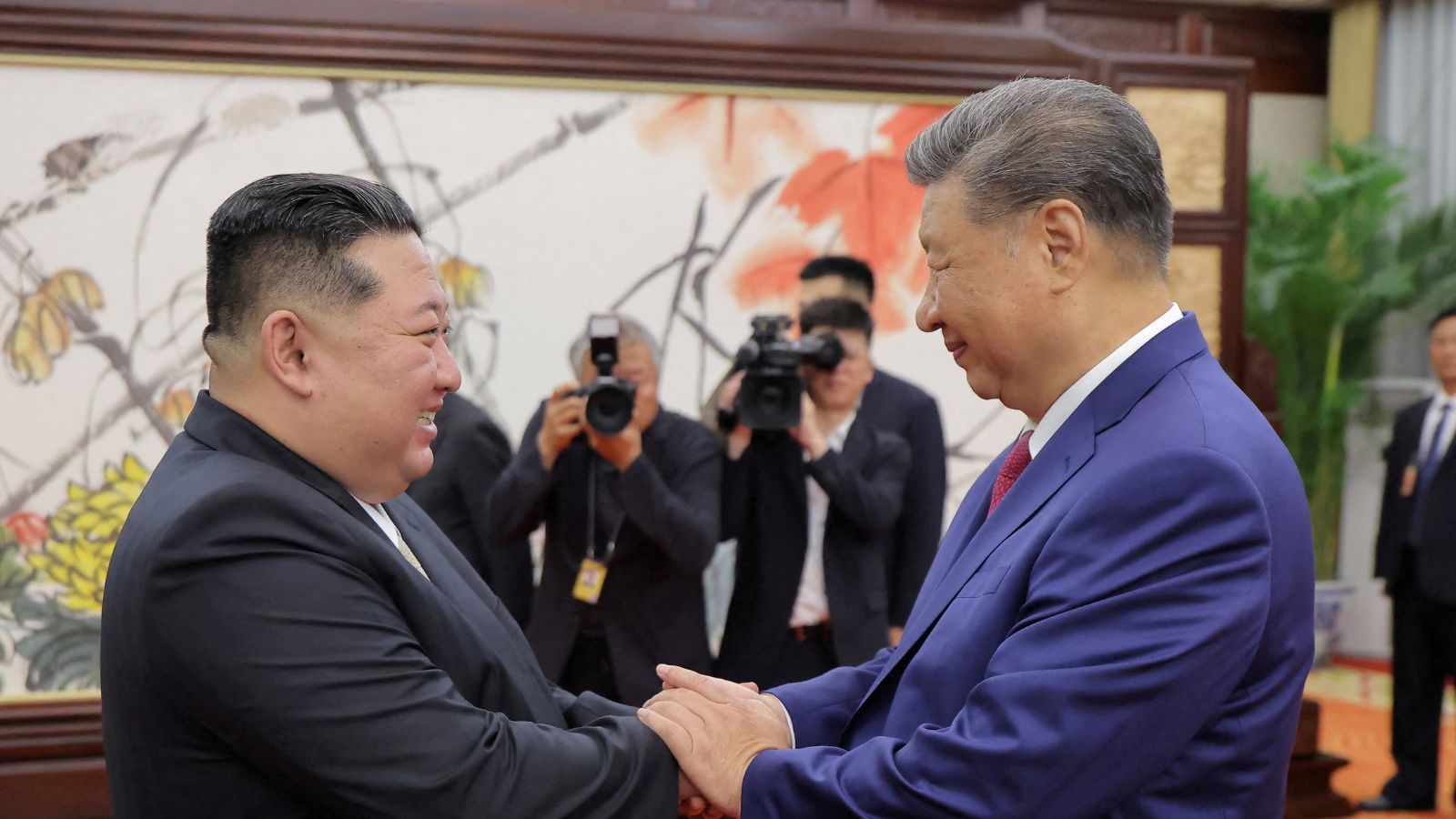
Chinese President Xi Jinping landed in Pyongyang this week for a rare, highly choreographed two-day summit with Kim Jong Un, signaling a desperate scramble to reassert Beijing’s dominance over an increasingly defiant neighbor. While official readouts parroted the usual script of an unbreakable socialist brotherhood, the reality on the ground is a tense, high-stakes geopolitical wrestling match. Xi is attempting to pull North Korea back into Beijing's orbit before Pyongyang permanently aligns its nuclear future with Russia or cuts a separate deal with Washington.
Behind the carefully staged optics of Kim Il Sung Square lies a stark strategic panic for the Chinese Communist Party. For decades, Beijing operated as North Korea’s undisputed patron, controlling more than 90 percent of the regime's trade volume and treating the country as a convenient buffer zone against American forces in East Asia. That absolute leverage has evaporated.
Pyongyang has systematically built an alternative economic and military pipeline through Moscow, trading artillery shells for advanced telemetry, satellite tech, and diplomatic cover at the United Nations. By choosing Pyongyang for his first international trip of the year, Xi is not celebrating an ally; he is attempting to manage an active geopolitical crisis on his own border.
The Kremlin Shadow Over the Yalu River
The primary driver of this sudden Chinese outreach is not the 65th anniversary of their bilateral friendship treaty. It is Vladimir Putin. Ever since Kim boarded his armored train to Vladivostok to meet the Russian president, Beijing has watched with growing alarm as its unruly client state found a new, more permissive bankroller.
Russia's war in Ukraine has turned North Korea into a vital defense industrial asset for Moscow. In exchange for millions of conventional artillery munitions, Russia has provided Pyongyang with the kind of sophisticated military engineering that Beijing has historically withheld to keep Kim compliant. This alternative patron has effectively broken China's monopoly on North Korea's survival.
When North Korea closed its borders during the pandemic, its economy shrank to near-collapse, leaving it entirely at Beijing’s mercy. The Russia-Ukraine war changed that equation completely, giving Kim a second geopolitical lifeline that bypasses Chinese scrutiny.
This puts Xi in an uncharacteristic position of weakness. If China squeezes North Korea too hard on sanctions or nuclear testing, Kim can simply lean further into Moscow’s embrace. If China remains passive, a nuclear-armed state right next door becomes more erratic, potentially drawing a heavier, permanent deployment of American strategic assets to Japan and South Korea.
Xi’s delegation, which includes Foreign Minister Wang Yi and top internal strategist Cai Qi, arrived with a clear mandate: match Russia’s offerings with economic incentives that Moscow cannot compete with over the long term.
The Mirage of Denuclearization
Western analysts often misinterpret China's goals, assuming Beijing shares Washington’s absolute commitment to a denuclearized Korean Peninsula. It does not. What Beijing desires above all else is stability and control. A nuclear-armed North Korea that obeys China is acceptable; a nuclear-armed North Korea behaving as a wild card under Russian influence is a direct threat to Chinese security.
The joint readouts from this week's summit are most telling for what they omitted. There was absolutely no mention of denuclearization. Just days before Xi’s arrival, Kim toured a new weapons-grade nuclear material facility, openly bragging that the state’s production capacity had more than doubled over the last five years and ordering an exponential expansion of the country’s atomic arsenal.
His sister, Kim Yo Jong, issued a blunt public warning on the eve of the summit, declaring North Korea's nuclear status an absolute and inviolable boundary.
Xi accepted these terms without public pushback. For the Chinese leadership, publicly demanding denuclearization right now would only alienate Kim and push him deeper into the Kremlin's arms. Instead, Xi shifted the conversation entirely to practical economic integration, pushing for the full reopening of border ports, the immediate resumption of international passenger trains, and expanded agricultural and infrastructure cooperation.
China is quietly conceding the nuclear debate in the short term to secure its position as North Korea's primary economic anchor.
The Triangulation of Trump and Tokyo
The timing of this trip is linked directly to a broader diplomatic chess game involving Washington and Tokyo. Xi hosted the American president in Beijing just last month in an effort to stabilize a fractured US-China trade relationship. During those meetings, Washington pressured Beijing to rein in Pyongyang's nuclear ambitions. Yet, almost immediately after, Xi boarded a plane to North Korea to offer unconditional strategic coordination to the very regime he was asked to police.
Kim understands this dynamic perfectly and is using it to maximize his own leverage. Pyongyang’s state media has subtly hinted that it holds good personal memories of past summits with the US administration, signaling to both Beijing and Moscow that North Korea is not inherently anti-Western if the price is right.
By demonstrating that he can talk to Washington, Moscow, or Beijing at a time of his choosing, Kim has transformed his isolated nation into a central pivot point of global alignment.
East Asian Security Implications
China’s renewed embrace of Pyongyang is also heavily influenced by its deteriorating security outlook in the Pacific, particularly regarding Japan. Beijing watches the accelerating defense cooperation between Washington, Tokyo, and Seoul with intense anxiety.
By shoring up its alliance with North Korea, China secures its northern flank, ensuring that any potential conflict over Taiwan would be complicated by the threat of a secondary crisis on the Korean Peninsula.
- Sovereignty Guarantees: Kim explicitly reaffirmed North Korea's total support for the One-China principle regarding Taiwan during the meetings.
- Militarism Pushback: Both leaders used state media editorials to attack what they termed the revival of regional militarism, a direct rhetorical swipe at Tokyo's expanding defense budget.
- Border Infrastructure: Agreements were fast-tracked to upgrade telecommunications and transport links across the Yalu and Tumen rivers, deepening the physical integration of the two economies.
The Limits of Economic Coercion
The fundamental problem for Chinese statecraft is that its traditional toolkit for managing North Korea is yielding diminishing returns. For decades, Beijing could simply tighten or loosen the valve on oil shipments and food aid via the Dandong-Sinuiju pipeline to alter Pyongyang's behavior.
Today, a nuclear-armed North Korea that can trade munitions for Russian oil and agricultural goods is far less vulnerable to Chinese economic pressure.
This reality has forced Xi to adopt a strategy of high-symbolism, low-cost courtship. The lavish reception at the Kumsusan State Guesthouse and the mass rallies are designed to give Kim the international prestige he craves without requiring China to violate major UN sanctions overtly.
Beijing’s goal is to keep North Korea dependent enough on Chinese consumer goods, digital infrastructure, and banking networks to maintain a veto over Kim’s most extreme choices.
This strategy is highly fragile. China is trying to balance its desire to appear as a responsible global stakeholder to the West while maintaining a defense pact with a rogue nuclear state that openly threatens its neighbors.
As Kim accelerates his production of weapons-grade material and solidifies his military trade with Moscow, Beijing’s space for diplomatic ambiguity is shrinking. Xi's rare journey to Pyongyang shows that China is no longer directing events on the peninsula; it is reacting to them, desperate to keep a seat at a table it once completely controlled.