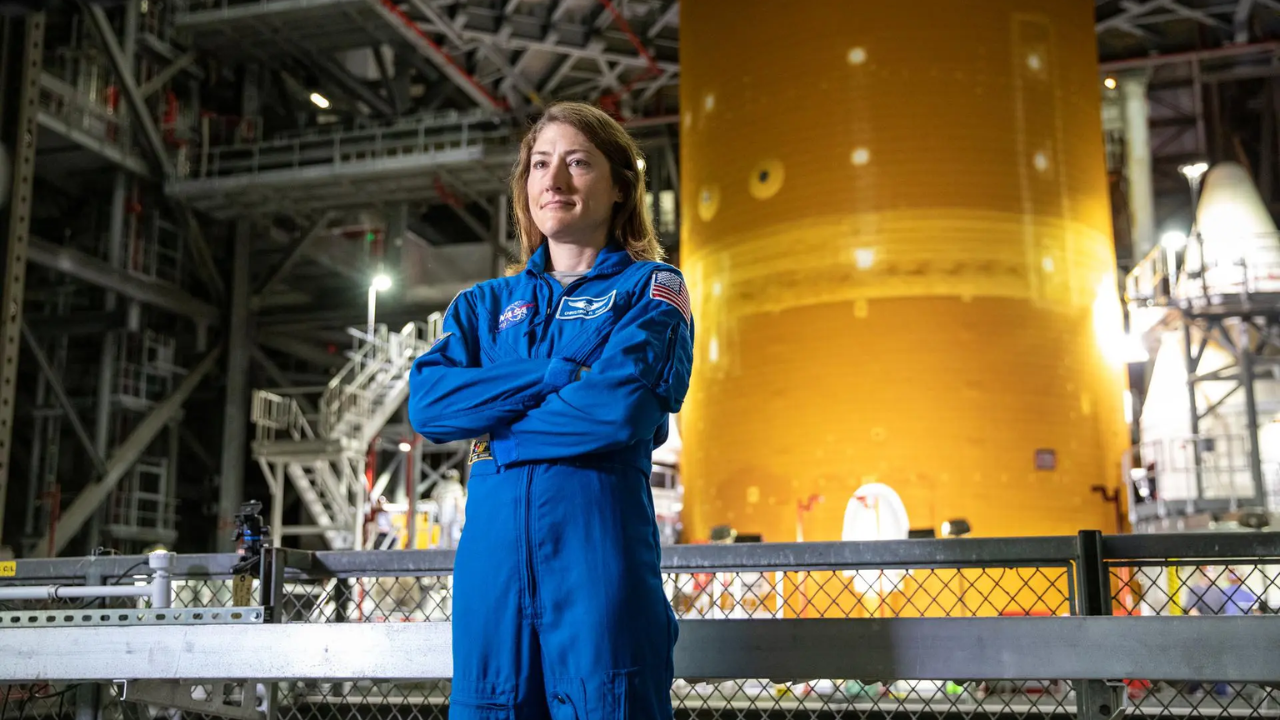
NASA named astronaut Christina Koch as its acting deputy chief engineer effective November 1, 2026, pulling one of its most battle-tested flight veterans out of active spaceflight status to oversee technical oversight and mission readiness across the agency.
Routine press releases treat this move as a tidy handoff after Katherine Van Hooser retired following more than 35 years at NASA. Look closer at the timing, the leadership structure under NASA Administrator Jared Isaacman, and the transition of the Artemis II crew, and a sharper picture emerges. NASA is trading a veteran propulsion bureaucrat who spent decades inside rocket engine development for an electrical engineer who has survived harsh polar field stations, 328 straight days on the International Space Station, and the April 2026 Artemis II lunar flyby. For a different look, see: this related article.
Why NASA Pulled a Lunar Flyer Off the Roster
Spaceflight looks glamorous from the outside. Inside NASA, moving a high-profile astronaut into an acting engineering leadership seat is a deliberate institutional bet. Related reporting regarding this has been shared by Gizmodo.
Koch launched aboard the Space Launch System rocket and Orion spacecraft on April 1, 2026, flying around the Moon with commander Reid Wiseman, pilot Victor Glover, and Canadian Space Agency astronaut Jeremy Hansen before splashing down in the Pacific Ocean on April 10. That mission pushed humans farther from Earth than ever before and made Koch the first woman to travel around the Moon, capping a career that already included a 328-day single spaceflight record by a woman and participation in the first all-female spacewalks. Stepping into the acting deputy chief engineer slot shifts her to management astronaut status, effectively closing the door on near-term flight assignments while placing her operational judgment directly inside technical governance.
Administrators often talk about bridging the gap between builders and flyers. In practice, that gap widens quickly during major program transitions. Flight crews live with every design compromise, thermal quirk, alert threshold, and procedural workaround when hardware stops being a slide deck and becomes a pressure vessel hurtling through space. Putting someone who has ridden deep-space hardware into the engineering oversight chain gives leadership a direct reality check on how ground engineering translates into crew risk and operational margin.
What the Acting Deputy Chief Engineer Actually Does
The title sounds ceremonial to casual readers. In aerospace governance, engineering authority is where schedule pressure and safety risk collide.
Working under Chief Engineer and Associate Administrator Amit Kshatriya, the deputy chief engineer helps guide NASA's engineering community across technical oversight, mission readiness, and engineering excellence on agency programs and projects. That work sits outside the everyday cheerleading of mission launches. It involves scrutinizing requirements, testing assumptions, challenging schedule optimism, and making sure technical standards hold up when budgets tighten or hardware faces delays.
Van Hooser brought deep institutional roots in liquid rocket engine turbomachinery, Space Shuttle main engines, and the Space Launch System's Liquid Engines Element at Marshall Space Flight Center before becoming deputy chief engineer in 2023. Koch brings a different kind of technical pedigree:
- Space instrument hardware: She began as an electrical engineer at Goddard Space Flight Center and later worked at the Johns Hopkins University Applied Physics Laboratory on instruments for missions including Juno and the Van Allen Probes.
- Extreme remote operations: Before joining the 2013 astronaut class, she worked in Antarctica—including a winter-over at Amundsen-Scott South Pole Station and stints at Palmer Station—as well as Barrow (now Utqiaġvik), Alaska, Summit Station in Greenland, and American Samoa.
- High-stakes flight execution: She logged 337 total days in space across six spacewalks and the Artemis II lunar flyby, moving from design benches to live flight operations.
That combination matters because deep-space exploration is no longer a single-vehicle campaign. It is a multi-contractor, multi-mission architecture stretching from lunar orbit and surface systems toward eventual Mars planning.
The Trade-Offs Nobody Likes to Admit
Every appointment solves one problem and creates another. Calling Koch's move a pure upgrade ignores the real friction points inside a large federal agency.
First, there is the "acting" label. An acting assignment gives an agency flexibility to test leadership fit or manage organizational transitions after a longtime senior official departs. It can also leave an official with slightly less immediate institutional runway than a permanent appointment while programs face hard technical calls.
Second, flight experience is not a substitute for deep program-management or propulsion-system history. Knowing how an avionics box or life-support loop behaves in orbit helps an engineer ask sharper questions, yet large aerospace programs also depend on supply-chain discipline, structural margins, test-stand rigor, and years of institutional memory. NASA has to make sure Koch is paired with veteran systems engineers who know where the skeletons are buried in legacy hardware.
Third, there is the human cost of retiring a proven explorer from active flight status. When a veteran astronaut steps into management, the agency gains a sharp technical leader and loses an experienced crew member who already knows the rhythm of deep-space operations.
What This Signals for Artemis and Deep Space
Look across the Artemis II roster after the April flight and you see an agency reshaping its leadership bench all at once. Commander Reid Wiseman moved to deputy director at NASA's Jet Propulsion Laboratory, while fellow crew members shifted into new post-flight roles as NASA prepares for upcoming lunar missions and longer-term Mars ambitions.
| Dimension | Katherine Van Hooser (Outgoing) | Christina Koch (Incoming Acting) |
|---|---|---|
| Start of Role | Deputy Chief Engineer since 2023; retiring Oct. 21, 2026 | Acting Deputy Chief Engineer effective Nov. 1, 2026 |
| Core Technical Roots | Liquid rocket turbomachinery, shuttle main engines, SLS liquid engines | Electrical engineering, space science instruments, remote polar stations |
| Flight Background | Ground and propulsion engineering leadership | 337 days in space, six spacewalks, Artemis II lunar flyby crew |
| Primary Strength | Decades of heavy-lift propulsion and agency oversight | End-to-end perspective from instrument design to deep-space operations |
For contractors and program managers, the message is blunt. Technical reviews under this leadership team will not just ask whether a subsystem meets a paper requirement; they will ask how a human crew actually operates, diagnoses, and survives with that system when things go sideways far from home.
Whether Koch's appointment becomes a permanent fixture or a transitional bridge, the real test will happen in the quiet design reviews and flight-readiness boards where schedules slip and shortcuts get tempted. Watch how those calls get made over the coming months—that is where NASA's true engineering standard lives.