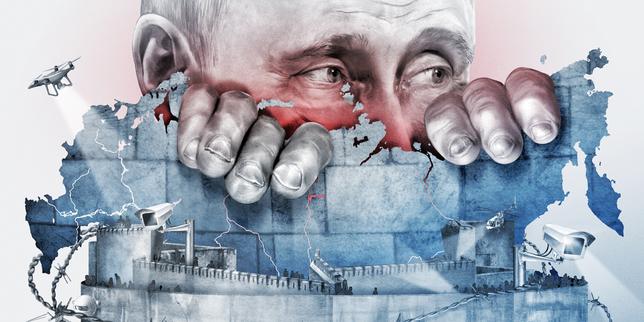
Power isolates. Absolute power constructs concrete boundaries. When Vladimir Putin looks out across the Russian political landscape, he does not see a nation of bustling regions, dynamic enterprises, or vibrant municipal councils. He sees a perimeter. The architecture of modern Russian governance has transformed from an open-market bureaucratic state into a fortress economy and an enclosed psychological space, sealing the Kremlin behind layers of internal security, sanitized information flows, and physical separation.
To understand why contemporary Russia operates under glass, we have to look past the superficial veneer of regular televised cabinet meetings and pre-scripted public addresses. The bunker mentality did not emerge overnight. It is the cumulative product of decades of centralization, a systemic fear of popular dissent, and an administrative paranoia that views any independent social friction as an existential threat.
The Infrastructure of Seclusion
Physical security is the most visible manifestation of this isolation. Over the past several years, the physical distance between the Russian leadership and the citizenry has expanded from a matter of protocol into a gulf of geography and architectural design. Standard motorcades now paralyze central Moscow not just for state visits, but for routine internal transit. Vast country estates, protected by restricted airspace and multi-layered Federal Protective Service perimeters, shield the executive branch from the daily friction experienced by ordinary residents in provincial cities.
This physical distancing mirrors the administrative structure. Regional governors have been systematically stripped of independent political weight. Where federalism once offered a messy, negotiated balance of power between Moscow and oil-rich republics or industrial oblasts, today's governors act as operational project managers whose primary Key Performance Indicator is absolute loyalty and crisis suppression.
When dissenting voices emerge outside this controlled hierarchy, the response is immediate legal and physical neutralization. Independent media outlets have been liquidated, driven into exile, or strangled by administrative fines and foreign agent designations. The information ecosystem inside the country has been subjected to a thorough sanitization process, ensuring that the official narrative flows downward without encountering the friction of public debate or investigative journalism.
The Economic Consequences of the Glass Dome
Enclosure exacts a heavy price. A state that shuts itself off from external criticism inevitably begins to believe its own manufactured statistics. During the initial rounds of international sanctions following the 2022 escalation in Ukraine, technocrats within the Russian central bank and financial ministries managed an emergency stabilization effort that surprised many external observers. By implementing stringent capital controls, redirecting hydrocarbon exports toward Asian markets, and enforcing import substitution, the regime avoided an immediate economic collapse.
Yet stabilization is not modernization. The economy has pivoted from a globally integrated, commodity-exporting market into a state-directed war machine.
- Capital Flight and Brain Drain: Hundreds of thousands of engineers, software developers, and entrepreneurs have relocated to hubs in Central Asia, the Caucasus, and Western Europe, stripping the domestic labor market of high-value human capital.
- Technological Atrophy: Access to advanced semiconductor supply chains, specialized aviation parts, and industrial software has been severely restricted, forcing domestic manufacturers to rely on lower-grade substitutes or complex smuggling networks.
- Fiscal Concentration: State spending is overwhelmingly channeled into military production and security apparatuses, crowding out long-term investments in healthcare, education, and municipal infrastructure.
These shifts create a dual reality. On the surface, luxury retail centers in Moscow have found new domestic and parallel-imported stock to replace departed Western brands. Beneath that veneer, regional budgets are strained to the breaking point, and critical infrastructure, from municipal heating grids to commercial aviation, absorbs mounting wear and tear without access to OEM replacement parts.
The Psychology of the Inner Circle
At the core of this closed system lies a tightly knit cohort of security service veterans, known as the siloviki. Their worldview is shaped by a zero-sum paradigm where every domestic protest is interpreted as a foreign intelligence operation, and every international critique is seen as proof of a concerted geopolitical campaign to fragment the Russian state.
This insular perspective alters how intelligence reaches the top. In heavily bureaucratized authoritarian systems, subordinates quickly learn that delivering bad news carries career-ending risks. As a result, reporting is routinely filtered, massaged, and optimized to align with the ideological preferences of the leadership. When strategic miscalculations occur—such as the operational assumptions underpinning military campaigns or the resilience of Western financial coalitions—the root cause often traces back to a systemic inability within the apparatus to process uncomfortable truths.
The leader remains insulated within this echo chamber, relying on filtered briefing binders and curated economic dashboards that emphasize resilience while masking structural decay.
Managing the Public Sphere
Control over public perception requires more than censorship; it demands emotional management. The population is not merely suppressed; it is encouraged into a state of political atomization. By convincing citizens that political participation is futile, dangerous, or irrelevant, the administration minimizes the risk of organized mobilization.
State television broadcasts maintain a dual narrative. On one hand, they project an image of an unyielding global power capable of defying Western hegemony. On the other hand, they foster a profound sense of external siege, framing every national difficulty as the inevitable byproduct of hostile encirclement. This siege mentality creates a paradoxical form of passive loyalty. Many citizens may feel indifferent or pessimistic about their economic prospects, yet they rally around the flag during perceived external threats because the alternative—acknowledging the failure of the entire governance model—feels too destabilizing to contemplate.
The Long-Term Trajectory of a Closed State
History demonstrates that highly centralized systems can sustain themselves through resource extraction and heavy-duty repression long after their dynamic growth has stalled. The Soviet experience is a clear historical precedent: a state can maintain strategic military parity and internal order while its economic foundations slowly hollow out from structural rigidity.
Yet the modern globalized economy offers fewer hiding places for stagnation than the twentieth century did. As technological frontiers advance in fields like artificial intelligence, green energy, and biotechnology, a nation locked behind economic and informational sanctions risks falling into a permanent peripheral status, dependent on raw material exports and secondary tech transfers.
The bunker in Moscow remains well-fortified, impervious to street protests and insulated from the daily anxieties of the provinces. But the walls that keep dissent and reality at bay also trap the regime within its own assumptions, ensuring that the primary threats to its stability are no longer external adversaries, but the inevitable contradictions of a system built entirely on isolation.