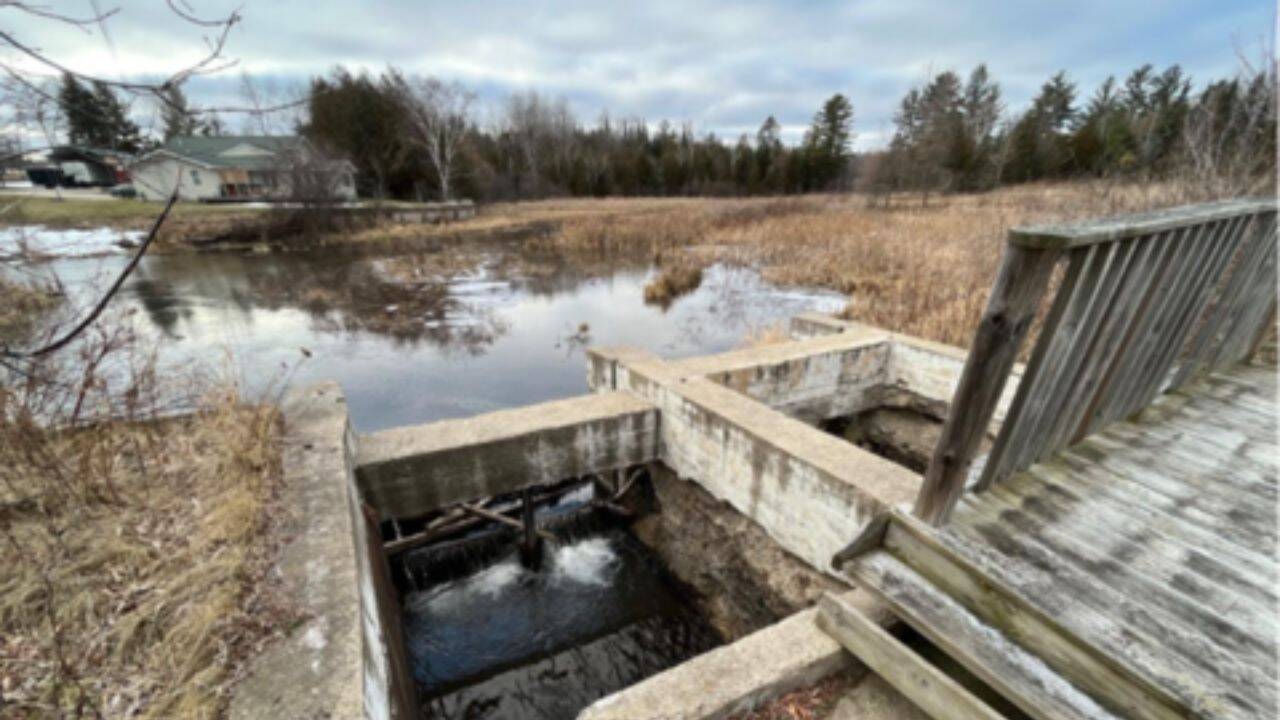
The concrete was rotting long before anyone decided to care. For over a century, the Sanback Dam on Beechwood Creek in Rose City, Michigan, sat as a quiet relic of an industrial past, originally built to power local mills before bleeding into total obsolescence. By the time heavy machinery rolled into Metcalf Park, the structure was doing nothing except trapping heat, blocking native brook and brown trout, and holding back a ticking ecological time bomb.
The successful removal of the Sanback Dam concluded at the end of July 2026, effectively reopening a half-mile of critical cold-water stream, restoring 14 acres of dynamic wetland habitat, and shielding more than 70 downstream miles of the Houghton Creek and Rifle River watersheds from catastrophic sediment collapse. Yet, celebrating the concrete's absence misses the darker narrative of what was lurking behind the wall. This project was never just about a pretty stream. It was an emergency intervention against years of administrative inertia and toxic accumulation.
The Arsenic Burden Nobody Wanted to Talk About
Decaying infrastructure carries physical weight. When water slows down behind an artificial barrier, it drops its payload. Decades of agricultural runoff, local street drainage, and industrial residue settled into the muck behind the Sanback structure.
Testing revealed a grim reality. The sediment trapped behind the dam contained concentrations of arsenic well above residential safety thresholds.
If a structural failure had occurred naturally during a heavy spring melt, thousands of tons of arsenic-laden silt, sand, and organic sludge would have blown out downstream. That slurry would have choked the spawning beds of the Rifle River—one of Michigan's premier designated natural river systems—and pushed toxic loads straight toward the fragile coastal wetlands of Saginaw Bay.
Preventing a disaster requires calculated aggression. Rather than waiting for an uncontrolled blowout, regional conservation groups like Huron Pines, alongside state agencies and engineering partners, executed a meticulously managed drawdown. They slowly bled down the impoundment pool, stabilized the banks, and captured dangerous sediments before the final slabs of concrete were cracked and hauled away.
Engineering a Free Flowing Future
Ecological restoration rarely looks natural at first glance. Once the barrier vanished, Beechwood Creek woke up. Streams are dynamic, living systems that demand room to breathe, meander, and cut their own paths through the valley floor.
When a channel is unspooled from an impoundment, the immediate aftermath resembles an active construction site. Banks are raw. Water runs turbid for a brief window as the system adjusts to its new gradient.
Biologists understand this friction. Without this shock to the system, the creek remains trapped in an artificial loop of thermal degradation. Reservoirs created by low-head dams act like solar collectors, warming the water column. Trout cannot thrive in warm, oxygen-depleted water. By eliminating the impoundment, the surface area exposed to direct sunlight shrank, dropping water temperatures and reintroducing the sharp, oxygen-rich riffles that cold-water species require to survive.
Reconnecting a fragmented stream corridor also allows native fish populations to dodge genetic bottlenecks. Brook trout, slimy sculpin, blacknose dace, and creek chub can now travel freely between upstream spawning zones and deep-water winter refuges.
The Economics of Letting Go
Communities built around nineteenth-century mills often struggle with identity once the industrial engine stalls. Local governments inherit liabilities disguised as historic assets. Maintaining a concrete dam requires deep municipal pockets—pockets that small towns in rural northern Michigan simply do not possess.
When liabilities pile up, safety hazards follow. Low-head dams create violent hydraulic undertows directly beneath the spillway, trapping swimmers and kayakers in invisible, circular currents that earn these structures the grim moniker of drowning machines.
By partnering with the Michigan Department of Environment, Great Lakes, and Energy (EGLE) and leveraging grants from the Great Lakes Restoration Initiative, Rose City traded a crumbling public hazard for a clean public amenity. Metcalf Park is currently undergoing a complete redesign. The municipality is actively gathering public input to shape new recreational infrastructure, turning an industrial scar into an asset for eco-tourism and community engagement.
The math of modern conservation is shifting away from building monuments to control water. The true return on investment lies in getting out of the way and letting gravity, native vegetation, and cold-water currents do the heavy lifting.