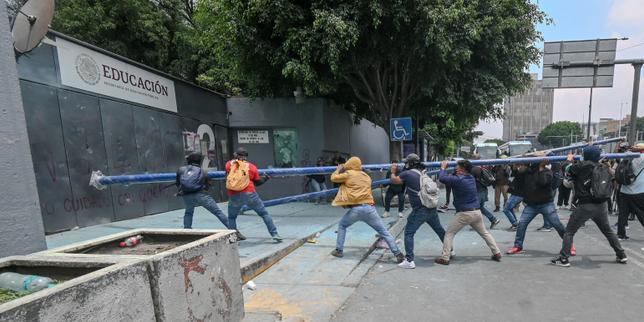
The global spotlight is fixed squarely on Mexico City as the 2026 FIFA World Cup prepares to kick off at the historic Azteca Stadium. But just outside the newly erected metal barricades and FIFA fan zones, a different kind of clash is reaching a boiling point. Dissident public school teachers have occupied the capital, turning the tournament’s international stage into a high-stakes leverage play against the government. Mexican President Claudia Sheinbaum has publicly hit back, branding the timing of these mass protests and encampments a deliberate provocation designed to project an image of mass social turmoil to the world.
While the administration insists the opening match is entirely guaranteed and stable, the standoff exposes a deep structural fracture. This is not a simple dispute over labor contracts. It is an intricate geopolitical chess match where a major host nation is fighting to protect its global image while a militant labor union exploits a multi-billion-dollar sporting event to force historic concessions.
The Strategy of Global Leverage
The National Coordination of Education Workers, known as the CNTE, is a breakaway, highly mobilized faction of the broader Mexican teachers' union. They understand the mechanics of international leverage. By timing their nationwide strike and mass encampments to coincide with the arrival of thousands of international journalists and millions of football fans, they have effectively hijacked the state's public relations machinery.
Streetlight poles have been used as battering rams against government buildings. Statues celebrating football stars along the capital's main promenade have been unceremoniously toppled. The union's calculus is entirely logical. They know the Mexican government desperately wants to avoid international headlines featuring police brutality and tear gas on the eve of the world's biggest party.
Sheinbaum has explicitly stated that she recognizes this trap. In her daily press conferences, she has repeatedly invoked the dark ghost of Mexico's political history, declaring that her government will not mirror the heavy-handed, historic state repressions of the past. By framing the radical protests as an engineered provocation, the administration is attempting to de-legitimize the disruption in the eyes of the public while maintaining a policy of containment rather than direct confrontation.
The Math Behind the Rebellion
At the heart of this conflict lies a massive financial chasm that highlights why standard negotiations have hit a brick wall. The economic realities of the public school system are entirely incompatible with what the teachers are demanding.
- The Union Demand: A 100 percent increase in the starting gross monthly wage for public school educators.
- The Government Offer: A 9 percent salary increase, backed by tri-partite negotiation tables.
- The Pension Battle: The outright repeal of the 2007 ISSSTE pension law, which dissidents claim gutted retirement security.
The government maintains that a 100 percent wage increase across the entire federal education sector is a fiscal impossibility. It would instantly derail the country's national budget. On the other hand, the teachers look at the staggering sums of money poured into stadium renovations, corporate hospitality infrastructure, and security arrangements for FIFA dignitaries, and they see a government with clear priorities. The contrast between global spectacle and local austerity is the fuel driving the unrest.
High Stakes on the Zocalo
The physical epicenter of this struggle is the Zocalo, the massive central square of Mexico City. Under normal circumstances, the plaza serves as the heart of civic life; this week, it was designated as the primary World Cup Fan Fest zone.
[Azteca Stadium / Fan Zones] <--- Heavy Police & Steel Barricades ---> [CNTE Encampments & Protesters]
The administration has deployed sweeping security perimeters to isolate the tourist zones from the labor strike. Federal police have used tear gas and deterrents to keep breakaway groups from breaking through to the core areas where international broadcasts are anchored. The government's strategy is clear. They are attempting to build a physical and visual wall between the sanitized, corporate tournament experience and the volatile domestic reality of Mexico's working class.
This strategy comes with immense risks. The CNTE has announced that its ranks will be joined by the families of the disappeared, bringing one of Mexico's most painful and enduring human rights crises directly into the path of the World Cup news cycle. It is a coalition that cannot be easily swept away by riot shields without causing the exact public relations disaster Sheinbaum is trying to avert.
A Precarious Balance
The coming days will test the limits of what a host government can tolerate. The state cannot afford to let protests disrupt the actual matches at the Azteca Stadium without facing immense financial and legal penalties from FIFA. Yet, aggressive clearing of the streets could trigger a wave of civil unrest that would define the country’s global image for a generation.
Dialogue remains technically open, but the fundamental positions are deadlocked. The government cannot give what it does not have, and the teachers will not leave the streets while they possess the most valuable asset in modern politics: international attention. The tournament will proceed, but the illusion of a unified, celebratory host nation has already been shattered.



:max_bytes(150000):strip_icc():focal(665x0:667x2)/gettyimages-50733149-2000-8b129a2475974982a915418ce92a73d8.jpg)