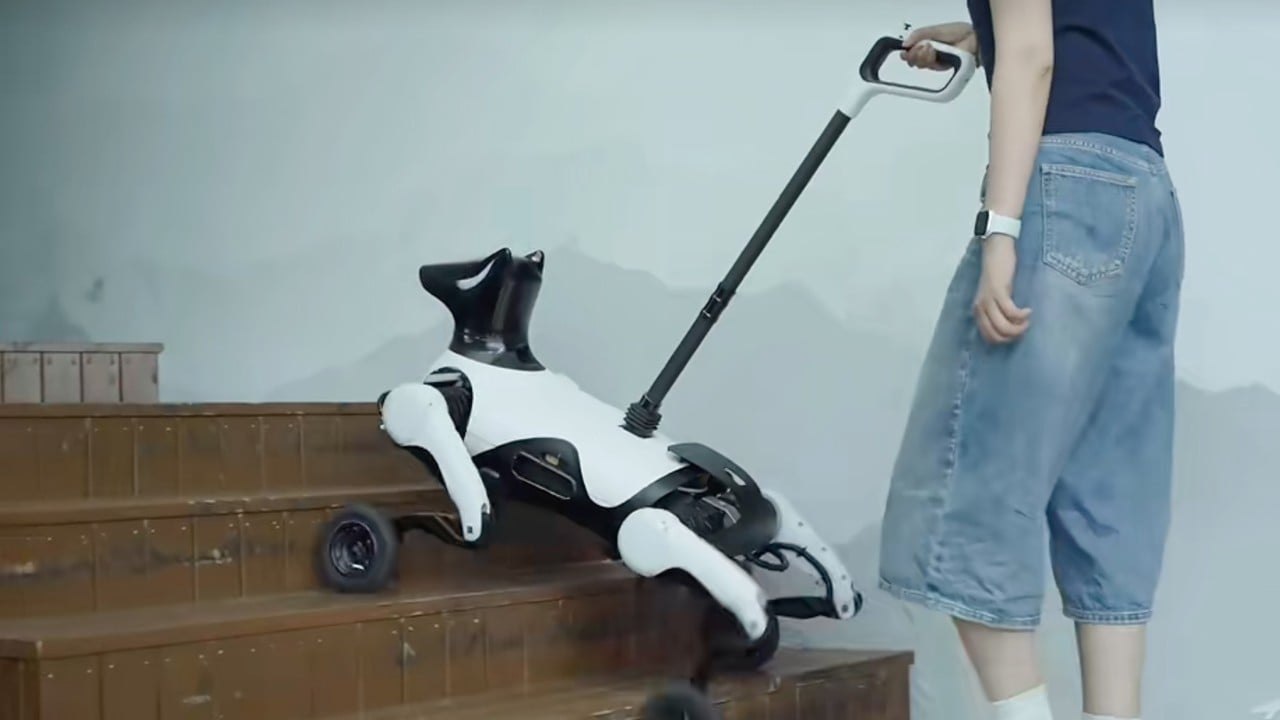
Twenty million people navigate a country built without them in mind, forced to rely on a system of support that essentially does not exist. Official figures place the number of active, fully trained biological guide dogs in China at just over four hundred. A population roughly the size of the entire state of New York scrambles for a handful of working animals. The math is brutal, unforgiving, and completely unsustainable. Into this vast structural void step university laboratories and engineering consortia brandishing polished metal quadrupedal and hexapodal machines, promising an automated revolution.
The mechanical guide dog has arrived, heralded by breathless press releases and slick demonstration videos filmed on pristine university plazas. Engineers at institutions like Shanghai Jiao Tong University have built sophisticated chassis equipped with LiDAR, depth cameras, and end-to-end speech recognition models capable of interpreting spoken commands and parsing traffic lights. These machines respond to verbal inputs, maintain steady pacing, and theoretically avoid the multi-year breeding bottlenecks that plague biological animal training. Yet behind the gleaming titanium joints and optimized software loops lies a stark reality. A machine that performs brilliantly on a flat institutional campus will crumble against the chaotic, unregulated realities of an everyday urban commute.
The Anatomy of an Impossible Supply Crisis
Breeding, raising, and certifying a traditional guide dog requires up to two years of intensive resources, specialized trainers, and astronomical funding. Only a fraction of candidate dogs successfully graduate from these elite programs due to rigorous temperament standards. This biological reality creates a permanent bottleneck. You cannot simply double production next quarter by adding a second shift to a factory line.
Proponents of robotic alternatives point to scalable manufacturing as the ultimate equalizer. After all, once a design achieves commercial maturity, an assembly line can churn out thousands of units per month. But hardware scalability solves only the simplest variable in a deeply complex equation. A biological guide dog is not merely a mobility tool; it is a sentient partner capable of independent stubbornness. If an owner commands an animal to cross a street, but an unseen delivery scooter barrels around a blind corner, a well-trained biological dog will actively disobey the command to protect its handler.
A machine relies on probabilistic inference and sensor fusion. It executes code based on what its algorithms calculate as optimal parameters. When a sensor lens smudges in a sudden downpour, or a localized software glitch stalls the operating system in the middle of a chaotic intersection, the machine lacks the intuitive judgment required to improvise safety. The reliance on mass production overlooks the fact that human-machine trust requires absolute fail-safe predictability in environments that defy predictable rules.
Navigating the Physical and Cultural Labyrinth
Consider a hypothetical urban worker attempting to commute from a residential lane in Changning District to an office complex across town. The journey involves broken paving stones, construction zones spilling onto pedestrian walkways, random piles of shared bicycles blocking ramps, and vendors pushing carts haphazardly through crowds.
Biological guide dogs excel here through dynamic adaptation and mutual physical feedback. The harness transmits subtle shifts in the animal's weight, allowing the handler to feel an obstacle before the dog even stops. Robotic counterparts attempt to replicate this through force-feedback canes and motor-actuated guidance rods. Yet mechanical actuators introduce weight, mechanical lag, and battery limitations. Most current prototypes boast operational windows that barely cover a few hours of continuous field use before demanding a recharge.
Furthermore, social infrastructure remains entirely unaccommodating. Traditional guide dogs face persistent illegal rejections from restaurants, subways, and taxis across major metropolitan areas despite legal protections. Introducing an expensive, unfamiliar robot dog into public spaces that already reject biological assistance animals invites immediate friction. Shopkeepers do not know how to categorize a motorized hexapod blocking a doorway. Commuters crowd around to film the device with their smartphones, turning a vulnerable commuter's transit into a public spectacle.
Software Promises Versus Hardware Truths
Engineering teams frequently highlight artificial intelligence integration as the bridge over troubled waters. Voice recognition modules boast accuracy rates exceeding ninety percent under controlled conditions, allowing users to speak destinations directly to the chassis. Deep learning models process visual data to distinguish between red and green pedestrian signals.
Yet laboratory environments are sanitized ecosystems. Real-world acoustics feature roaring diesel engines, echoing subway platforms, overlapping pedestrian chatter, and sudden construction noise that degrades speech-to-text fidelity. When a visually impaired user issues a critical stop command in a high-decibel environment, a momentary processing delay or a misconstrued phonetic syllable transforms an assistive device into a physical hazard.
Maintenance represents another unaddressed chasm. Biological dogs require veterinary care, food, and daily rest. Robotic units require firmware updates, sensor calibration, delicate actuator replacements, and specialized technical support networks that currently exist only within the university labs that built them. Scaling a fleet of robotic aids without a massive, nationwide service infrastructure means that a single broken sensor turns an expensive lifeline into dead weight sitting in a hallway.
Technology offers a seductive narrative of redemption, suggesting that every human limitation is merely an engineering problem waiting for the right microchip. The severe shortage of biological support animals demands creative thinking, but treating automated hardware as a direct 1:1 replacement ignores the nuanced, emotional, and intensely physical reality of navigating the world without sight. Until engineering teams step outside their controlled campuses and confront the unfiltered chaos of the streets, the mechanical guide dog will remain a brilliant laboratory triumph that leaves the everyday traveler stranded.
China: AI Robotic Dog Guides Visually Impaired Passengers on Shenzhen Metro This news report showcases how robotic guide dog technology is being trialed in real-world public transit settings like the Shenzhen Metro.