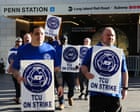
The immediate effect of a complete shutdown on North America’s largest commuter rail system is easy to see on the gridlocked arterial highways feeding New York City. When 3,500 unionized workers walked off the job at the Long Island Rail Road (LIRR), they did more than halt trains for 300,000 daily riders; they severed an economic artery that generates an estimated $61 million in daily economic activity. While headline writers focus on the immediate misery of sports fans stranded outside the Subway Series or commuter political finger-pointing, the real crisis is institutional, structural, and decades in the making. The collapse of these labor talks reveals a bankrupt transit funding model catching up with reality.
Public narratives from the Metropolitan Transportation Authority (MTA) framework paint a picture of sudden labor intransigence, pointing to a failed 1% margin on wage increases just hours before the strike deadline. The reality is far more calcified.
The Illusion of a Sudden Breakdown
For months, negotiations bounced between federal mediation panels and stubborn executive boardrooms. The five striking unions—representing engineers, signalmen, machinists, and technicians—demanded a retroactive 9.5% wage increase to cover the last three inflationary years, capped with an additional 5% bump for 2026. Management countered with a lower offer, arguing that meeting the union demands would instantly duplicate a scheduled 4% fare hike to 8% next year.
To understand why the system broke down at 12:01 a.m. on Saturday, you have to look past the immediate math. The LIRR has not seen a labor stoppage since a brief two-day walkout in 1994. For thirty-two years, labor peace was bought by kicking the financial can down the tracks. Every successive contract relied on rising pre-pandemic ridership and cheap debt financing to bridge the gap between what workers deserved during inflationary spikes and what riders were willing to pay.
That math is dead.
Ridership patterns have fundamentally altered since 2020. The commuter rail model was built on five-day-a-week white-collar desk workers journeying from Suffolk and Nassau counties into midtown Manhattan. Today, hybrid work schedules mean the system routinely operates at lower weekday capacities than its historical peaks, while fixed operating costs remain unchanged. The unions are fighting to catch up with historical inflation that eroded their purchasing power over the past three years. Management is looking at a structurally altered revenue ledger and panicking.
The Friction of Divided Accountability
Compounding the financial deadlock is a fractured political apparatus that ensures no one takes ultimate responsibility until the tracks are already empty.
[Federal Mediation Panels]
       │ (Non-binding Recommendations)
       ▼
[MTA Executive Management] <───(Financial Pressure)───> [Striking LIRR Unions]
       ▲
       │ (Appoints Leadership / Faces Reelection Pressure)
       ▼
[State Executive Leadership]
The executive layer of the state government blamed federal authorities for shortening the runway on mediation, while opposition parties characterized the shutdown as an executive management failure. This sort of public theatre obscures the structural mechanics of how transit labor disputes are resolved under the Railway Labor Act. Non-binding recommendations from federal emergency boards appointed by Washington repeatedly advised the MTA to offer more money. The MTA ignored those recommendations because federal panels do not have to find the revenue to fund their own suggestions.
When the agency claims it offered workers everything they asked for in terms of basic pay, it omits the structural battleground: health care premiums and pension contributions. The MTA wants future hires to pay significantly more toward their health benefits to offset legacy pension obligations that threaten to consume the agency’s operating budget by the end of the decade. The unions view this as a back-door pay cut that undermines the headline wage increases.
Why the Contingency Plans are Failing
The fallback measures deployed to handle the fallout highlight the irreplaceable nature of heavy rail infrastructure. The MTA activated a fleet of 275 shuttle buses to ferry stranded suburbanites from key locations like Ronkonkoma and Huntington to Queens subway terminuses.
It is an exercise in basic geometry that cannot succeed.
A single standard commuter train can transport up to 1,200 passengers at peak hours. It requires dozens of transit buses to duplicate the capacity of a single ten-car train. When you subtract the rail capacity that feeds Penn Station and Grand Central Madison, those 275 buses become a drop in an ocean of stranded commuters. The resulting traffic surge onto the Long Island Expressway and the Grand Central Parkway creates a secondary economic penalty: lost productivity for logistics, commercial transport, and emergency services caught in the gridlock.
Rider advocacy groups find themselves caught in the middle of this operational warfare. The LIRR Commuter Council noted that if the unions receive their full demands without a corresponding injection of external state or federal subsidy, riders will bear the cost through compounded fare increases. Yet, asking workers to accept sub-inflation wages to subsidize a broken funding apparatus is equally unsustainable.
The Structural Dead End
This strike is an indicator of a broader national crisis facing legacy mass transit systems across North America. From Boston to Chicago, commuter rail networks are discovering that their financial foundations are incompatible with post-pandemic reality. They are locked in a cycle of declining farebox recovery ratios, rising labor costs driven by real-world inflation, and aging physical infrastructure that requires constant capital infusion.
The temporary solution will likely involve a rushed, politically motivated cash injection from state reserves to get the trains running before a full work week exposes the depth of the economic damage. But an emergency patch will not solve the underlying equation. Until transit systems are funded as vital public utilities rather than self-sustaining corporate entities dependent on farebox revenue, the choice will remain a brutal one: underpaid workers, astronomical fares, or empty platforms.