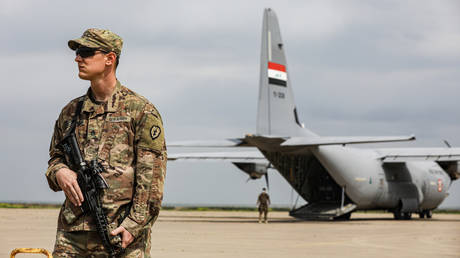
The headline out of Baghdad sounds definitive. Washington and Iraq have locked in a hard deadline of September 30, 2026, to shutter the United States-led military mission and empty the remaining bases. Officials on both sides point to bilateral agreements, staged handovers of facilities like Al-Asad air base, and formal timelines to argue that the era of Western boots on the ground in Mesopotamia is coming to a close.
Do not believe it.
Decades of covering regional security architecture teach a hard lesson: great powers rarely abandon strategic terrain; they merely rebrand their footprint. Beneath the diplomatic theater of staged withdrawals, the Pentagon and Baghdad are executing a delicate repositioning maneuver. The primary mission may be changing name plates, but the underlying geopolitical architecture remains firmly anchored to American interests.
The Mechanics of the Mirage
To understand why a total American military evaporation from Iraq is functionally impossible, look at what is happening to the hardware. Weeks before the much-touted deadline, logistics convoys began packing up advanced air defense assets, including Patriot missile batteries, from compounds near Erbil. Local officials in the semi-autonomous Kurdistan region watched anxiously as the heavy defensive shielding was pulled back, leaving the northern skies dangerously exposed to drone and missile incursions.
Yet pulling down a Patriot battery is not the same as pulling out the personnel. What looks like a wholesale retreat is actually a bureaucratic sleight of hand. The formal anti-ISIS coalition is dissolving, yes. The legal parameters established in 2014 are expiring. But military planners have already engineered a parallel track: transitioning from a multilateral combat framework to a bilateral advisory and intelligence partnership.
Take the capital itself. When U.S. forces formally stepped back from immediate intra-city positions in Baghdad, a counter-rocket, artillery, and mortar (C-RAM) system quietly stayed behind to protect the sprawling embassy compound inside the Green Zone. That pattern repeats across the theater. The flag comes down over a major base, but the specialized technical units, intelligence cells, and logistics hubs simply morph into new organizational structures under different acronyms.
The Domestic Pressures Driving the Dance
For Iraqi Prime Minister Ali al-Zaidi, securing a hard exit date is an absolute political necessity. Successive governments in Baghdad have walked a tightrope, squeezed between Washington's regional containment strategies and the persistent political gravity of Iran-aligned factions inside the Iraqi parliament. Whenever tensions spike between the United States and regional proxy networks, moderate Shia political blocs face immense domestic pressure to demand the immediate expulsion of all foreign troops.
The timeline agreed upon in bilateral talks serves a dual purpose for Baghdad. It allows domestic leaders to claim victory over foreign occupation while maintaining the institutional safety net provided by Western intelligence. Without external surveillance data and logistical backbone, the Iraqi security forces and the regional Peshmerga face severe blind spots regarding remnant militant networks.
At the same time, Washington retains considerable financial leverage. The threat of economic adjustments or restricted access to international financial mechanisms keeps Baghdad cooperative. When Prime Minister Zaidi traveled to Washington for high-level white-house meetings, the conversation was never about a clean break. It was about packaging the enduring relationship so that it becomes politically digestible at home.
The Kurdistan Complication
Nowhere is the friction of this transition more visible than in the north. The security co-operation agreement governing U.S. support for the Kurdish Peshmerga forces faces its own expiration clock alongside the broader coalition drawdown. For years, Western funding and advisory teams served as the central engine driving military institutional reform and unit unification within the fractured Kurdish command structure.
Kurdish officials have rushed to reassure domestic audiences that the expiration of specific funding mechanisms does not mean an abrupt cutoff in military assistance. Behind closed doors, however, regional leaders worry about their vulnerability. As air defenses shrink and formal coalition frameworks dissolve, the burden of managing local security falls back onto local authorities who lack independent long-range intercept capabilities.
This creates a dangerous vacuum. If Iran-backed armed groups test the boundaries during the transition window, the absence of robust defensive architecture could force a crisis before the ink on the new bilateral agreements is fully dry. Washington must decide whether to quietly supply alternative point-defense packages or leave its regional partners to absorb the shock alone.
The Permanent Footprint
History shows that military interventions rarely end with a clean closing ceremony. The U.S. departure in 2011 was hailed as the definitive end of an era, only for troops to flood back three years later under the banner of Operation Inherent Resolve when the landscape collapsed under the weight of new threats.
Pentagon planners are acutely aware of this cycle. The geopolitical cost of ceding airspace and strategic depth to competing regional influences is simply too high. Whether designated as advisors, trainers, or embassy-defense specialists, a residual U.S. presence will persist in Iraq because the underlying vulnerabilities of the state have not vanished. The banners will change, the official missions will be declared complete, but the strategic anchor will remain lodged in the soil.