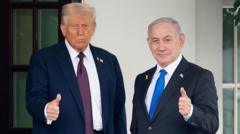
The physical route out of Israel was chosen for its paranoia, not its protocol. Avoiding Ben Gurion Airport entirely, Prime Minister Benjamin Netanyahu boarded his official aircraft from an active military installation, a security precaution driven by acute regional threats and a deepening political chill. When he touched down in Washington to face Donald Trump, the agenda at the White House carried consequences far beyond standard diplomatic theater. This was not a routine alliance check-in. It was a high-stakes collision between two political survivors whose interests, once entirely synchronized on the Iran war, have fractured under the heavy weight of military reality and domestic survival.
To understand why this summit matters, look past the official readouts of mutual handshakes and shared strategic goals. The core friction centers on an unbridgeable gap in objectives. Trump is confronting the biting economic fallout of a protracted conflict, watching energy prices climb alongside public fatigue ahead of midterm elections. He wants an off-ramp, a diplomatic conclusion, or a contained footprint that stops the bleeding. Netanyahu, conversely, faces domestic electoral pressure that demands absolute, unyielding escalation. For the Israeli leader, stopping short of total degradation of Iran and its proxies threatens to collapse his coalition and seal his political demise.
The Divergence on Iran
When the joint campaign against Tehran launched, the White House and Jerusalem projected an image of absolute unity. That facade has since eroded. Iranian counter-strikes, regional disruptions near the Strait of Hormuz, and the grinding limitations of air power alone have forced Washington to reevaluate its risk tolerance.
Trump has signaled an appetite for diplomatic outs or limited horizons when endless campaigns threaten American economic stability. Netanyahu arrived in Washington to counter that impulse. His mission was simple yet nearly impossible: convince an American president who is eager to wind down foreign entanglements to double down instead.
"We have a little difference," Trump acknowledged to reporters ahead of the sit-down, offering the classic understatement of a leader managing an unpredictable alliance.
That difference is operational policy. Netanyahu seeks to bind Washington to a maximalist strategy that prevents any premature settlement with Tehran. He needs American military backing not just for defense, but as a permanent engine for regional realignment. Trump, meanwhile, measures success by domestic metrics and the immediate containment of costs.
The Shadow of Regional Realignment
Beyond the immediate theater of conflict with Iran, the talks turned heavily toward the architecture of the wider Middle East. The U.S.-backed frameworks concerning Lebanon and the long-term status of Gaza remain fragile blueprints. Washington is pushing for diplomatic mechanisms, including phased arrangements with regional partners and stabilization forces, to project an image of order.
However, enforcement remains an open wound. Local actors like Hezbollah and Hamas continue to reject disarmament terms, viewing them as capitulation rather than compromise. Netanyahu’s government views these American stabilization timelines with deep skepticism, preferring hard security control over diplomatic optimism.
Simultaneously, the pursuit of broader normalization agreements, including potential ties with Saudi Arabia, hangs in the balance. Riyadh continues to tie normalization to concrete movement on Palestinian statehood—a demand that remains entirely toxic to Netanyahu's right-wing coalition partners. Trump’s desire for a diplomatic grand bargain clashes directly with the domestic political boundaries Netanyahu has drawn around himself.
The Domestic Trap
Both men are trapped by their immediate political calendars. Netanyahu is navigating an electorate deeply critical of security failures and wary of a widening diplomatic rift with Washington. Every concession he makes to American pressure on Gaza or regional governance threatens to fracture his ruling coalition.
Trump is operating under the shadow of domestic voter dissatisfaction driven by inflationary pressures and economic friction directly tied to prolonged foreign instability. A president who campaigned on strength and economic prosperity cannot afford a stagnant, open-ended conflict that drains federal resources and alienates his base.
When Netanyahu left the White House, the fundamental contradictions of their partnership remained unresolved. They can agree on the shared enemy, but they cannot agree on the endpoint. As the military campaigns grind forward and domestic pressures mount on both leaders, this high-stakes encounter may ultimately be remembered not as a moment of alignment, but as the turning point where their paths permanently diverged.