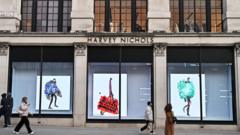
The death spiral of a British retail icon ended not with a quiet corporate restructuring, but with a swift administration and a £40 million rescue deal orchestrated by Mike Ashley's Frasers Group. When Harvey Nichols slid into insolvency, it marked the terminal point for Sir Dickson Poon’s 35-year stewardship of the luxury department store chain. For decades, the Knightsbridge establishment stood as the absolute pinnacle of high-end consumerism, famously immortalized in popular culture as the playground of television's most decadent shoppers. Today, it represents something entirely different: a stark warning about the lethal combination of post-pandemic tourism shifts, soaring operational overheads, and the unforgiving economics of modern physical retail.
Frasers Group secured six domestic stores—including the flagship London location—alongside the online operation and more than 1,000 employees. Yet the transaction lays bare an uncomfortable truth about the state of traditional British luxury. When a brand accumulates cumulative pre-tax losses approaching £190 million over a six-year window, sentimentality becomes an unaffordable luxury. Ashley diagnosed the asset accurately prior to the acquisition, labeling the downward trajectory a death spiral that required immediate, unfiltered surgery.
The Anatomy of a High-End Decline
To understand how Harvey Nichols reached the brink, one must look past simple macroeconomic grievances. Consumer confidence fluctuations and the evaporation of lucrative tax-free shopping for international tourists certainly accelerated the bleeding, dropping annual revenues to £184.7 million. However, the deeper systemic failure lies in an identity crisis that festered for years.
Department stores built on Victorian and Edwardian footprints require astronomical capital expenditure to remain relevant. While competitors like Harrods and Selfridges poured immense fortunes into turning physical stores into immersive experiential destinations, Harvey Nichols struggled to maintain a distinct competitive moat. It was caught uncomfortably in the middle: too expensive for the everyday consumer squeezed by cost-of-living pressures, yet increasingly lacking the hyper-exclusive product lines and bespoke customer service rituals that ultra-high-net-worth shoppers demand.
As digital alternatives captured the middle tier of luxury spend, legacy physical footprints became financial anchors. Maintaining multi-floor palaces of retail in regional cities like Birmingham, Manchester, Bristol, and Leeds ceased to make economic sense years before the administrators arrived. Rent liabilities, business rates, and localized utility spikes transformed historic flagships into cash-burning liabilities.
The Frasers Playbook and the House of Fraser Parallel
Market watchers tracking Mike Ashley's corporate maneuvers recognize an established script. When Frasers Group acquired House of Fraser out of administration in 2018, the initial rhetoric promised a grand rehabilitation of a high street staple. The reality on the ground proved far more bruising. Within years, roughly forty of those sixty stores were shuttered as management systematically trimmed the fat to achieve profitability.
The integration of Harvey Nichols will follow a similarly aggressive blueprint. Chief Executive Michael Murray has already signaled that the immediate future involves a smaller business footprint, characterized by a rigorous rationalization of the store portfolio, cost baselines, and organizational structures.
Consider a hypothetical retail restructuring scenario to understand the mechanism at play. When a parent company absorbs an insolvent luxury asset via a pre-pack administration, it selectively sheds legacy debts and onerous lease obligations while retaining core inventory and brand equity. The survivors of this purge are rarely treated to a renaissance of old-world charm. Instead, they are subjected to strict supply chain integration, centralized IT infrastructure, and margin-driven brand curation designed to align with the broader corporate ecosystem.
Industry analyst Richard Hyman noted bluntly that the enterprise cannot afford to operate as it did historically, because those exact operational habits generated the catastrophic losses that drove it into a corner.
The Supplier Anxiety and the Ghost of Matches
While securing the immediate survival of over 1,000 jobs offers a vital human victory, the secondary economic ripples demand scrutiny. Frasers has publicly committed to maintaining strong relationships with the brand's expansive roster of premium and luxury suppliers. Yet institutional memory in the fashion sector runs long and deep.
The collapse of online luxury platform Matches Fashion under Frasers' brief ownership left top-tier design houses—including industry giants like Gucci and Prada—recovering mere pennies on the pound for historical debts. Against that recent backdrop, luxury houses approached the Harvey Nichols transition with understandable caution. When a department store enters administration, the collateral damage extends straight down the manufacturing pipeline. Brands that consign high-value inventory to struggling physical stores face acute exposure whenever insolvency proceedings freeze commercial payments.
Restoring absolute trust among international fashion houses requires more than corporate press releases. It requires demonstrating that the new ownership structure possesses both the liquidity and the strategic discipline to pay invoices on time while protecting brand equity from aggressive discounting.
The Future of the Flagship and Regional Outposts
The immediate geographical footprint of the acquisition reveals where Frasers intends to draw its battle lines. While the Knightsbridge and Edinburgh locations appear secure under core brand banners, the long-term outlook for regional strongholds is decidedly murky. Industry whispers point toward potential rebrandings, with regional branches in locations like Birmingham, Manchester, Leeds, and Bristol targeted for conversion into House of Fraser or Flannels outlets.
Even the iconic Knightsbridge flagship faces structural questions. In retail real estate circles, speculation persists regarding whether the massive multi-level floor plan will remain strictly dedicated to high-end apparel and dining, or if portions of the square footage will eventually be repurposed to accommodate complementary ventures within the broader Frasers portfolio, such as fitness spaces or mass-market sporting goods concepts similar to the transformation seen at London's former Lillywhites building.
Meanwhile, ancillary assets like the famous OXO Tower restaurant were peeled away from the core administration package entirely, sold to separate buyers to preserve localized operations and independent employment streams. Such piecemeal unbundling illustrates the true nature of modern retail rescue operations: the brand is no longer an indivisible temple of prestige, but a portfolio of modular components to be optimized, relocated, or liquidated based on pure yield.
The ultimate survival of Harvey Nichols under its new banner will not be decided by nostalgia for 1990s cultural touchstones or glamorous window displays. It will be forged in the unglamorous trenches of supply chain efficiency, inventory velocity, and ruthless cost containment. The brand has escaped immediate liquidation, but the hard work of proving that traditional luxury department stores still have a viable economic pulse in the modern era begins now.