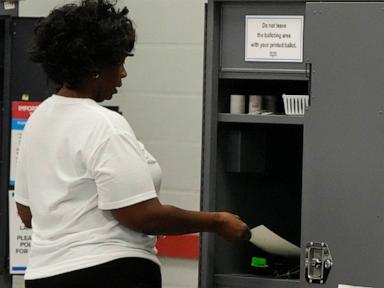
The Georgia Legislature just avoided a self-inflicted catastrophe by delaying its own legally mandated ban on QR codes used to count votes. By pushing the deadline out to 2028 during an emergency special session, lawmakers prevented the immediate collapse of the state's election infrastructure just months before the high-stakes midterms.
Yet the panic behind closed doors reveals a deeper crisis. The state's political leadership has trapped itself between technical reality and the demands of election-denial conspiracists, creating a regulatory gridlock that will plague Georgia for years to come.
This emergency legislative scramble was not born out of a sudden technological failure, but rather a profound failure of governance. In 2024, the Republican-controlled General Assembly passed a sweeping election law that made the state's existing $100 million Dominion voting machines entirely illegal after July 1, 2026. The law explicitly banned ballot tabulators from reading the unique QR codes that encode voter selections.
The problem was that lawmakers walked away without providing an alternative system, without appropriating the estimated $66 million to $300 million needed for replacement hardware, and without any realistic timeline for county election boards to adjust.
The Manufactured Emergency
The current infrastructure relies on ballot-marking devices. A voter makes selections on a touchscreen, and the machine prints a paper receipt. This receipt features text written in plain English alongside a unique QR code. While humans read the text, the digital scanner reads only the code to tally the vote.
Skepticism of this process emerged prominently after the 2020 presidential election. Activists argued that because a voter cannot visually decipher a QR code, they cannot truly verify if the machine accurately recorded their intent.
Cybersecurity professionals have long expressed similar structural concerns about black-box counting mechanisms. But local lawmakers weaponized this technical nuance to satisfy a restless base, passing the ban with zero material preparation.
When the regular 2026 legislative session adjourned without a resolution, Georgia’s 159 counties faced a terrifying reality. Come July, they would legally own an illegal voting system, with no money, no alternative hardware, and a major statewide election looming.
Faced with the prospect of being forced into chaotic, error-prone, total manual hand-counts for millions of mid-term ballots, Republican Governor Brian Kemp was forced to call a special session to untangle the knot.
The Compromise and the Poison Pill
The resulting emergency legislation, Senate Bill 3EX, passed by a partisan 94-79 vote in the House and 36-16 in the Senate. It delays the implementation of the QR code prohibition until 2028, effectively codifying the status quo for the upcoming midterms.
To secure the votes of hardline Senate Republicans who resisted the extension, leadership attached a controversial amendment. The bill now mandates a full manual hand recount for the top two statewide races on a ballot, but only if the final margin of victory is within a half percentage point.
This compromise satisfied enough lawmakers to avert an immediate operational shutdown, but it introduced a volatile new mechanism into the certification process. If a marquee statewide race—such as the gubernatorial or attorney general contest—falls within that razor-thin 0.5% window, local election workers must manually count the physical paper receipts within 17 days.
Longtime election administrators view this addition with profound exhaustion. Hand-counting paper ballots is universally recognized by experts as slower, far more expensive, and significantly more prone to human error than machine tabulation. Humans clearing thousands of ballots under intense public scrutiny naturally miscount, misfile, and fatigue.
By inserting a hand-count trigger into the law, the legislature has guaranteed that any ultra-close election in Georgia will feature a structural variance between the initial machine tally and the subsequent human count. That mathematical delta will inevitably be weaponized by whichever campaign is losing to claim fraud, achieving the exact opposite of the bill's stated goal to boost voter confidence.
Who Controls the Future Machine
The true undercurrent of the special session, however, was not about the immediate midterms. It was a brutal turf war over who will control the procurement of Georgia's next uniform voting system for 2028 and beyond.
SB 3EX strips significant authority away from the Secretary of State’s office. Republican incumbent Brad Raffensperger and his chief operating officer, Gabe Sterling, have spent two years publicly criticizing the QR code ban as an impractical, multimillion-dollar solution in search of a problem. Their insistence on logistical reality alienated populist lawmakers who viewed the office as overly defensive of the existing Dominion contract.
In retaliation, the new legislation establishes an independent, nine-member Election Equipment Specifications and Standards Committee. The panel will dictate the precise technical requirements for the next statewide voting infrastructure, specifically directing them to evaluate ballot-on-demand printing options and hand-marked paper systems.
The political leverage is baked into the committee’s composition. The nine seats will be appointed in equal parts by the Governor, the Speaker of the House, and the Senate Committee on Assignments. Currently, every single one of those appointing authorities is a Republican.
Democratic lawmakers fiercely fought the provision, demanding guaranteed minority party representation on the selection panel. They were flatly denied. The resulting structure ensures that the blueprint for how Georgia votes for the next decade will be drawn exclusively by one side of the aisle, entirely bypassing the state's chief election officer.
The Financial Fallout for Counties
While state politicians celebrate a temporary legislative fix, local county governments are left holding an expensive, uncertain bag. Securing a brand-new, statewide voting system that relies on optical character recognition—reading the actual printed text instead of a barcode—is a staggering fiscal hurdle.
The Secretary of State's office previously noted that modifying the current machinery to read text would demand at least $25 million. Scrapping the infrastructure entirely to pivot to a completely new vendor could easily top nine figures.
The legislature has still not passed a dedicated appropriation to cover these long-term procurement costs. Underfunded rural counties are looking at a looming 2028 cliff, terrified that the state will issue another unfunded mandate requiring them to purchase local ballot-on-demand printers or face extreme staffing costs associated with manual tallies.
The compromise bill managed to stop the clock, but it did not solve the underlying political sickness dictating Georgia's election policy. Lawmakers did not change their minds about the technology; they simply realized they had run out of time to build a replacement without triggering an immediate operational emergency.
By pushing the deadline to 2028, the General Assembly ensured that the upcoming midterms will run on the exact same machines that have driven years of conspiracy theories, while simultaneously building an entirely new partisan committee to redesign the apparatus in secret. Georgia didn't fix its voting problem. It just bought itself two more years to argue about it.