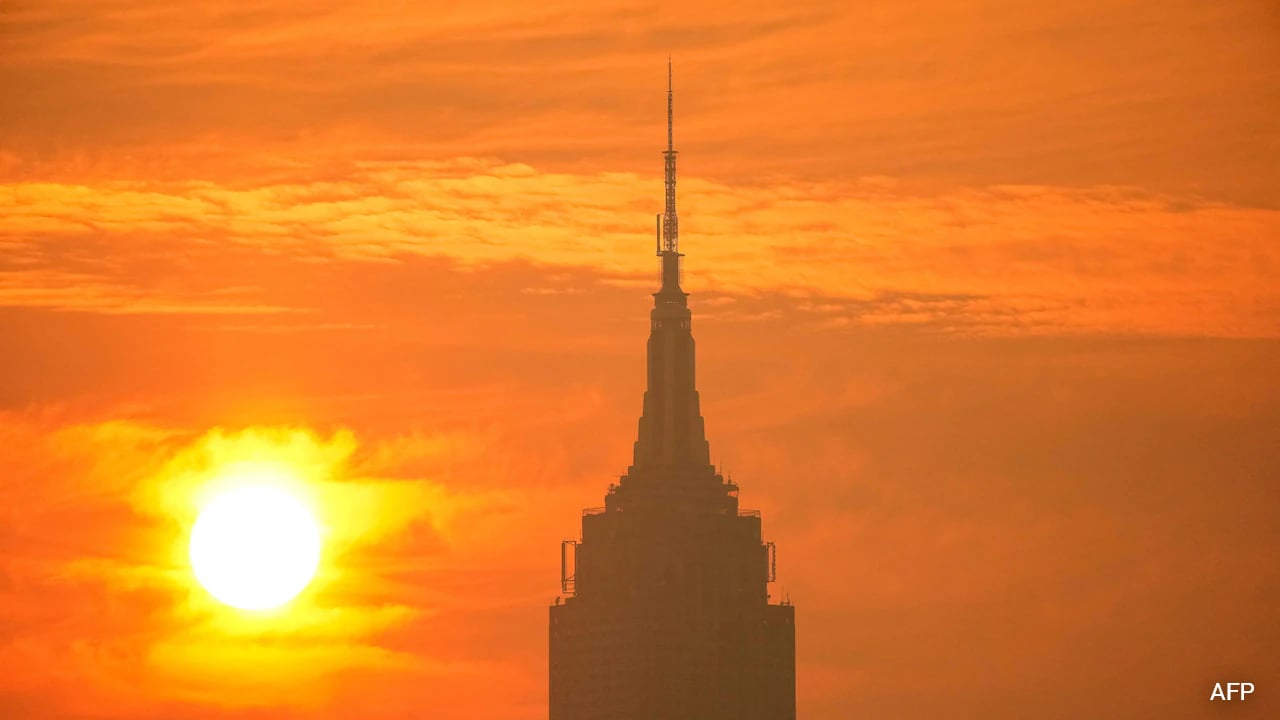
The United States is currently facing an unprecedented convergence of toxic smoke, runaway wildfires, and catastrophic flash flooding that threatens to dismantle the nation's core infrastructure. While public attention fixes on the spectacular visuals of orange skies and submerged highways, the true crisis lies beneath the surface in the systemic collapse of the nation's power grids and insurance markets. The existing baseline for managing seasonal weather is obsolete. Decades of underinvestment and regulatory stagnation have left the country exposed to overlapping environmental shocks that are no longer rare aberrations, but predictable annual fixtures.
The immediate danger is not merely physical discomfort. It is the cascading failure of interconnected systems that keep American society functional. When a heat dome settles over the Eastern Seaboard, it does not act in isolation. It accelerates grid degradation, compounds drought conditions that fuel fires in adjacent states, and triggers atmospheric shifts that culminate in sudden, violent downpours downwind. The country is attempting to fight a multi-front war with tools designed for a simpler, cooler era.
The Invisible Threat to High Voltage Transmission
Public conversations regarding extreme heat typically focus on the surge in air conditioning demand. Millions of units drawing power simultaneously creates an obvious strain, but the more dangerous vulnerability exists within the physical components of the grid itself.
High temperatures decrease the efficiency of aluminum and copper transmission lines. As the metal heats up, electrical resistance increases, causing the lines to expand and sag closer to the ground. This thermal sag introduces a severe operational hazard. A line that drops too low can arc into vegetation, triggering the very wildfires that utilities are desperately trying to avoid.
At the same time, substation transformers depend on ambient air to cool their internal systems. When nighttime temperatures fail to drop below ninety degrees, these multi-million-dollar assets cannot shed their accumulated heat. They bake in their own insulation oil, accelerating their degradation and shortening a lifespan that was already nearing its end due to age.
A secondary, largely unmonitored hazard travels through the air. Wildfire smoke is not just a respiratory threat to humans; it is a mechanical threat to high-voltage equipment.
Smoke plumes carry millions of tons of conductive carbon particulates. As these plumes drift hundreds of miles away from the actual fire lines, the particulates settle on the porcelain and glass insulators that separate live wires from utility poles and transmission towers. When morning dew or light mist mixes with this soot layer, it creates a conductive pathway. The electricity jumps the insulator, creating a ground fault that trips breakers and shuts down lines instantly, often on perfectly clear days in states far removed from the actual blaze.
[Particulate Accumulation on High-Voltage Insulators]
Smoke Particulates + Moisture -> Conductive Bridge -> Line Fault / Outage
This phenomenon explains the mystery behind sudden regional power drops that occur without a direct storm strike. The bulk power system was engineered assuming that wind, fire, and rain were separate events. The reality of modern summers is that they are deeply interdependent.
The Financial Evacuation of the American Suburb
The physical destruction wrought by these overlapping weather patterns has triggered a silent financial crisis in the housing market. Homeowners insurance is quietly vanishing from large swaths of the American map.
Major national carriers are not just raising premiums; they are pulling out of entire states, leaving property owners without viable commercial options. This is not localized to coastal Florida or the immediate forests of California. The crisis has spread to the Midwest, where severe convective storms, straight-line winds, and historic hail damage have turned previously stable markets into financial black holes for underwriters.
The numbers reveal an unsustainable trajectory. Between 2020 and 2024, home insurance premiums across the country climbed by over forty percent, far outpacing general inflation and median wage growth.
In states like Texas and Colorado, the average annual premium now hovers around six thousand dollars. For working-class families, this increase acts as a second mortgage payment.
Home Insurance Premium Surges (2020-2024 Cumulative)
|||||||||||||||||||||||||||||| 41.4% Premium Increase
|||||||||||||||| 22.5% CPI Inflation
The consequence of this pricing pressure is a dangerous surge in the number of uninsured properties. Nearly thirteen percent of American homeowners now operate without any property insurance.
The vast majority of these individuals are not wealthy citizens choosing to self-insure. They are lower-income households who have been forced to choose between keeping the lights on or paying for a policy that has doubled in price over a three-year window.
When a flash flood rips through an inland valley or a wind-driven wildfire consumes a subdivision, these uninsured families lose everything. They cannot rebuild. They cannot sell a ruined asset to pay off their remaining mortgage. The result is a slow-motion foreclosure crisis that threatens local tax bases and destabilizes regional banks holding the underlying debt.
To counter this, states are rushing to implement stopgap measures. Colorado recently pioneered legislation forcing insurance companies to disclose the specific proprietary models they use to calculate risk, while mandating discounts for homeowners who actively clear brush or fortify their roofs.
Other states are scrambling to mimic this framework, but it remains an uphill battle against mathematical reality. Insurers operate on probability. When the probability of multi-billion-dollar losses becomes an annual certainty rather than a once-in-a-century anomaly, the private market model breaks down completely.
The Collision of New Demand and Old Supply
The operational stress on the American energy sector arrives at the worst possible moment. The grid is attempting to survive extreme summer conditions while undergoing a massive structural transformation.
On one side of the ledger, traditional coal and older natural gas generation units are being retired due to age and economic pressures. On the other side, demand is exploding, driven not just by residential cooling but by the rapid expansion of industrial manufacturing and power-hungry artificial intelligence data centers.
The North American Electric Reliability Corporation has repeatedly warned that this transition period introduces severe reliability gaps.
While the rapid deployment of utility-scale solar installations and massive battery storage systems has provided critical relief during peak daylight hours, the system remains highly vulnerable during the late evening.
As the sun sets, solar generation drops to zero, yet temperatures remain dangerously high due to the urban heat island effect. Batteries must then discharge everything they have to carry the load until midnight. If a multi-day heatwave limits the ability of these batteries to recharge during the day because every scrap of solar power is being consumed immediately, the safety margin vanishes entirely.
Consider the compounding effect of a typical summer scenario. A prolonged drought dries out the rivers used to cool inland thermal power plants. Because the water is too warm or the river levels are too low, these plants must curtail their output or shut down completely to avoid killing local aquatic life.
Simultaneously, a stagnant high-pressure system cuts wind speeds across the plains, rendering wind turbines idle. The grid operator is left balancing a system where traditional generation is constrained, renewable generation is fluctuating, and demand is hitting all-time highs.
This is the structural vulnerability that emergency declarations cannot fix. The federal government can issue temporary orders allowing plants to bypass environmental regulations to keep the power flowing during a crisis, but it cannot create water out of dry riverbeds or force aged transformers to cool down faster.
The Localized Reality of Infrastructure Failure
The macro-level statistics obscure the brutal reality of how these failures play out on the ground. When the grid fails during a combined heat and smoke event, the consequences are immediate and lethal.
Modern homes are built like sealed boxes. Without electricity to run mechanical ventilation and filtration systems, indoor air quality rapidly degrades to match the hazardous conditions outside.
For vulnerable populations—the elderly, those with pre-existing cardiovascular conditions, and infants—the lack of power is a direct threat to survival.
Municipalities have attempted to establish cooling centers, but these facilities rely on the very same electrical infrastructure they are meant to protect. If a substation fails, the cooling center goes dark along with the rest of the neighborhood.
Furthermore, the physical separation between where power is generated and where it is consumed means that a failure in one county can trigger a blackout three hundred miles away. The system is too tightly coupled, leaving no room for localized isolation when things go wrong.
The fix requires a fundamental shift in how capital is deployed. The nation cannot simply build more of the same infrastructure and expect a different result.
Investment must shift toward hardening existing assets: undergrounding critical distribution lines to protect them from wind and fire, replacing aging paper-insulated transformers with modern solid-state units, and aggressively expanding decentralized microgrids that can operate independently when the main transmission network drops offline.
These are not cheap or politically expedient projects. They require billions of dollars in upfront capital and years of disruptive construction. Yet the alternative is already visible in the soaring premium notices arriving in mailboxes and the rolling blackouts cutting power to millions of citizens every July.
The triple threat of smoke, fire, and flood is exposing the fiction that the United States can maintain a first-world economy on a third-world foundation. The margins have run out. The infrastructure is telling the story that politicians want to ignore, and every passing summer makes the reality harder to deny.