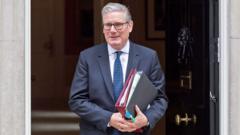
The Westminster village is currently transfixed by the clock. Journalists stand huddled under umbrellas outside the famous black door of Number 10, staring at a blank wooden lectern and wondering exactly when the Prime Minister will speak. They want to know the hour of the announcement, the phrasing of the statement, and the choreography of a leader confronting his political mortality.
This obsession with the immediate schedule completely misses the point.
The imminent unraveling of Keir Starmer’s administration is not a sudden accident triggered by a single bad by-election result in Makerfield. It is the predictable consequence of a governing philosophy built entirely on political evasion. For two years, the administration operated under the assumption that winning an election on a platform of vague reassurance was the same thing as securing a mandate for radical change. It was an institutional delusion. By treating public policy as an exercise in risk management rather than ideological conviction, the government created an ideological vacuum that its rivals were always going to fill.
The illusion of a permanent mandate
When the current administration took power in 2024, it did so with a massive parliamentary majority that masked an incredibly shallow foundation of public enthusiasm. Voters did not flock to the government because they were deeply inspired by its vision. They simply wanted to punish the previous incumbents. Instead of recognizing this instability, Downing Street strategists mistook a negative coalition of exhausted voters for a deep, permanent shift in the British political alignment.
They focused on stability as an end in itself. This proved fatal. A government that promises nothing but competence will inevitably be destroyed by the first major crisis that competence alone cannot solve.
When the conflict in the Middle East began to disrupt international shipping lanes and drag down economic growth, the treasury found its fiscal calculations instantly shredded. The economy contracted. Tax receipts dipped. Suddenly, the quiet competence that had been promised looked a lot like paralysis. Because the Prime Minister had spent years purging his platform of any controversial ideological commitments, he had no deep well of public philosophy to draw upon when forced to choose between competing national priorities.
Trade-offs and the cost of public caution
Governing is fundamentally an exercise in deciding who bears the pain of national sacrifice. The current crisis has escalated because the administration tried to protect every interest group simultaneously, an impossibility when national productivity is flatlining.
Consider the recent internal warfare over the Defence Investment Plan. The government committed itself to an ambitious target of reaching a high threshold of national output for military spending. At the same time, cabinet ministers were openly greenlighting billions for local infrastructure, walking paths, and green transit initiatives. You cannot fund both in a stagnant economy without massive tax increases or historic borrowing. The Prime Minister refused to choose.
This refusal created a toxic atmosphere within the cabinet. Ministers began briefing against each other in a desperate bid to protect their departmental budgets from the looming autumn spending review. The public did not see a unified team steering the country through a geopolitical storm. They saw a fractured committee of managers arguing over a dwindling pile of cash.
The institutional caution that helped the party win power became the very mechanism of its undoing. Every major policy announcement was vetted not for its transformative potential, but for its susceptibility to hostile tabloid headlines. This hyper-cautious approach ensured that every reform package emerged from Downing Street so diluted, so compromised, and so thoroughly pre-managed that it failed to satisfy either reformers or traditionalists.
The Makerfield tipping point
The by-election in Makerfield was supposed to be a routine defense of a solid seat. Instead, it became the moment the internal opposition found its champion. Andy Burnham’s victory and his immediate trajectory toward a Westminster return galvanized a parliamentary party that had grown deeply resentful of Downing Street’s top-down, hyper-centralized control.
Members of parliament look at their constituencies and see a growing sense of public frustration. The cost of living remains stubbornly high. Public safety infrastructure feels frayed. Immigration numbers have not responded to rhetorical clampdowns. When backbenchers raised these concerns with the Prime Minister’s inner circle, they were routinely met with spreadsheets, polling data, and instructions to stay on message.
The message had run out of road.
Burnham represents a completely different style of politics. His appeal lies in an overt, often emotional identification with regional grievances, a sharp contrast to the legalistic, bloodless style practiced by the current leadership. When more than enough members of parliament signed letters indicating they had lost confidence in the Prime Minister, they were not just switching their allegiance to a new individual. They were explicitly rejecting the entire technocratic project that has defined the last four years of political management.
Why a leadership contest will not fix the deeper structural cracks
Changing the person at the top will do nothing to alter the brutal material realities facing the British state. The underlying economic model is broken, and no amount of rhetorical repositioning by a new leader can change that fact.
The UK is trapped in a low-growth, high-tax cycle that leaves no room for error. The country faces an aging population that places exponential demands on the health service. Energy costs remain highly vulnerable to external geopolitical shocks. The national debt is a massive, looming burden that restricts every single policy choice.
A new prime minister will inherit the exact same choices that broke the current one. If they want to rebuild the public services, they will have to raise taxes on an already exhausted middle class. If they want to boost growth through deregulation, they will have to fight their own backbenchers and trade union allies. If they want to lower immigration significantly, they must confront the reality of widespread labor shortages in agriculture, social care, and hospitality.
+------------------------------------+------------------------------------+
| The Technocratic Approach          | The Regional Populist Approach     |
+------------------------------------+------------------------------------+
| Centralized control from No. 10    | Devolved power to metro mayors     |
| Focus on fiscal rules & caution    | Focus on public spending & reform  |
| Rule-based, legalistic messaging   | Emotional, grievance-led messaging |
| Risk-avoidance via polling data    | High-risk rhetorical interventions |
+------------------------------------+------------------------------------+
The tragedy of the modern political class is the belief that these structural crises can be managed away through superior communication or sharper media branding. The next few weeks will see an explosion of commentary analyzing the personal traits of the leadership contenders. There will be endless profiles written about their backgrounds, their speaking styles, and their factional operations within the parliament.
None of it matters.
The public is not looking for a more articulate manager. They are looking for a government that can visibly improve their daily material conditions. If the next leader continues to operate within the same rigid fiscal and intellectual boundaries as the current one, their administration will meet the exact same end. The lectern will be set up outside Downing Street once again, the journalists will gather in the rain, and the clock will start ticking for a new prime minister who thought that winning an internal party election was the same thing as solving a national crisis.