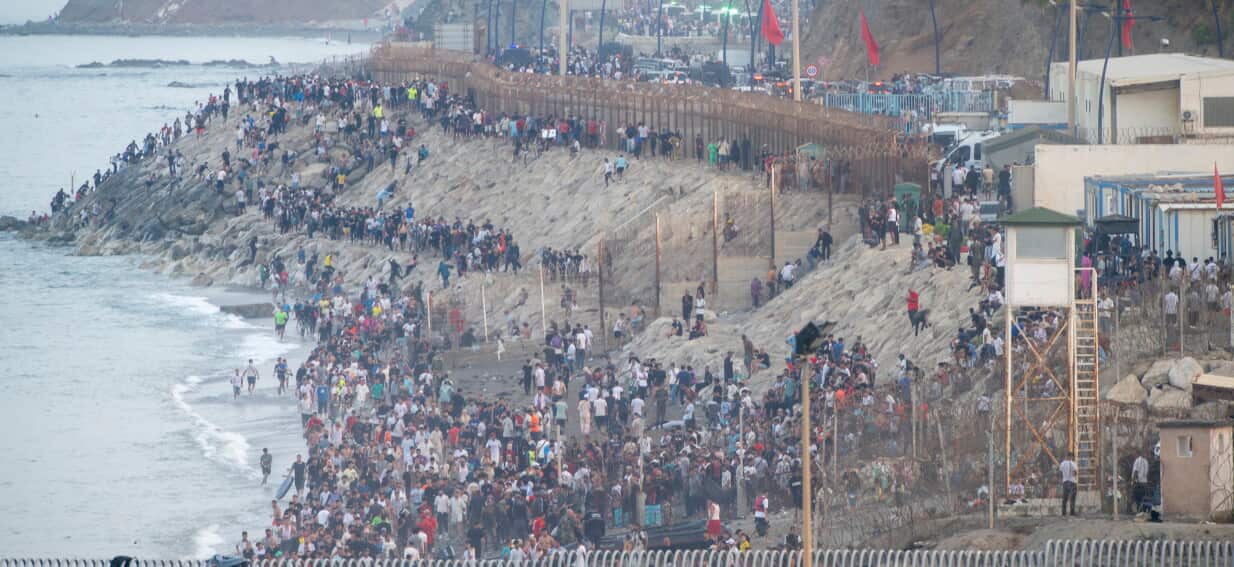
The concrete double fence guarding the Spanish enclave of Ceuta on the northern coast of Africa does not just mark a border. It marks the edge of an impossible arithmetic. On one side sits Europe, wealthy, fortified, and aging. On the other side sits a continent of young populations, economic stagnation, and the quiet pressure of desperation. When tragedy strikes at these perimeters, the headlines flash briefly across global screens before fading back into the white noise of international indifference.
At least 57 migrants died trying to force their way across this heavily militarized frontier, while thousands of others made the sudden, agonizing decision to voluntarily return to Morocco. Why would thousands walk away from the European dream after enduring months or years of hardship to reach the wire? The answer reveals the cold mechanics of modern border control, the limits of human endurance, and the quiet coercion built into international migration policy.
To understand what happened at Ceuta, you have to look past the official press releases issued in Madrid and Rabat. You have to look at the ground.
The Geography of a Chokepoint
Ceuta is an anomaly. Together with Melilla, it is the only land border shared between the European Union and the African continent. This geographic reality turns these tiny territories into magnets. For anyone trapped in sub-Saharan Africa or economically battered parts of North Africa, Ceuta looks like a locked door with a window left slightly open.
The perimeter itself is an engineering marvel of deterrence. It consists of parallel six-meter-high fences topped with razor wire, outfitted with noise and movement sensors, thermal cameras, and closed-circuit television networks. Between the barriers lies a road reserved for the Guardia Civil and Moroccan auxiliary forces. It is designed to be a physical psychological trap.
Yet, physical barriers have never stopped migration. They merely redirect it. When land routes become too heavily defended, people take to the sea on flimsy rubber dinghies. When the sea becomes too patrolled, they rush the fences in massive, coordinated groups known as sturms.
The fatal incident involving the 57 deaths was not an accident. It was the predictable outcome of a pressure cooker built by decades of deterrence-only policies. When thousands of people mass near a border, kinetic energy builds. When security forces respond with batons, tear gas, and rubber bullets, panic ensues. People are trampled. People drown in the breakwaters. People fall from heights while trying to scale sheer metal sheets designed to slice flesh.
The Mechanics of Voluntary Return
The most perplexing element of the crisis was the mass voluntary return. Thousands of people who had managed to slip past initial security checks, or who had survived the chaotic rush at the border posts, turned around and walked back into Morocco.
Mainstream coverage often framed this as a change of heart. That is a comforting fiction.
The reality on the ground was a masterclass in coordinated state pressure. Once the initial breach occurred, Spanish and Moroccan security forces locked down the enclave. Movement within Ceuta was choked off instantly. Food, water, and shelter were virtually non-existent for those sleeping rough in parks and construction sites. The message from the authorities was blunt and unmistakable: you can stay and face indefinite detention, legal limbo, and eventual deportation, or you can walk back across the border right now.
Furthermore, Morocco deployed its own security apparatus to signal consequences for those who chose to push forward. The choice presented to these migrants was not between freedom and captivity. It was between two forms of misery. Choosing to return to Morocco was an admission of temporary defeat, driven by the immediate threat of violence, hunger, and exhaustion.
This dynamic exposes a core flaw in how the European Union manages its southern borders. By outsourcing border enforcement to third countries like Morocco through financial aid and political agreements, Europe creates a buffer zone where human rights obligations become blurry. Morocco acts as the wall behind the wall. When migrants realize that even crossing into European territory does not guarantee safety or a hearing, the psychological cost of holding out becomes too high.
The Economic Engine of Deterrence
Behind every border fence is a multi-million-dollar industry. Security contractors, surveillance tech firms, and logistics providers reap massive profits from the perpetual state of emergency at the gates of Europe.
When politicians talk about securing the frontier, they are feeding a cycle. More money buys better cameras. Better cameras spot movements earlier. Earlier detection requires larger police deployments. Larger deployments lead to more desperate, high-risk crossing attempts. More high-risk attempts lead to fatalities. And fatalities prompt public outrage that leads to demands for even more security funding.
It is a closed loop. At no point in this cycle does the system address the push factors. No amount of razor wire will stop a person fleeing civil war, climate-induced agricultural collapse, or systemic joblessness. Treating a humanitarian reality as a law enforcement problem guarantees ongoing failure.
Consider the human cost of this industrial logic. The families of the 57 dead will likely never receive a full accounting of how their loved ones perished. Investigations into border deaths are notoriously opaque. Accountability is diffused between two sovereign nations, each eager to point the finger at the other. Spain blames the volatility of the crowd and the tactics of the migrants. Morocco blames the impenetrability of the European border and the rigidity of Spanish immigration quotas.
Meanwhile, the thousands who voluntarily returned are now scattered. Some will try again next week, next month, or next year. Others are broken, their savings exhausted, their bodies scarred by the razor wire and the batons.
The Myth of Control
Governments love the theater of control. A press conference standing in front of a newly reinforced fence projects strength. It signals to domestic electorates that the state is managing its sovereignty.
But sovereignty in the twenty-first century cannot be enforced purely with steel and concrete. As long as the wealth gap between Europe and Africa remains an abyss, and as long as global instability upends traditional livelihoods, people will move. They will walk across deserts, cram into wooden boats, and scale walls that defy gravity.
The tragedy at Ceuta is not an anomaly. It is a preview. It demonstrates the precise breaking point where human desperation collides with state inflexibility. Until policymakers shift away from deterrence and toward safe, legal pathways for mobility, the numbers will only grow. More people will mass. More fences will go up. And the body count will continue to rise in the shadows of fortress Europe, leaving behind a trail of unanswered questions and unheeded warnings.