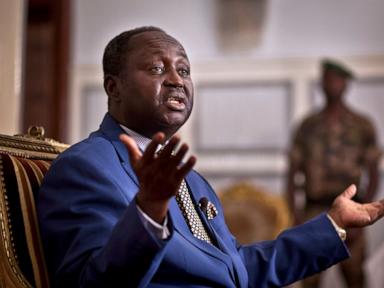
In the capital city of Bangui, a heavily fortified courtroom has just commenced the war crimes trial of former President François Bozizé. This development should register as a monumental triumph for international accountability, marking the first time a former head of state faces the country’s unique United Nations-backed hybrid tribunal, the Special Criminal Court. Yet, the bench facing the judges sits completely empty. Bozizé is currently living thousands of miles away in comfortable, state-sanctioned exile in Guinea-Bissau, completely insulated from the proceedings. What is transpiring in Bangui is not a breakthrough for global justice, but a stark illustration of its severe limitations in West and Central Africa.
By putting a ghost on trial, the court exposes a bitter reality. Regional political alliances and systemic underfunding have reduced a landmark human rights experiment into a symbolic theater.
The Special Criminal Court was established in 2015 and became operational in 2018 with a specific, ambitious blueprint. Unlike distant international tribunals in The Hague, this hybrid court pairs local Central African judges with international jurists right in the capital. The goal was to build trust by delivering justice directly to the population surviving decades of civil war. On paper, the charges against the 79-year-old former president are comprehensive. They detail a systemic campaign of murder, enforced disappearances, rape, and torture executed by his presidential guard between 2009 and 2013, primarily centered within the notorious Bossembélé military training camp.
But trying a former dictator in absentia yields a highly fractured version of accountability. While three of Bozizé's co-defendants—former senior military officers Eugène Ngaïkosset, Vianney Semndiro, and Firmin Junior Danboy—sit in pre-trial detention cells attending the sessions, the primary architect of the regime remains entirely out of reach. For the survivors of these atrocities, a conviction without an arrest yields no real closure. It offers zero physical deterrence to the armed groups still controlling vast swaths of the country’s gold- and diamond-rich hinterlands.
The Geopolitical Protection Shield
To comprehend why Bozizé remains free, one must look at the cynical calculations of regional diplomacy. The court issued an international arrest warrant for the former president, but international law possesses no independent enforcement mechanism. It relies entirely on the political will of sovereign states.
Bozizé’s journey into impunity reveals how West African governments prioritize elite solidarity over human rights treaties. After being ousted by the mainly Muslim Séléka rebel coalition in 2013, Bozizé did not flee to the wilderness. He moved through a network of regional capitals. When he attempted a violent return to power in late 2020 by leading a new rebel alliance called the Coalition of Patriots for Change, he nearly toppled the current government. That rebellion was ultimately repelled, not by UN peacekeepers, but by the rapid deployment of Russian mercenaries from the Wagner Group.
Following that failed coup, Bozizé secured safe passage first to Chad, and later to Guinea-Bissau. The government of Guinea-Bissau welcomed him under the guise of regional stabilization, viewing his presence as a managed retirement that keeps an unstable actor away from Bangui’s fragile borders. Despite repeated demands from human rights organizations to execute the warrant and extradite him, the Bissau-Guinean authorities have consistently looked the other way. For regional heads of state, enforcing an arrest warrant against a fellow former president sets an unwelcome precedent that many fear could one day apply to themselves.
A Tribunal Left to Starve
While diplomatic shield-play protects the accused, a more quiet crisis threatens to dismantle the tribunal from within. The court is facing a catastrophic financial shortfall. Despite its grand mandate, the institution runs almost entirely on voluntary donations from foreign entities like the European Union and individual Western governments.
Those donors are quietly pulling back. Human rights monitoring groups have confirmed that the court's staff has already been systematically reduced by 25 percent due to direct budgetary constraints. The court's current operational mandate formally runs until October 2028, but internal financial projections indicate it is at serious risk of complete structural closure much sooner.
This financial starvation highlights a glaring double standard in global justice funding. Billions of dollars flow into international legal mechanisms for high-profile European conflicts, while hybrid experiments in sub-Saharan Africa are left to haggle over basic administrative overhead. Investigating mass graves in remote, rebel-held provinces requires significant logistical support, including armored transport, forensic teams, and secure witness protection programs. When a court cannot afford to protect its witnesses or pay its investigators, its legal machinery grinds to a halt.
The Empty Chair Precedent
Supporters of the court argue that proceeding with the trial in Bozizé's absence is still a necessary step. They contend that a formal, public presentation of evidence establishes an unassailable historical record of the regime's atrocities, making it impossible for future revisionists to sanitize his presidency.
The practical legal reality is far more compromised. Trials held without the accused present inherently invite long-term procedural challenges regarding fair trial standards and due process. If Bozizé is convicted, his defense teams will permanently argue that the verdict is a politically motivated exercise conducted by a court running out of time and money. Furthermore, more than 30 other high-level suspects subject to the court's arrest warrants remain completely at large, scattered across neighboring nations or hiding within domestic rebel factions.
This reveals the ultimate limitation of the hybrid court model. It possesses the specialized expertise to build a meticulous legal case, but lacks the raw sovereign power to compel compliance from regional neighbors. Without external diplomatic pressure or severe financial consequences tied to non-cooperation, international warrants remain nothing more than symbolic declarations. The empty defense bench in Bangui does not represent a triumph over impunity. It stands as a monuments to a fractured global architecture that allows deposed leaders to purchase safety with political currency, leaving the actual survivors of state violence to watch a trial of a man who is simply not there.