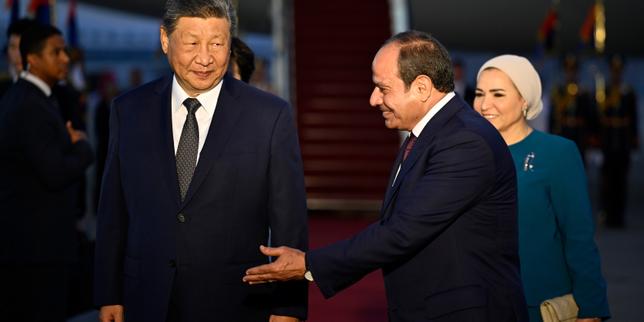
When Chinese President Xi Jinping touched down in Cairo for his first state visit to Egypt in a decade, the red carpet rolled out by President Abdel Fattah el-Sisi signaled far more than anniversary diplomacy. It marked a calculated structural shift in how regional capitals deal with Washington. For decades, Cairo served as a primary anchor of American hegemony in the Middle East, sustained by billions in annual military aid and decades of institutionalized defense sharing. Yet, standing alongside Beijing’s top official, the message projected outward was unequivocal: the monopoly Washington held over the security architecture of the Global South is fracturing under the weight of its own military entanglements.
To understand why this diplomatic pivot matters, one must look past the standard boilerplate of bilateral communiqués and examine the cold calculus of resource scarcity and strategic hedging. Washington’s prolonged military engagements, most visibly manifested in the punishing economic and physical fallout of regional wars involving Iran, have left traditional allies questioning the reliability of long-term American commitments.
The Economics of Strategic Diversification
Egypt’s embrace of Beijing is not an overnight conversion; it is a pragmatic insurance policy. Cairo faces mounting fiscal pressures, heavy foreign debt burdens, and the chronic challenge of maintaining foreign currency reserves. While the United States remains an indispensable security partner, American assistance comes with stringent legislative guardrails, human rights stipulations, and periodic policy whiplashes dictated by shifts in Capitol Hill.
China offers a different value proposition. Through the framework of the Belt and Road Initiative, Beijing has poured over ten billion dollars into Egyptian infrastructure projects, spanning industrial parks east of Cairo to electric rail systems in the Nile Delta. During Xi's visit, both administrations expanded these agreements into advanced sectors including data centers, semiconductor supply chains, and artificial intelligence.
Crucially, the two countries are actively working to bypass traditional Western-dominated financial clearing systems by expanding local currency settlements in bilateral trade. For an Egyptian economy striving to maintain strategic balance amidst global polarization, partnering with the world's second-largest economy provides a vital shock absorber against Western financial pressure.
Redesigning Regional Security Architecture
Beyond balance sheets, the core friction point of Xi's Cairo itinerary centered on regional security. Beijing is aggressively marketing itself as an alternative diplomatic mediator, contrasting its diplomatic footprint with decades of American military interventions. Xi laid out proposals calling for regional actors to become the exclusive masters of their own destiny, explicitly rejecting external military meddling.
This rhetoric strikes a resonant chord in capitals fatigued by decades of asymmetric warfare and economic sanctions. By positioning the Palestinian question at the center of regional stability and emphasizing multilateral frameworks through organizations like the Shanghai Cooperation Organisation and BRICS, Beijing is systematically constructing an alternative diplomatic ecosystem.
Consider the maritime security dynamics of the Red Sea and the Bab el-Mandeb Strait. Recent conflicts have violently disrupted commercial shipping lanes vital to both Egyptian revenue—via the Suez Canal—and Chinese export logistics. While the United States has historically shouldered the burden of maritime patrol through multinational naval coalitions, China is now stepping into cooperative security frameworks with regional heavyweights to safeguard these critical choke points. This shifts the perception of security provider from a solitary Western superpower to a distributed network of multipolar stakeholders.
The Limits of Beijing's Reach
A clear-eyed analysis requires acknowledging the severe limitations facing this emergent axis. China does not possess the regional force projection capabilities that the United States maintains, nor has Beijing shown any appetite to serve as a direct security guarantor for Middle Eastern states in an active theater of war. When real kinetic crises erupt, regional actors still dial Washington, not Beijing.
Furthermore, deeper structural alignments carry inherent risks for Cairo. Entangling critical national infrastructure with Chinese tech giants and supply chains introduces complex geopolitical vulnerabilities, particularly as Washington pressures global allies to decouple sensitive data networks from Chinese telecommunications firms. Egypt's balancing act is narrow, precarious, and fraught with friction.
Yet the underlying reality remains unchanged. The diplomatic choreography in Cairo demonstrates that the architecture of global power is no longer unipolar. Washington can no longer take compliance for granted, nor assume that traditional security partnerships will remain immune to economic gravity. As regional capitals assert independent foreign policies, the center of gravity in international relations continues its steady, irreversible migration toward a fragmented, multipolar horizon.