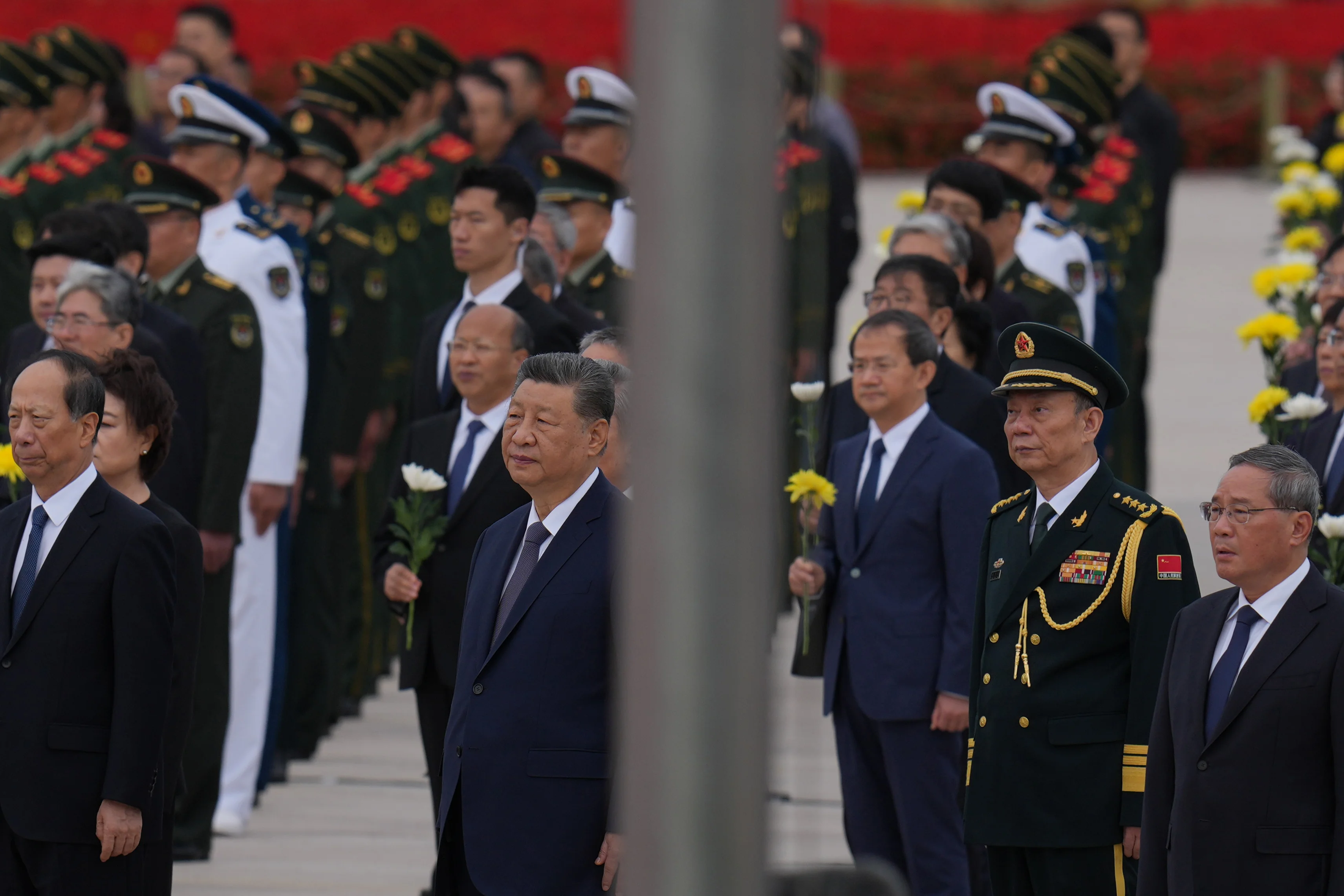
China’s decision to elevate a senior military general to the Politburo while simultaneously tightening internal Party discipline signals a calculated effort to merge operational combat readiness with ideological obedience. According to state media announcements and geopolitical analysts tracking Chinese Communist Party (CCP) personnel shifts, this dual move addresses an enduring friction inside Beijing's leadership: ensuring that a rapidly modernizing military remains completely subordinate to civilian Party authority. Rather than treating military promotion and anti-corruption purges as separate tracks, the leadership is using high-level appointments to enforce loyalty from the top down.
The mechanics of this shift matter far more than the ceremonial announcements. When a uniformed officer steps into the 24-member Politburo—the CCP’s premier decision-making body—it alters the institutional balance between civilian bureaucrats and the People's Liberation Army (PLA). Yet, this elevation does not grant the military independent political power. Instead, it binds the armed forces tighter to the Party center, making senior commanders directly accountable for both battlefield modernization and internal ideological purity.
The Structural Logic of Elevating a General
To understand why Beijing places a military commander inside its top political council, one has to look at how the CCP governs the gun. Mao Zedong’s famous dictum—that the Party commands the gun, and the gun must never be allowed to command the Party—remains the foundational operating principle of Chinese governance. However, executing that principle becomes vastly more complicated as a military transforms from a massive, low-tech infantry force into a sophisticated, multi-domain fighting machine.
Modern warfare requires specialized technical expertise. Civilian politicians rarely possess the operational background to evaluate hypersonic missile procurement, cyber warfare doctrine, or joint theater command structures. By elevating a seasoned general to the Politburo, the leadership brings direct operational experience into the room where grand strategy is debated.
This integration serves a dual purpose. First, it prevents strategic miscalculation by ensuring military capabilities are accurately represented during foreign policy and economic discussions. Second, it co-opts the military's top brass into the broader political apparatus. A general sitting on the Politburo is no longer just an advocate for defense budgets; he becomes a stakeholder in overall regime stability, macroeconomic health, and domestic governance.
Balancing Expertise Against Autonomy
There is an inherent risk in bringing uniformed officers into high politics. Historical precedent across authoritarian systems shows that when military leaders gain political influence, they often develop institutional interests that diverge from the ruling party. Beijing mitigates this risk through a rigorous system of dual command and ideological oversight.
Even at the highest levels of the Central Military Commission (CMC) and the Politburo, a military officer's authority is checked by political commissars and discipline inspection teams. The general elevated to the Politburo does not operate as an independent warlord. His promotion is contingent upon proven ideological reliability and personal loyalty to the Party leadership. In practice, the seat at the table is a reward for political conformity just as much as it is a recognition of military competence.
Why Party Discipline Intensifies Alongside Military Promotions
Observers outside China often view anti-corruption campaigns and discipline drives as mere factional purges—a way for leaders to eliminate political rivals. While factional politics certainly play a role in any closed political system, dismissing the discipline drive purely as a power grab misses the deeper institutional anxiety driving Beijing.
Corruption inside the PLA is not just a political embarrassment; it is a direct threat to combat effectiveness. Over the past decade, investigations into China's military-industrial complex, particularly within the Rocket Force and equipment procurement departments, exposed systemic graft. Kickbacks in weapons development, inflated defense contracts, and the buying and selling of officer ranks hollowed out readiness. You cannot fight a modern war with missiles fueled by substandard components or led by officers who purchased their commissions.
Therefore, strengthening Party discipline is an operational necessity. The leadership recognizes that decades of rapid defense spending created massive opportunities for self-enrichment among senior officers and defense contractors. By coupling a high-profile military promotion with an intensified discipline campaign, Beijing sends an unmistakable message to the officer corps: career advancement is still possible, and the military remains central to national rejuvenation, but any deviation from Party rules or financial integrity will result in immediate ruin.
The Mechanics of Ideological Enforcement
How does the CCP enforce this discipline across an organization of two million active-duty personnel? It relies on an interlocking web of surveillance, self-criticism sessions, and institutional audits that penetrate down to the company level.
- Discipline Inspection Commissions: Embedded within every military unit, these bodies report vertically to the Central Commission for Discipline Inspection (CCDI) and the CMC Discipline Inspection Commission, bypassing local commanders.
- Political Work Conferences: Regular, mandatory ideological summits force senior officers to publicly reaffirm their allegiance to the Party center and confess institutional shortcomings.
- Auditing and Procurement Overhauls: Civilian and military auditors now scrutinize defense contracts retrospectively, holding retired officers accountable for procurement decisions made years earlier.
- Rotation of Command: Senior officers are frequently rotated across different theater commands and service branches to prevent them from building personal fiefdoms or entrenched patronage networks.
This apparatus creates an environment of perpetual vigilance. Officers know that their communications, financial records, and personal associations are continuously monitored. The elevation of a trusted general to the Politburo reinforces this system by placing a proven enforcer at the apex of power, signaling that the military itself is policing its own ranks on behalf of the Party.
The Geopolitical Signal to Washington and the Region
Personnel changes inside the Politburo are scrutinized intensely by intelligence agencies in Washington, Tokyo, Taipei, and New Delhi. When Beijing elevates a military figure while emphasizing strict discipline, foreign analysts read it through the lens of regional security and crisis management.
From the perspective of Western defense planners, a Politburo with strong military representation suggests a Beijing leadership that is increasingly focused on deterrence and military preparedness. If the elevated general brings background experience in joint operations, aerospace, or maritime strategy, it underscores the specific theaters where China anticipates potential friction—namely the Taiwan Strait, the South China Sea, and the Western Pacific.
At the same time, the emphasis on Party discipline complicates how foreign militaries assess Chinese intent. In crisis scenarios, Western policymakers often worry about rogue actions by field commanders—an aggressive intercept by a fighter pilot or a naval collision escalating into a broader conflict. Beijing’s relentless focus on top-down discipline is meant to reassure the Party leadership that the PLA will not act independently or trigger an unintended war. However, that same rigid hierarchy can make the Chinese military slower to react in fast-moving crises, as mid-level officers hesitate to make tactical decisions without explicit clearance from political authorities in Beijing.
Historical Precedents and the Evolution of Civil-Military Relations
The relationship between the CCP and the PLA has never been static. It has swung dramatically across different eras, reflecting the shifting priorities of China’s paramount leaders.
During the Mao era, the military was deeply entangled in domestic politics, stepping in to restore order during the chaos of the Cultural Revolution. Under Deng Xiaoping, the military was ordered to step back from politics, slash its troop numbers, and subordinate defense spending to economic development. During the 1990s and early 2000s, the PLA operated with considerable institutional autonomy, managing vast commercial enterprises and handling its own internal affairs with minimal civilian interference.
The current era represents a sharp correction to that autonomy. Over the last ten years, Beijing has systematically dismantled the PLA's commercial holdings, broken up the old regional military regions into five joint theater commands, and reasserted direct, centralized control over military personnel and budgets.
The elevation of a general to the Politburo today looks entirely different from military representation in the 1970s. Back then, generals held independent power bases built during revolutionary warfare. Today, the generals entering the Politburo are professionalized, technocratic managers whose authority derives entirely from the Party institution that promoted them. They are products of the system, not founders of it.
The Gray Areas and Institutional Friction
While Beijing projects an image of seamless unity between the Party and the armed forces, significant tensions persist beneath the surface. Acknowledging these gray areas is essential to understanding the limits of China’s governance model.
First, there is an inherent contradiction between demanding absolute ideological conformity and fostering tactical innovation. Modern warfare rewards decentralized initiative—the ability of junior officers and non-commissioned officers to adapt rapidly when communications are jammed and plans fall apart. Yet, an intense focus on Party discipline and political loyalty naturally breeds risk aversion. When the penalty for a mistake is political disgrace or a corruption investigation, officers prioritize following procedures and protecting their careers over taking bold, innovative action on the training ground.
Second, the relentless pace of anti-corruption purges can temporarily disrupt operational readiness. Removing senior commanders, procurement chiefs, and aerospace executives creates leadership vacuums. Replacements must be vetted not only for their technical skill but for their political cleanliness, a process that slows down decision-making and weapons acquisition timelines.
Finally, elevating a military figure to the Politburo does not guarantee smooth coordination between the PLA and China’s diplomatic corps. Historically, the Ministry of Foreign Affairs and the military have occasionally operated on different wavelengths, with diplomatic messaging lagging behind military exercises or maritime deployments. While a Politburo seat facilitates high-level communication, institutional silos within the Chinese bureaucracy remain notoriously difficult to break down.
What This Means for Governance and Strategy
The dual track of military elevation and Party discipline reveals a leadership preparing for a prolonged period of strategic competition. Beijing views its external security environment as increasingly hostile and its internal governance challenges as deeply interconnected.
By placing a senior general in the Politburo, the CCP ensures that military realities inform national policy at the highest level. By simultaneously tightening the screws of Party discipline, it attempts to guarantee that the massive resources poured into defense modernization actually translate into reliable combat power rather than vanishing into bureaucratic graft.
For analysts, diplomats, and business leaders watching China, the takeaway is straightforward: do not separate China’s military posture from its domestic political campaigns. The purges, the promotions, and the ideological mandates are all components of the same machinery. Beijing is actively reshaping its command structure to ensure that if the military is ever called upon to act, it will execute the Party's orders with absolute precision and zero hesitation.


