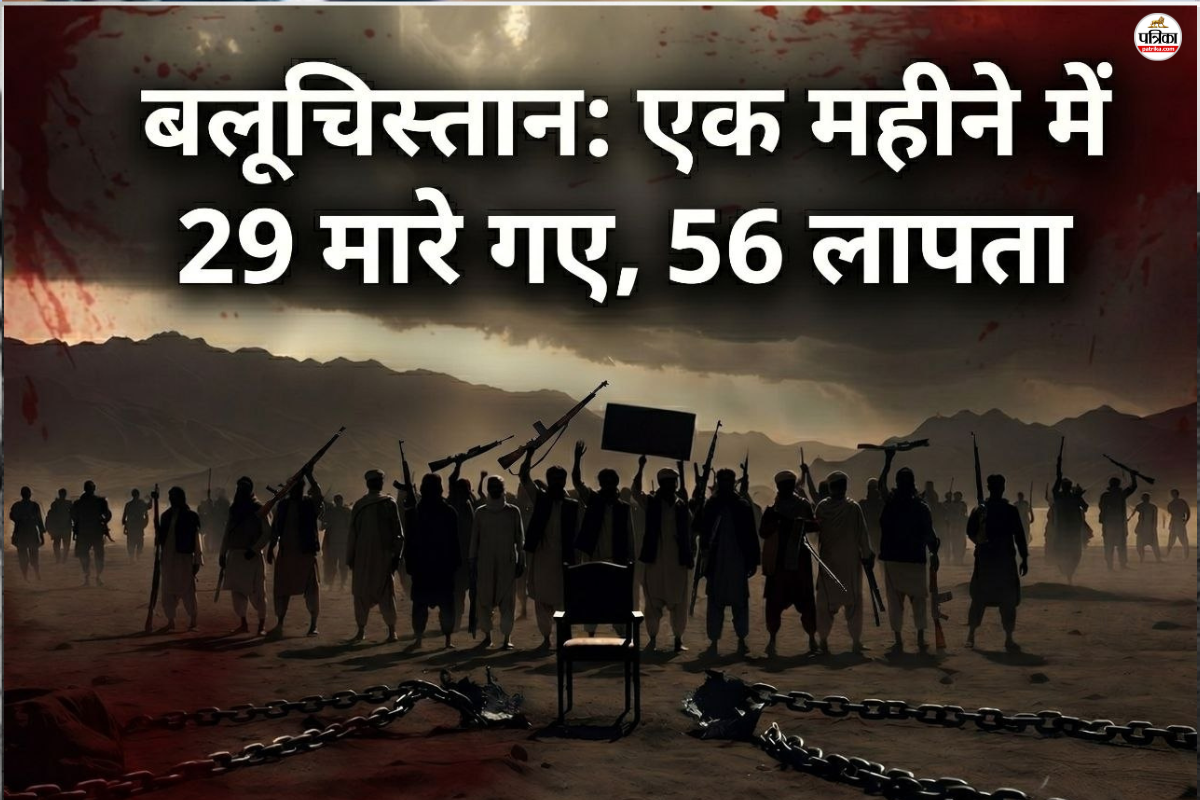
The escalating humanitarian crisis in Balochistan is defined by a brutal surge in enforced disappearances and extrajudicial killings that conventional news outlets consistently overlook. Recent documentation from the Human Rights Council of Balochistan reveals a devastating pattern. In a single month, local monitoring groups verified dozens of targeted killings and scores of unexplained disappearances across the region. This is not a localized law-and-order issue. It is a systematic campaign executed outside the bounds of judicial oversight, designed to suppress political dissent and secure absolute control over a resource-rich landscape.
The mainstream narrative often reduces this friction to a simple conflict between state security forces and fringe militant factions. That explanation is dangerously incomplete. The reality on the ground indicates that the primary targets of these operations are civilian intellectuals, students, political organizers, and human rights defenders. Security agencies operate with systemic impunity, utilizing counter-terrorism legislation to justify the extrajudicial detention of citizens without warrants or formal charges. You might also find this related article insightful: Why Everything You Know About Maritime Activism Is Wrong.
The Mechanics of Disappearance
The execution of these state-sponsored abductions follows a precise, recurring methodology. Security forces, frequently identified by witnesses as personnel from the Frontier Corps or the Counter-Terrorism Department, conduct late-night raids on civilian residences. Doorways are breached, communications are severed, and individuals are removed to undisclosed detention facilities.
Financial exploitation has now deeply integrated into this system of repression. Reports from advocacy groups like Baloch Voice for Justice indicate that state actors routinely demand exorbitant sums of money from the families of those detained. These transactions do not guarantee a legal trial or proper legal representation. Instead, they operate as a predatory racket where families exhaust their life savings merely to confirm whether a relative is still alive. As extensively documented in recent coverage by Associated Press, the implications are widespread.
The judiciary offers virtually no protection. Despite constitutional guarantees outlining explicit arrest and detention protocols, domestic courts consistently fail to hold security agencies accountable. Subpoenas are ignored, and official inquiries are stonewalled by defense ministries citing national security imperatives. This systemic failure forces families into a perpetual state of legal and emotional limbo, protesting in the streets with photographs of missing relatives while the state apparatus maintains absolute denial.
Strategic Resources and Collective Punishment
To comprehend the intensity of this crackdown, one must analyze the economic geography of Balochistan. The province holds vast mineral wealth, including massive copper and gold reserves like the Reko Diq mining project, alongside critical infrastructure nodes tied to international trade corridors. The state views local opposition to these major development projects not as civic dissent, but as economic sabotage.
State Security Imperative -> Suppression of Resource Dissent -> Mass Enforced Disappearances
Consequently, security operations have evolved into a strategy of collective punishment. When a community expresses opposition to resource extraction or infrastructure development, the response from security forces is often a sweeping sweep of local youths. This tactical shift is explicitly designed to dismantle the social fabric of Balochistan, ensuring that the local population remains too destabilized to organize cohesive political opposition.
- Targeted Operations: Elite units focus on regional universities, arresting politically active students to prevent the emergence of a cohesive intellectual leadership.
- Geographic Isolation: Security checkpoints restrict movement between districts, allowing local commanders to isolate communities before executing mass arrests.
- Information Blackouts: Regular internet disruptions and the intimidation of local journalists prevent real-time reporting of human rights abuses to the international community.
The Evolution of Resistance
The nature of Baloch resistance has fundamentally shifted in response to this unchecked violence. The traditional, male-dominated political structures have been severely fractured by decades of targeted assassinations and disappearances. In their place, a powerful, female-led civil rights movement has emerged.
Organized groups such as the Baloch Yakjehti Committee, spearheaded by prominent young activists, have transformed the nature of political dissent in Pakistan. These movements utilize peaceful long marches, sit-ins, and digital advocacy to bypass the heavily censored national media. By reframing the conflict from an armed insurgency to a fundamental battle for human rights and physical survival, these organizations have successfully mobilized thousands of women and children across the province.
The state has responded to this non-violent shift by expanding its apparatus of intimidation. Female activists now face arbitrary detention, smear campaigns labeling them as foreign agents, and direct physical violence during peaceful demonstrations. By criminalizing peaceful civic assembly, the state closes off all avenues for legal grievance, creating a highly volatile environment where systemic escalation becomes inevitable.
The International Policy Vacuum
The global community remains largely silent on the atrocities unfolding within Balochistan. Geopolitical dependencies and complex diplomatic alliances frequently cause international bodies to prioritize stability over the enforcement of human rights standards. Major Western democracies regularly issue statements championing global human rights, yet they maintain robust security and trade partnerships with the administration in Islamabad.
This silence carries profound operational consequences. It signals to the Pakistani military apparatus that the domestic cost of conducting extrajudicial campaigns remains negligible. International development finance continues to flow into projects situated in conflict zones, effectively subsidizing the infrastructure used to sustain the military occupation of the province. Without explicit, conditional diplomatic pressure tying financial assistance to verifiable human rights benchmarks, the cycle of disappearances will continue unabated.
The situation demands an immediate overhaul of how international human rights organizations monitor the region. Relying entirely on state-sanctioned data or restricted domestic media guarantees an incomplete assessment. Independent, international fact-finding missions must be granted unhindered access to Gwadar, Quetta, and the interior districts to document the scale of the crisis accurately.
The ongoing campaign in Balochistan is a deliberate policy of demographic and political containment. The state is systematically dismantling an entire generation of Baloch leadership through extrajudicial execution and forced isolation. Until the international community acknowledges that economic development cannot be built upon a foundation of mass graves and disappeared citizens, the province will remain a highly militarized zone of terror.