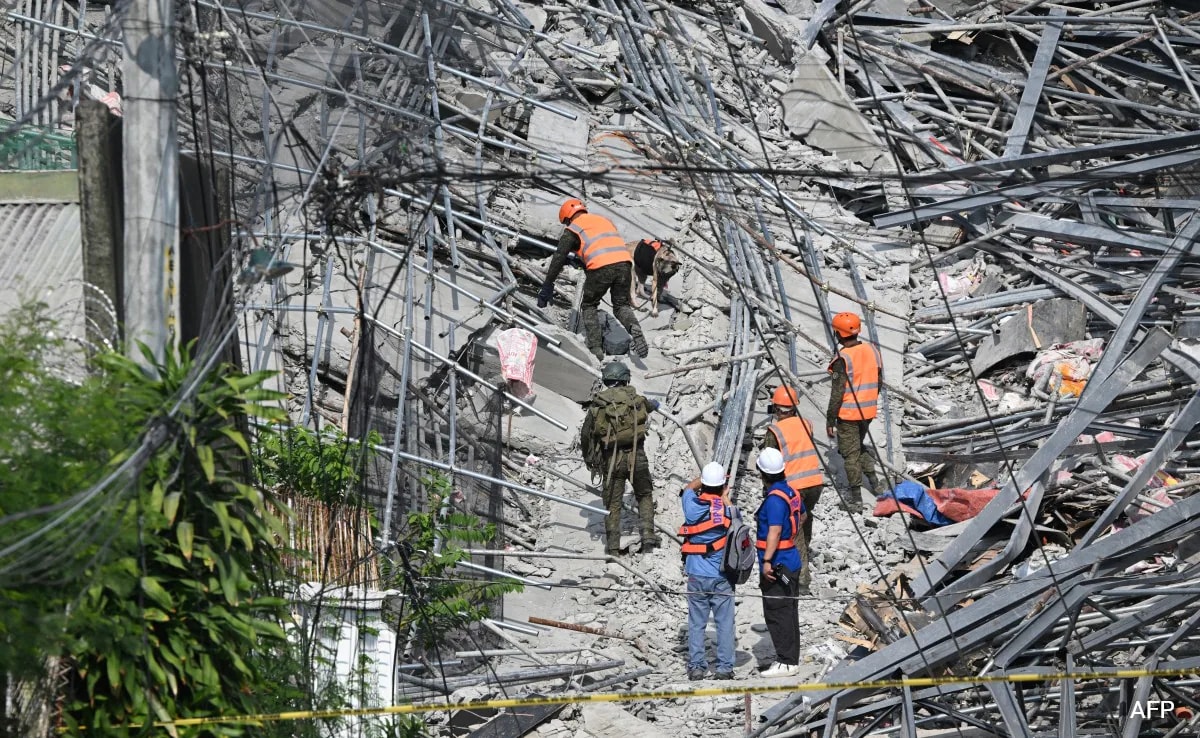
The catastrophic collapse of an unfinished nine-story condo-hotel in Angeles City, Philippines, has left four people dead and 17 others missing under a mountain of pulverised concrete and sheared steel bars. The structural failure occurred in the pre-dawn hours following a severe local thunderstorm. While initial media reports framed the tragedy as an unavoidable consequence of extreme weather, the systemic reality is far more troubling. Thunderstorms do not level code-compliant, reinforced concrete buildings. The disaster points directly to a deeper crisis within regional boomtown construction practices, where rapid commercial expansion frequently outpaces structural oversight.
Rescue teams have been working around the clock to tunnel through precarious layers of aluminum scaffolding and massive floor plates. The four confirmed fatalities include an unidentified victim recently pulled from the debris, two construction laborers who succumbed despite emergency medical interventions inside the rubble, and a Malaysian tourist staying in an adjacent budget inn that was crushed by the falling building.
For decades, the standard playbook for infrastructure failures in rapidly developing economic zones has followed a predictable script: blame the elements, promise a sweeping investigation, and allow public attention to drift. This time, the sheer scale of the structural failure makes that narrative impossible to accept.
The Illusion of the Weather Excuse
Weather is the easiest scapegoat in construction failures. In the hours following the collapse, local accounts frequently cited the fierce wind and heavy downpours of the night before. This explanation collapses under basic engineering scrutiny.
A nine-story building is designed to handle immense dead loads—the weight of its own concrete and steel—and significant live loads. Wind loads from a standard localized thunderstorm represent a fraction of the structural capacity that a building of this height must possess by law. When an entire multi-story frame pancaked into a single, compact heap of debris, it indicates a fundamental failure of structural integrity, not an act of God.
Several critical engineering vulnerabilities usually explain why an unfinished concrete building fails so totally during construction.
Concrete Curing and Strength Deficits
Pouring a nine-story building requires a strict, metered schedule. Concrete must reach its specified compressive strength before the temporary falsework and shoring can be safely removed or loaded with the weight of subsequent floors. In high-speed commercial developments, developers face intense financial pressure to strip formwork early. If the concrete in the lower columns had not properly cured, a sudden increase in load or a minor lateral force from wind could trigger a progressive collapse, causing upper floors to fall sequentially onto the lower ones.
The Subcontracting Cascade
The structural integrity of a building relies heavily on the quality of its materials. In regional construction hubs, procurement often involves a chain of sub-contractors and brokers. Testing concrete cylinder samples or validating the grade of reinforcing steel rebar requires rigorous field testing. When oversight is weak, substandard cement mixtures or lower-grade structural steel can slip into the supply chain unnoticed.
Inadequate Temporary Shoring
An unfinished building is at its most vulnerable state. Without architectural shear walls, exterior cladding, and fully tied structural diaphragms, the building relies entirely on temporary aluminum and timber scaffolding to distribute weight. A failure in the shoring network on a single critical floor can cause a localized structural failure that rapidly escalates into a total building collapse.
The Hidden Human Cost of the Construction Boom
The tragedy in Angeles City highlights a deeply entrenched labor issue within the domestic construction industry. Of the victims trapped and killed, the vast majority were laborers who lived inside the uncompleted structure.
====================================================================
               ANGELES CITY HOTEL COLLAPSE PROFILE
====================================================================
Current Death Toll       : 4 (including 1 Malaysian national)
Missing Status           : 17 workers unaccounted for
Surviving Workers        : 26 escaped or rescued alive
Structure Profile        : 9-story condo-hotel under construction
Location Context         : Bordering the Clark Freeport Zone
====================================================================
It is common practice for provincial workers to sleep on pieces of plywood laid over raw concrete ground floors to save on accommodation costs. This arrangement blurs the line between a hazardous industrial work site and a residential zone, significantly multiplying the human cost when a structural failure occurs.
The location of the disaster is highly significant. Angeles City sits right outside the Clark Freeport Zone, a bustling industrial and tourism enclave built on the footprint of a former U.S. Air Force base. The economic transformation of this area has sparked an unprecedented real estate and hospitality boom.
Dozens of budget hotels, cafes, spas, and high-density residential buildings have risen rapidly to cater to an influx of international tourists and commercial enterprises. This rapid growth has created an environment where the speed of construction often outpaces the capacity of municipal engineering offices to conduct independent, rigorous on-site safety audits.
The Slow Rescue Reality
Local authorities, led by Angeles City Mayor Carmelo Lazatin, have maintained that operations will remain focused on rescue rather than body retrieval. The reality on the ground, however, is a grinding, dangerous process.
       [ Upper Concrete Slabs ] -> Unstable, hanging precariously
                 ↓
    [ Tangle of Aluminum Scaffolding ] -> Risk of secondary collapse
                 ↓
       [ Core Debris Field ] -> 17 workers trapped beneath
Rescuers cannot simply bring in heavy excavators and wrecking balls to clear the site. The massive concrete slabs are held up precariously by a tangled matrix of buckled scaffolding and bent rebar. One wrong move with heavy machinery could shift the weight of the debris field, crushing air pockets where survivors might still be breathing, or causing a secondary collapse that threatens the lives of the rescue personnel.
As a result, hundreds of firefighters, police officers, and specialized engineers are forced to use manual cutting tools, hydraulic jacks, and thermal scanners. This painstaking pace increases the anxiety of families waiting in temporary shelters near the rubble, who watch the hours slip away in the intense tropical heat.
Beyond the Official Investigation
National police chief Gen. Jose Melencio Nartatez Jr. announced a comprehensive investigation into potential violations of safety and building regulations. While an official inquiry is necessary, true systemic accountability requires looking beyond the immediate blueprint of this single building.
The investigation must address whether the municipal building permits matched the actual field execution, how frequently independent structural inspectors visited the site, and whether material supply logs show compliance with national structural codes. If the inquiry stops at blaming a rogue contractor or an unpredictable storm, the underlying vulnerabilities within the regional construction boom will remain unaddressed.
The Angeles City collapse serves as a stark warning for rapidly growing economic corridors across developing urban centers. When commercial growth outpaces structural enforcement, the cost is ultimately paid in human lives.