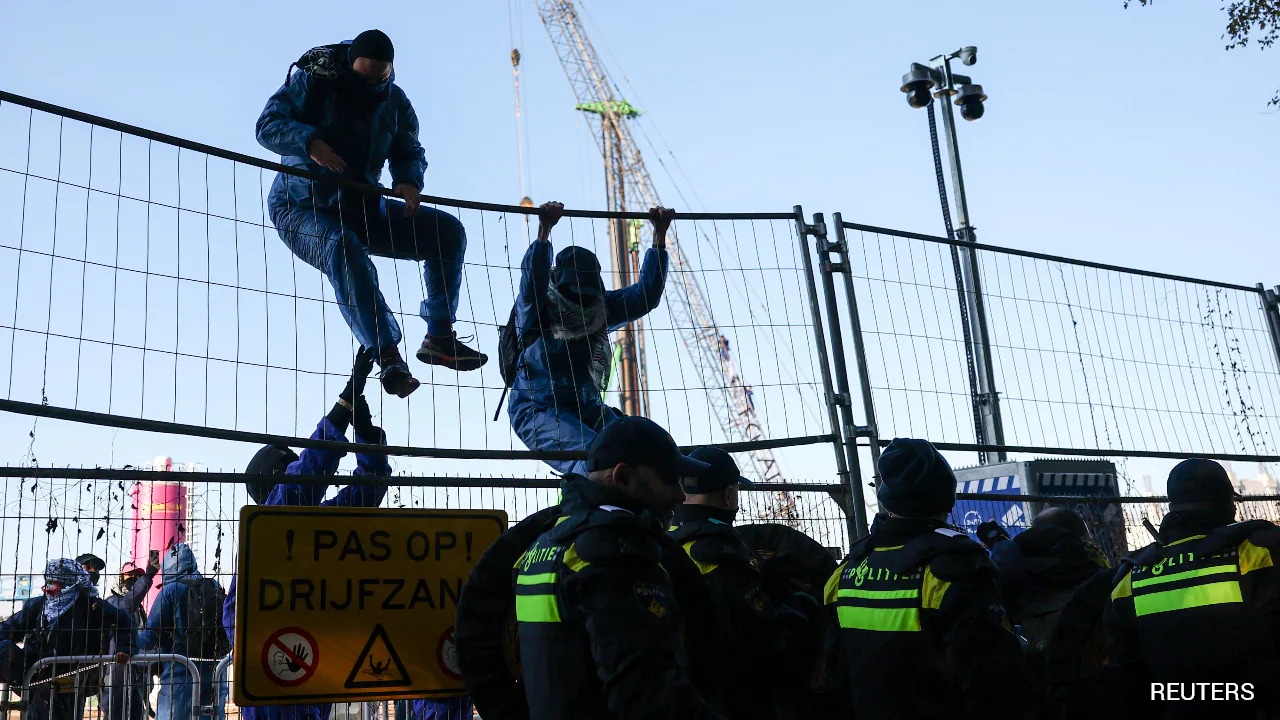
Hyperscale data center expansion in Western Europe has entered a phase of structural constraint where physical resource limits collide directly with municipal permitting frameworks. When climate activists occupied the construction site of Microsoft’s planned data center in the Wieringermeer polder north of Amsterdam—specifically within the municipality of Hollands Kroon—standard media coverage framed the event as a localized environmental protest. That framing misses the operational reality. The physical occupation of the site represents the visible tip of a deeper systemic failure: the inability of traditional industrial zoning and regional utility grids to absorb the concentrated power, water, and land demands of cloud computing infrastructure.
To understand why a tech giant’s routine capital expenditure project escalated into direct physical confrontation and eventually triggered a national moratorium on hyperscale construction in the Netherlands, operators must analyze the event through four distinct structural lenses: grid capacity mechanics, thermodynamic cooling trade-offs, municipal versus national governance friction, and the asymmetric economics of local land use. For a closer look into this area, we recommend: this related article.
The Four Pillars of Hyperscale Resistance
Standard reporting treats protests against digital infrastructure as ideological opposition to corporate growth. In practice, sustained local and activist resistance only gains traction when it aligns with tangible, measurable strain on shared public utilities. In the Amsterdam metropolitan region and surrounding North Holland province, four interconnected variables created the conditions for operational paralysis.
1. Electrical Grid Congestion and Queue Displacement
A hyperscale data center does not consume power like a standard manufacturing plant; it operates as a continuous, non-negotiable baseload draw with minimal tolerance for voltage fluctuation. In the Netherlands, the national transmission system operator (TenneT) and regional distribution operators (such as Liander) already manage one of the most congested electrical grids in Europe, driven by rapid solar and wind adoption alongside industrial electrification. To get more background on this issue, extensive coverage can be read on The Verge.
When a single hyperscale campus requests connections ranging from 100 to 300 megawatts—roughly equivalent to the residential electricity demand of a mid-sized city—it alters the regional load profile. In North Holland, this concentrated demand coincided with severe connection bottlenecks for residential housing developments, agricultural greenhouses, and small-to-medium enterprises. Activists successfully weaponized this zero-sum queue dynamic. Rather than arguing abstractly about carbon emissions, opposition groups pointed to the direct displacement of local grid capacity, turning an engineering allocation problem into a visceral political grievance.
2. Thermodynamic Cooling and Potable Water Scarcity
Data centers convert nearly 100 percent of their electrical input into heat. Removing that thermal load requires either high electricity consumption via mechanical chillers or substantial water evaporation via adiabatic cooling towers.
In the Wieringermeer polder, public scrutiny intensified around the discrepancy between projected water consumption during peak summer temperatures and the actual figures disclosed during early permitting stages. While hyperscale operators frequently cite low annual average Water Usage Effectiveness (WUE) metrics, regional water boards manage infrastructure based on peak-day stress, not annual averages. During dry summer months in the Netherlands, fresh water reserves in the IJsselmeer lake system face simultaneous demand from agricultural irrigation, salinity intrusion prevention, and municipal drinking water supplies. When peak cooling demand aligns with seasonal drought conditions, the cooling loop becomes a direct competitor for a stressed public resource.
3. Land Use Asymmetry and Spatial Planning Mismatches
The Wieringermeer polder consists of reclaimed agricultural land characterized by large, flat parcels, low population density, and proximity to transatlantic subsea fiber landing stations along the Dutch coast. From a network topology standpoint, the location offers optimal latency to the Amsterdam Internet Exchange (AMS-IX) while avoiding the prohibitive real estate costs of the Amsterdam urban core.
However, placing massive windowless industrial structures across open agrarian landscapes creates severe visual and spatial disruption. More critically, the economic return per square meter for the local community exhibits extreme asymmetry:
- Construction Phase: Generates high short-term demand for specialized civil and electrical contractors, often imported from outside the immediate municipality.
- Operational Phase: Requires a remarkably small permanent headcount relative to the physical footprint and capital invested. A facility costing hundreds of millions of euros may employ fewer than 50 to 100 full-time technicians once commissioned.
- Tax and Revenue Capture: Under Dutch municipal finance structures, local councils capture limited direct tax upside from massive capital assets compared to the infrastructure burden placed on local roads and utilities.
4. Governance Fragmentation Between Local and National Levels
The Amsterdam-area protests exposed a critical regulatory vulnerability: the gap between local zoning authority and national strategic infrastructure planning. Under the Dutch spatial planning framework at the time, individual municipalities like Hollands Kroon held the legal authority to rezone agricultural land and issue building permits for massive industrial facilities, despite lacking the technical engineering staff to model regional grid impacts or cross-border environmental externalities.
Microsoft executed a textbook local permitting strategy, securing approvals from a rural municipality eager for economic development. Yet because the facility’s resource footprint spanned the entire province of North Holland, bypassing national-level scrutiny created a legitimacy deficit. Protesters exploited this regulatory seam, targeting the physical site to force intervention from the Dutch national parliament in The Hague—a tactic that ultimately succeeded when the national government imposed temporary restrictions on new hyperscale developments.
The Causal Chain of Project Derailment
Competitor analyses typically describe the Amsterdam protests as an isolated incident of civil disobedience. Viewed through an operational risk framework, the site occupation was actually the fourth stage in a predictable causal sequence that infrastructure developers repeatedly fail to interrupt.
[Stage 1: Local Permitting Arbitrage]
      │ (Securing zoning in small municipalities with low regulatory friction)
      ▼
[Stage 2: Information Asymmetry & Resource Opacity]
      │ (Under-communicating peak water/power loads in public filings)
      ▼
[Stage 3: Coalition Convergence]
      │ (Climate activists align with local farmers, residents, and grid-constrained businesses)
      ▼
[Stage 4: Direct Physical Intervention & Political Escalation]
      │ (Site occupations halt construction and force national legislative moratoria)
Stage 1: Local Permitting Arbitrage
Hyperscale site selection teams optimize for speed to market. Entering dense urban cores like Amsterdam proper involves multi-year environmental reviews, strict noise ordinances, and immediate grid moratoria. Consequently, developers shift 40 to 60 kilometers outward into peripheral agricultural municipalities. These local governments possess the statutory power to approve land-use changes quickly but lack the macro-grid visibility of national ministries.
Stage 2: Information Asymmetry and Resource Opacity
To protect competitive intelligence regarding server density and proprietary cooling architectures, operators routinely redact technical specifications in public environmental filings or present best-case efficiency metrics. In North Holland, investigative journalists and local opposition groups uncovered internal documents and water permit requests showing significantly higher maximum water draw than initially understood by local council members. Once a discrepancy emerges between public relations messaging and technical permit applications, institutional trust collapses permanently.
Stage 3: Coalition Convergence
Isolated activist groups rarely stop billion-dollar infrastructure projects on their own. The turning point in the Netherlands occurred when climate protesters occupying the site tapped into existing frustration among Dutch farmers and local residents. Farmers in the region were simultaneously facing strict government mandates to reduce nitrogen emissions, while local housing projects stalled due to grid congestion. Seeing a multinational corporation receive fast-track approval for massive land and utility consumption created a powerful cross-demographic coalition.
Stage 4: Direct Physical Intervention and Political Escalation
Once activists physically breached and occupied the construction site, the issue transitioned from a municipal planning dispute into a national security and public order story. For national politicians, defending a foreign tech giant’s right to consume scarce domestic electricity and water while local constituents faced connection delays became politically untenable. The resulting national freeze on hyperscale permits demonstrated that winning local zoning battles is meaningless if the project loses its broader social license to operate.
Operational Realities vs. Corporate Sustainability Claims
A core driver of the confrontation in North Holland was the friction between corporate carbon accounting and physical local infrastructure constraints. Hyperscale operators rely heavily on Power Purchase Agreements (PPAs)—long-term contracts to buy renewable energy from wind or solar farms—to claim 100 percent renewable operations.
From a financial and accounting perspective, PPAs incentivize new renewable generation on the broader European grid. From a local electrical engineering perspective, however, a PPA does not solve transmission bottlenecks. If a wind farm in the North Sea generates power during a storm, the physical electrons do not automatically reach a data center in Wieringermeer if the regional transformer substations are saturated. Conversely, during winter periods of low wind and low solar output (Dunkelflaute), the data center still draws 100 percent of its baseload power from the grid, forcing dispatchable natural gas plants to ramp up to maintain grid frequency.
Activists targeting the Amsterdam site specifically dismantled the corporate sustainability narrative by highlighting this distinction between annual financial offsets and real-time physical grid load. When infrastructure teams rely on global ESG (Environmental, Social, and Governance) messaging to answer hyper-local engineering objections, they accelerate community opposition rather than neutralizing it.
Limitations of Current Mitigation Strategies
Infrastructure operators attempting to prevent repeat scenarios in tier-one European markets (such as Frankfurt, London, Amsterdam, Paris, and Dublin—collectively known as the FLAP-D markets) frequently deploy standard community engagement playbooks. These approaches suffer from severe structural limitations:
- District Heating Offtake Promises: Operators frequently propose piping waste heat from servers into nearby residential networks or agricultural greenhouses. While thermodynamically sound in theory, low-grade waste heat (typically 25°C to 35°C) requires expensive heat pumps to raise temperatures to usable levels, alongside massive capital expenditure for insulated underground piping. Furthermore, data center heat output is constant year-round, whereas residential heating demand drops to near zero in summer, creating a severe seasonal mismatch.
- Closed-Loop Air Cooling Conversions: Switching from evaporative water cooling to closed-loop air chillers eliminates local water consumption concerns, directly addressing one of the primary flashpoints in the Wieringermeer protests. However, this creates an immediate engineering trade-off: mechanical chillers increase parasitic electrical load, raising the facility's Power Usage Effectiveness (PUE) ratio and exacerbating electrical grid congestion.
- Community Benefit Funds: Offering direct financial grants to local sports clubs, schools, or municipal funds often backfires in high-income Western European jurisdictions. When communities perceive their core utilities—water security, grid access, and spatial landscape—as being compromised, small financial payouts are routinely framed by opposition groups as attempted bribery rather than equitable value sharing.
Strategic Framework for Hyperscale Site Deployment
To build resilient infrastructure in capacity-constrained jurisdictions without triggering physical blockades or legislative freezes, capital allocation and site selection teams must abandon permitting arbitrage and adopt a grid-integrated deployment model.
Phase 1: Co-Located Generation and Grid-Support Architecture
Stop treating the regional electrical grid as an infinite battery. New hyperscale proposals in congested regions must integrate behind-the-meter energy storage (utility-scale lithium-iron-phosphate battery banks) and contract directly for dedicated, non-grid-congesting renewable generation. Operators should structure interconnection agreements as flexible load assets—capable of shedding non-critical compute workloads (such as batch AI training runs) during peak regional grid stress in exchange for priority permitting.
Phase 2: Radical Technical Transparency Prior to Filing
Eliminate the gap between public communications and engineering permits. Before submitting formal zoning applications, publish full peak-load scenarios—including worst-case summer water draw, noise propagation models, and backup generator testing schedules. Pre-emptively validating these figures with independent regional water boards and transmission operators removes the ammunition investigative journalists and activists use to allege corporate deception.
Phase 3: Multi-Tier Stakeholder Alignment
Never rely solely on municipal-level approvals for projects exceeding 50 megawatts. Engage provincial water authorities, national transmission operators, and regional agricultural or industrial associations during the initial feasibility study. Structure genuine industrial symbiosis before breaking ground—such as co-locating next to industrial facilities that require continuous year-round process heat, ensuring waste heat recovery is economically viable rather than a speculative future promise.
Phase 4: Decentralized Edge Topology Over Mega-Campuses
Where land and grid constraints reach saturation, split monolithic 200-megawatt campus designs into distributed 20-to-40-megawatt facilities connected via high-capacity dark fiber rings. Smaller footprints fit within existing brownfield industrial zones, distribute thermal and electrical loads across multiple substations, and avoid triggering the political threshold that turns a routine commercial construction project into a national activist target.