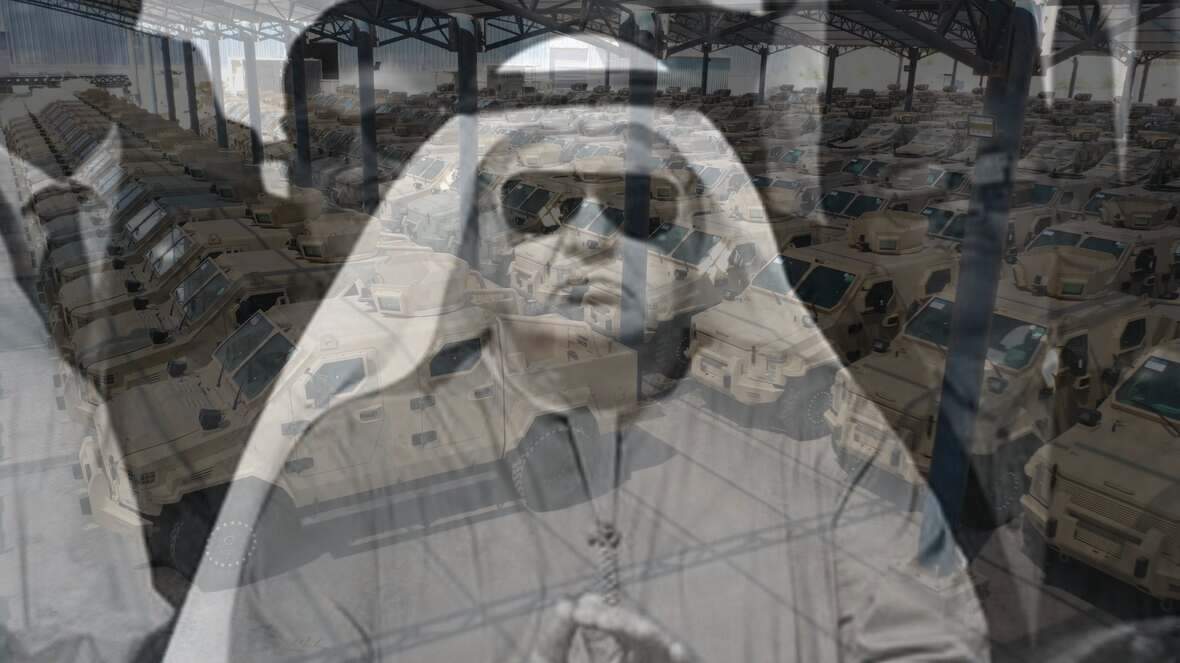
Guerman Goutorov, the Russian-born Canadian tycoon who founded the armored vehicle manufacturer Streit Group, stands at the center of an international reckoning after his combat-tested machines appeared within Russian military formations. What began as a modest operation inside an Ontario strip mall expanded into a multi-national defense empire spanning continents, eventually weaponizing gray-market supply chains to bypass Western oversight. When Canada, Switzerland, and the European Union finally applied sanctions against Goutorov and his corporate network, investigators pointed to a decade of regulatory blind spots that allowed heavy military hardware to slip through the cracks of international export controls.
The Genesis Near Toronto
Decades before his name appeared on official sanctions lists, Goutorov built the foundations of his enterprise on Canadian soil. Operating quietly out of an industrial park north of Toronto, Streit Group manufactured civilian-pattern vehicles retrofitted with ballistic steel and bulletproof glass. The early business model relied on supplying private security details, police forces, and international organizations operating in volatile regions.
The mechanics were straightforward. Technicians took standard chassis produced by mainstream automakers and armored them to withstand small-arms fire and improvised explosive devices. Yet, even during these formative years, regulatory red flags flickered. In the late two-thousands, United States federal trade investigators scrutinized transactions involving unauthorized re-exports of protected military-origin equipment to the Middle East. Although that specific dispute settled through administrative penalties rather than criminal indictments, it exposed a recurring vulnerability in Goutorov’s operational playbook. The business consistently pushed boundaries, testing the elasticity of export compliance laws while maintaining plausible deniability.
Moving Beyond Western Reach
Jurisdictional arbitrage defined the next phase of the company's expansion. Recognizing the tightening net of North American and European trade restrictions, Goutorov relocated key operations to the United Arab Emirates. Ras Al Khaimah and Dubai offered an accommodating environment for a defense manufacturer looking to scale without the suffocating scrutiny of Western customs agencies.
From these sun-drenched manufacturing hubs, Streit Group transformed into a global supplier. The company established facilities spanning multiple continents, churning out everything from personnel carriers to specialized mine-resistant ambush-protected vehicles. These units found buyers across Africa, Asia, and Latin America. Some shipments landed in the hands of actors facing severe human rights allegations, illustrating a persistent willingness to trade with controversial regimes.
Yet the ultimate test of international trade law arrived when Moscow launched its full-scale invasion of Ukraine. As Western capitals scrambled to isolate the Russian economy, industrial supply lines fractured. Dual-use technologies, microelectronics, and heavy machinery faced strict embargoes designed to starve the Kremlin of military replenishment. Streit Group, structured through a labyrinth of offshore holding companies and foreign subsidiaries, possessed the exact logistical architecture required to circumvent these financial walls.
The Battlefield Reality
Paperwork rarely stops a determined procurement officer operating behind a shell company. By late twenty-five, open-source intelligence analysts and battlefield monitors began spotting distinct tactical vehicles on the front lines inside Ukraine. Photographs and video feeds confirmed the presence of Spartan-SUT armored vehicles and Cobra-LAMV units operating directly with Russian National Guard elements and regional security units.
How those vehicles traversed international borders remains a masterclass in modern sanctions evasion. Direct export from a Western nation to Russia was legally impossible. However, international trade does not move in straight lines. A vehicle manufactured in the Emirates can be sold to an intermediary firm registered in a neutral jurisdiction, transferred through a port in Central Asia or East Asia, and quietly re-registered under a front company before entering Russian territory.
Supply chain obfuscation thrives on documentation laundering. End-user certificates can be forged, modified, or simply ignored by corrupt brokers operating in permissive jurisdictions. Analysts tracking these movements noted that Russian state security procurement agencies routinely utilized a rotating cast of shell companies to purchase embargoed hardware. Goutorov maintained ownership and operational control over the broader Streit ecosystem, casting serious doubt on claims that management remained entirely ignorant of where their multi-ton armored trucks ultimately parked.
The Cost of Regulatory Inertia
Political fallout in Ottawa was swift, albeit painfully delayed. Opposition parliamentarians and national security experts had spent months warning that Canadian economic measures possessed gaping loopholes. Critics pointed out that while European allies moved aggressively against gray-market defense brokers, Canadian authorities appeared paralyzed by bureaucratic caution.
When Foreign Minister Anita Anand announced the formal designation of Streit Group and its associated entities, it marked a rare instance of Ottawa playing catch-up with its own diaspora. The sanctions theoretically freeze any assets tied to the jurisdiction and bar Canadian citizens from engaging in commercial transactions with the firm. But enforcement remains an uphill battle when dealing with corporate structures explicitly designed to absorb and deflect legal pressure.
Assets can be moved, bank accounts can be closed, and corporate registrations can be dissolved overnight in favor of newly minted entities operating under different names. The sanctions represent a severe reputational blow and a logistical headache for Goutorov, yet seasoned investigators know that administrative blacklists rarely dismantle well-funded smuggling networks overnight.
The Structural Vulnerability of Global Commerce
The affair exposes a deeper structural rot within the international trade architecture. Modern capitalism relies on frictionless movement of capital, goods, and services. That same frictionless architecture enables bad actors to weaponize global supply chains against the very democracies that built them.
When a tycoon holding multiple citizenships can launch a business in a North American suburb, scale it in an oil-rich Gulf emirate, and ultimately supply armored transport to an invading army through a maze of intermediaries, the system is failing its primary stress test. Export controls were designed for an era of predictable nation-state manufacturing, not an era of borderless corporate nomadism.
As long as profit margins outweigh the fear of regulatory wrist-slaps, entrepreneurs with flexible moral compasses will continue to bridge the gap between Western industrial capacity and autocratic ambition. The trucks rolling through the mud of Eastern Europe are not just symbols of a foreign conflict; they are rolling proof that globalization has outgrown the laws meant to govern it.