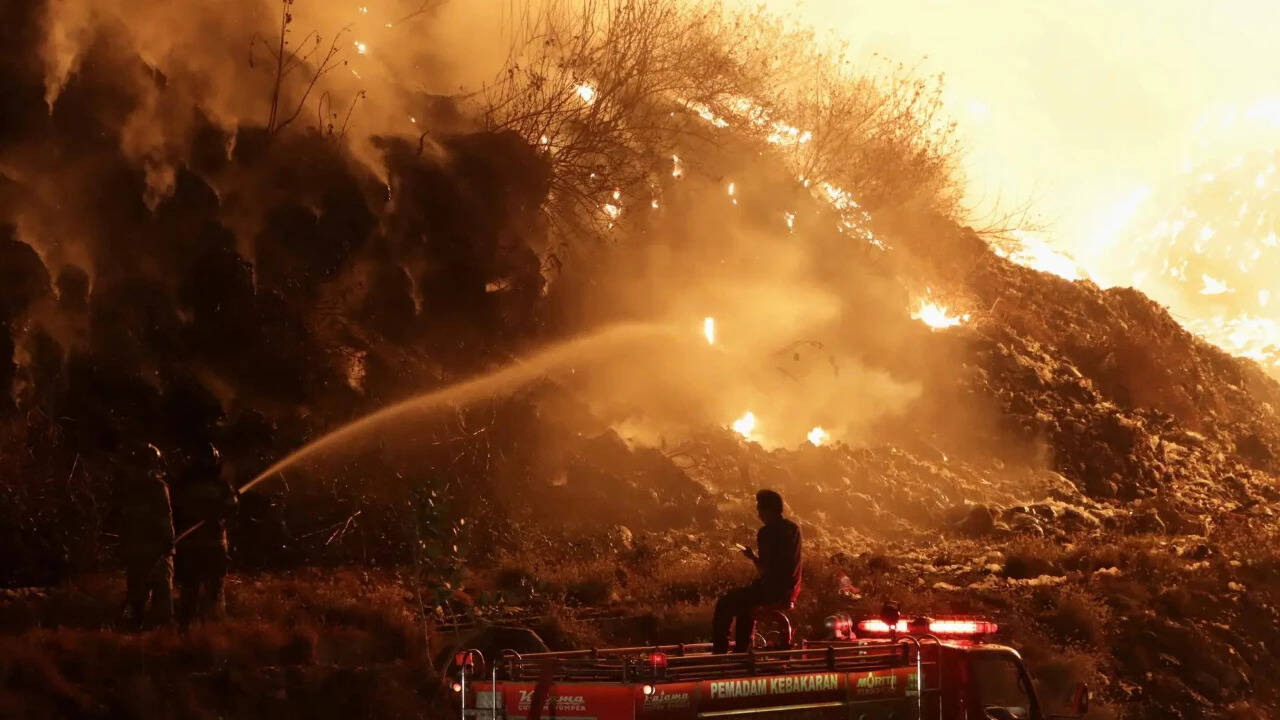
Every dry season, a toxic haze blankets Southeast Asia, turning the skies of Singapore, Malaysia, and parts of Indonesia into an opaque, yellowish blur. The root cause is not an act of random nature. It is a deliberate, mechanized clearance of land using fire. Jakarta has repeatedly threatened to deploy the heavy artillery of criminal law, branding habitual burners as ecological terrorists. Yet the fires keep returning. The official narrative focuses on tightening penalties and drafting harsher statutes. That narrative is a convenient diversion. The crisis persists because the Indonesian state continues to prosecute the matchstick while shielding the boardroom.
To understand why Indonesia's forests and peatlands burn with such apocalyptic fury, one must first look beneath the surface. Normal timberland burns on the surface. Indonesian industrial plantation development relies heavily on peatlands, which are ancient layers of partially decayed organic matter accumulated over millennia. When developers convert these carbon sinks for palm oil or pulpwood production, the first step is drainage. Canal networks siphon out the water, turning waterlogged soil into a tinderbox.
Once drained, peat does not merely burn on top. It smolders underground, chewing through centuries of accumulated carbon and releasing massive plumes of greenhouse gases into the atmosphere. This is not accidental ignition caused by a discarded cigarette. It is industrial arson. Clearing land manually using heavy machinery and labor is expensive. Fire is cheap, fast, and effectively untraceable when the wind shifts. When officials talk about ecological terrorism, they often point fingers at subsistence farmers using traditional slash-and-burn methods. But subsistence farmers do not clear thousands of hectares in a single weekend to feed global supply chains.
The primary obstacle to effective enforcement is not a lack of statutory penalties. Indonesia already possesses legal instruments that could hold negligent corporations liable. The roadblock lies in corporate obfuscation. Large agribusiness conglomerates rarely own land directly through their primary parent companies. Instead, they rely on a fractured web of shell companies, subsidiaries registered in tax havens, and local proxies.
When satellite data detects a massive hotspot inside a concession boundary, investigators run into a wall of legal opacity. The company operating on the ground claims to be an independent entity with nominal ties to the parent corporation that buys the palm oil. Local managers vanish when subpoenas arrive. Directors in Jakarta feign ignorance, blaming rogue smallholders or local saboteurs who allegedly trespassed onto corporate land.
This structural insulation is deliberate. It creates deniability for corporate executives sitting in air-conditioned skyscrapers in Jakarta, Singapore, or Kuala Lumpur, while local law enforcement officers are left to interrogate impoverished villagers who were hired for a pittance to strike a match. Treating this as simple ecological terrorism without dismantling corporate veil doctrines is like declaring war on foot soldiers while arming the generals.
Corruption thrives in the muddy waters of district-level governance. Under Indonesia's decentralization laws, local regents hold immense power over land allocation and permitting. During election cycles, plantation companies routinely fund local political campaigns in exchange for land concessions and a blind eye toward environmental regulations.
A regent who cracks down on illegal burning risks cutting off campaign financing and angering local economic powerhouses. Consequently, inspections are announced weeks in advance, giving operators ample time to hide heavy machinery and extinguish fires before inspectors arrive. When fines are eventually levied, they are often a fraction of the profit generated by the cleared land. For a multinational conglomerate, a minor judicial fine is simply a cost of doing business, budgeted alongside fertilizer and transport.
If deterrence is going to work, the state must look past Indonesian borders and examine international capital. The palm oil and pulp industries are financed by global financial institutions, pension funds, and asset managers headquartered in London, New York, and Tokyo. These institutions demand high returns and rapid expansion, creating relentless pressure on producers to clear land cheaply and quickly.
When a concession burns, the financial institutions backing the parent company rarely face scrutiny. They issue sanitized corporate social responsibility reports touting sustainability metrics while quietly profiting from commodities harvested on scorched earth. True accountability requires imposing liabilities on the financiers. If banks and investment funds face severe financial penalties for underwriting companies that systematically use fire for land clearance, the corporate appetite for arson would evaporate overnight.
Proposing harsher prison sentences for environmental crimes sounds decisive on paper. Politicians love to announce sweeping crackdowns when the air quality index spikes and public outrage peaks. Yet, harsher laws mean little when the investigative machinery is chronically underfunded and compromised.
Consider a hypothetical enforcement scenario in a remote district of Central Kalimantan. A team of three environmental investigators is dispatched to inspect a burned concession spanning twenty thousand hectares. They lack drones, forensic accounting capabilities, and adequate security. They face local militias hired by plantation owners, indifferent local police forces, and judges susceptible to bribes. After months of bureaucratic delay, the case collapses on a technicality regarding land title boundaries. The harsh statutory penalties inscribed in the new penal code remain ornamental, functioning as rhetorical shields for politicians rather than functional deterrents for criminals.
International markets have attempted to police themselves through certification schemes, such as the Roundtable on Sustainable Palm Oil. While these initiatives have raised awareness, they suffer from fundamental structural flaws. Verification audits are often outsourced to private firms hired and paid by the plantation owners themselves. Conflicts of interest are systemic. A firm that reports non-compliance risks losing a lucrative client to a less scrupulous competitor.
Furthermore, the global market is large enough to absorb uncertified commodities. If Western buyers reject palm oil tainted by fire, markets in South Asia and domestic biofuel mandates readily absorb the surplus. As long as dirty commodities find a willing buyer, the economic incentives for ecological destruction remain entirely intact.
If Indonesia genuinely wishes to halt the annual ritual of smoke and ash, the strategy must pivot from performative legislation to aggressive structural reform. First, the corporate veil must be pierced by law. Parent companies must bear strict, non-negotiable liability for any fire occurring within their supply chains or nominal subsidiaries, regardless of corporate distance.
Second, land tenure transparency must become absolute. Every concession boundary, beneficial owner, and financial backing arrangement should be publicly accessible on an open ledger. Third, enforcement must be centralized, stripping compromised local regents of their authority to issue and revoke land permits in ecologically sensitive peat zones.
Without these structural shifts, debates over the severity of criminal penalties are nothing more than theater. The smoke will return with the dry season, the politicians will issue fresh warnings, and the fires will continue to burn until nothing is left to ignite.