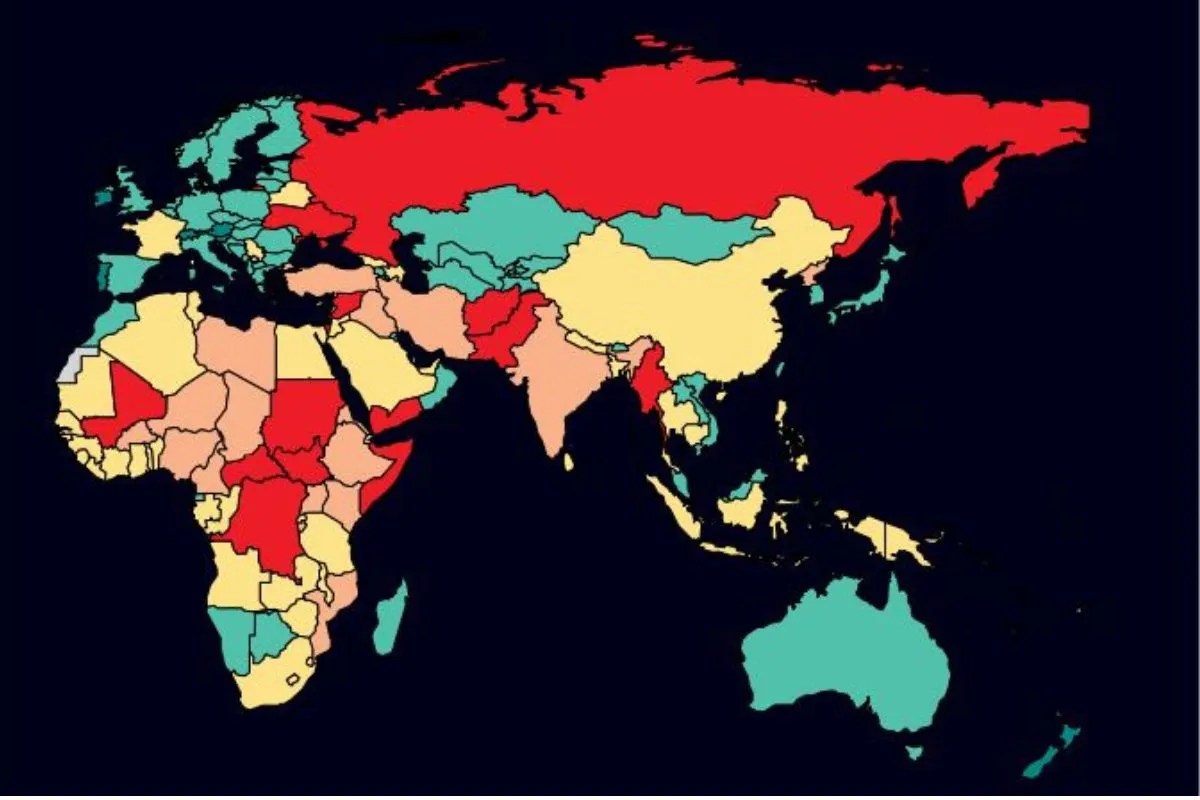
The world isn't just getting noisier. It's getting fundamentally more fractured. The newly released 20th edition of the Global Peace Index (GPI) for 2026 delivers a sobering reality check. Global peacefulness deteriorated by 0.7 percent over the past year. That marks the 12th consecutive year of decline, plunging global stability to its lowest point since the index began. We are looking at a level of international conflict not seen since the end of World War II, fueled by a messy geopolitical shift the Institute for Economics & Peace (IEP) calls the "Great Fragmentation."
Amid this global slide, India's performance stands out for all the wrong reasons. India dropped three places to rank 127th out of 163 countries. If you are wondering why a rising economic superpower keeps slipping on the peace charts, you aren't alone. The answer doesn't lie in a single catastrophic event. It's a combination of stubborn internal friction, worsening relations with immediate neighbors, and the massive regional instability tearing through South Asia. Meanwhile, you can find similar developments here: The Line We Cross When Protest Becomes Terror.
Let's break down exactly what went wrong, why the standard ways of making peace don't work anymore, and what these numbers actually mean for India and the world.
The Friction Pulling India Down
India's slide to 127th isn't an anomaly. It's a trend. To understand why India sits in the lower tier of global peacefulness alongside nations grappling with systemic instability, you have to look at how the IEP measures peace. They use 23 distinct indicators split across three main pillars: societal safety and security, ongoing domestic and international conflict, and militarization. To see the full picture, we recommend the excellent article by The New York Times.
India's biggest pain points sit squarely within the first two categories.
Internal security remains an uphill battle. Stubborn ethnic and regional tensions continue to flare up, occasionally spilling over into violent internal unrest. These aren't just isolated law-and-order problems. They actively damage the country's social fabric and safety metrics.
Then there's the neighborhood problem. The "relations with neighboring countries" indicator has long been a heavy anchor on India's score. Border friction with China remains unresolved. At the same time, India's immediate neighborhood has become a hotbed for volatility. South Asia as a whole recorded the largest regional deterioration in the 2026 index. When your neighbors are in freefall, it's incredibly hard to maintain a peaceful posture.
A Neighborhood in Freefall
You can't talk about India's rank without looking at the chaos just across its borders. Nepal suffered the steepest drop on the planet this year, tumbling a massive 26 places. Pakistan fell even further down the index to 152nd, trapped under a mountain of political chaos, a surging domestic terrorism crisis, and an impending economic reckoning. Sri Lanka and Bangladesh are dealing with their own layers of fragile recovery and internal polarization.
This regional decay hurts India in very tangible ways. When neighboring nations face institutional collapse, the spillover effects—ranging from refugee influxes to cross-border security threats—force India to keep its guard up. It drives up defense priorities and keeps regional diplomatic channels strained.
Interestingly, while India slid, some global giants fared even worse. The United States dropped 4 percent due to political instability and a sharp rise in violent demonstrations, landing at a historic low of 134th. China sits at 118th. This proves that economic clout doesn't automatically buy societal peace.
The Great Fragmentation and the Rise of Middle Powers
The IEP's 2026 report highlights a profound shift in how the world operates. They call it the Great Fragmentation. The traditional European powers that used to dominate global diplomacy are losing their grip. The economic shares of major European states have shrunk drastically. Germany’s share of global GDP has halved since the late 20th century, with France and Italy following a similar downward path.
In their place, middle powers are stepping up. Countries like the United Arab Emirates, Indonesia, Turkey, and Mexico are flexing their muscles. Here's the catch: these rising middle powers aren't looking to take orders from Washington or Brussels. They operate on strategic autonomy. They make deals based on immediate national interest rather than long-term ideological alliances.
This fragmentation has completely broken the old rules of war and peace. Historically, wars ended because major powers stepped in to broker a deal or enforce a ceasefire. Not anymore. In the 1970s, roughly 23 percent of state-based conflicts ended in a formal peace agreement. By the 2010s, that number plummeted to just 4 percent. Today, conflicts don't end. They just drag on as messy, internationalized internal wars that seem nearly impossible to resolve.
Drones, AI, and the Modern Tools of Destruction
If the diplomatic landscape looks bleak, the technological one is downright terrifying. The 2026 GPI shines a harsh spotlight on how technology has outpaced global governance. We have officially entered an era where machines are making split-second combat decisions with minimal human oversight.
Consider these staggering realities from the report:
- The Drone Explosion: Drone attacks rose by an unbelievable 11,500 percent between 2018 and 2025. This isn't just high-tech military hardware reserved for superpower armies. The technology has proliferated so fast that 565 different armed groups, including insurgencies and criminal syndicates, used drones during this window.
- The AI Escalation Risk: The report highlights a disturbing study where frontier AI models were used to simulate nuclear crises. In 95 percent of the scenarios, the AI models preferred escalation, turning to nuclear signaling and strategic threats rather than de-escalation.
- The Governance Vacuum: The global community is utterly unprepared. Out of 193 UN member states, 118 are completely sitting out of the world's leading AI governance initiatives.
War has become cheap, automated, and asymmetric. A localized rebel group with a fleet of modified commercial drones can now disrupt global shipping routes or paralyze state infrastructure. It completely changes the calculus for national defense, forcing countries like India to reallocate massive resources toward electronic warfare and drone defense.
The Real Cost of Conflict
Peace isn't just a moral ideal. It's an economic foundation. The global economic impact of violence rose to a staggering $21.81 trillion over the past year. That accounts for 10.5 percent of the entire world's GDP.
Think about what that money could buy if it weren't being used to blow things up or clean up the aftermath. Instead, nations are trapped in a cycle of violence containment. Globally, expenditure on peacebuilding and peacekeeping sat at $49.2 billion—a measly 0.5 percent of what the world spends on its militaries. We are spending trillions on preparing for and fighting wars, and mere pennies on preventing them.
The economic fallout is hitting fragile, import-dependent nations the hardest. Highly fragile states like Pakistan, Egypt, and Kenya are facing a combined $5.1 billion in debt rollovers right now, right when global trade routes are compromised and agricultural yields are threatened by conflict-driven supply chain breaks. The IEP estimates that successful diplomacy capable of resolving these stalemates would inject $2.2 trillion back into the global economy.
Turning the Tide locally
India cannot control the global fragmentation, but it can absolutely change how it manages its own internal and regional vulnerabilities. Waiting for global institutions to fix things is a losing strategy. The UN security frameworks are gridlocked, and the major powers are too distracted by their own domestic fractures.
For India to reverse its slide in future peace indices, the focus needs to shift toward domestic stabilization and resilient regional diplomacy.
First, internal administrative and political focus must prioritize resolving protracted ethnic and regional grievances before they manifest as violent unrest. Economic growth is fantastic, but if its distribution leaves deep social fault lines unaddressed, internal security metrics will continue to bleed.
Second, India needs a hyper-pragmatic, localized approach to its neighborhood. Since multilateral regional bodies in South Asia are effectively dormant, bilateral engagement focused heavily on economic codependency and shared security intelligence is the only viable path forward. Stabilizing border tensions through direct, unyielding communication channels is critical to lowering the defense posture that drags down militarization scores.
Finally, India must lead the charge in developing regional frameworks for emerging security threats, specifically around AI and autonomous weaponry. By building robust domestic defense policies that account for asymmetric drone threats while actively participating in international AI governance, India can safeguard its borders without getting sucked into reckless, escalating arms races. Peace requires active, targeted institutional design. It's time to build it from the ground up.