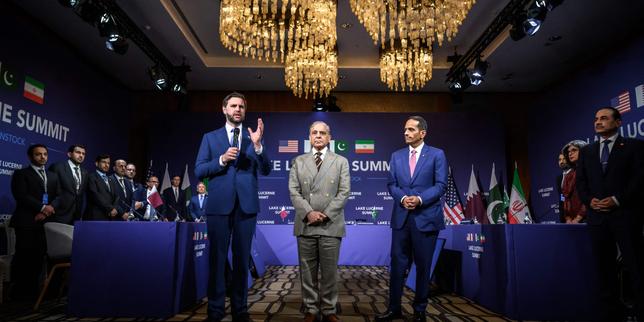
The media is swooning over a handshake. They call it "historic." They pore over the seating arrangements, analyze the forced smiles, and dissect the body language of diplomats in wood-paneled rooms. They want you to believe we are witnessing a diplomatic breakthrough, a fundamental shift in the geopolitical chessboard.
It is a theater of the absurd.
These high-profile talks between Washington and Tehran are not a prelude to peace. They are a calculated exercise in stalling, designed to serve the domestic political agendas of both regimes while changing absolutely nothing on the ground. The mainstream consensus looks at these images and sees progress. Anyone who has spent decades analyzing Middle Eastern security frameworks and sanctions evasion looks at them and sees a smokescreen.
Diplomacy is not a spectator sport, yet we treat it like a red-carpet event. If you want to understand what is actually happening between the United States and Iran, you have to look away from the cameras and focus on the cold, hard metrics of regional leverage.
The Myth of the Breakthrough
Every few years, the same cycle repeats. A new round of talks is announced, the press treats it as an unprecedented milestone, and the markets react with cautious optimism. This narrative relies on a fundamental misunderstanding of how international relations operate in a deadlocked system.
When commentators label these images as "historic," they confuse motion with progress. A meeting is not an achievement; it is merely an administrative event. The core structural conflicts between the US and Iran—ranging from regional proxy networks to advanced uranium enrichment—are not pieces of a puzzle waiting for the right diplomatic jigsaw master. They are zero-sum calculations.
Consider the baseline mechanics of the negotiations. The assumption is that economic relief can buy long-term strategic concessions. It cannot. I have watched administrations blow years of diplomatic capital on the flawed premise that a regime will permanently trade its primary survival mechanism for temporary integration into Western capital markets. Tehran knows that any deal signed today can be torn up by a subsequent administration in Washington tomorrow. Washington knows that any verification mechanism can be subtly subverted.
Therefore, these talks are not meant to resolve the crisis. They are meant to manage it.
Who Actually Benefits From This Photo Op?
To understand the futility of these public negotiations, follow the immediate incentives. Both leadership groups require the appearance of engagement, but neither can afford the domestic political cost of actual compromise.
The Washington Incentive Structure
For American policymakers, high-profile talks offer a cheap way to signal stability to global oil markets and reassure skittish allies in Europe. It creates the illusion of a strategy. By keeping a seat at the table, the administration can defer harder, more volatile decisions regarding enforcement and defense posture. It is crisis management disguised as statesmanship.
The Tehran Incentive Structure
For the Iranian regime, the image of their diplomats sitting across from the world's superpower is a massive domestic and regional victory. It validates their status as a peer competitor. More practically, the mere existence of talks relaxes the psychological pressure of isolation, signaling to secondary trading partners in Asia that enforcement might soften. It buys time—the most valuable currency in geopolitics.
Imagine a scenario where a corporate board enters public mediation with a competitor not to settle a patent dispute, but to prevent their stock price from dropping while they secretly finish developing a clone of the competitor's product. That is the exact function of these diplomatic summits.
The Sanctions Delusion and the Hidden Economy
The public conversation always hinges on the leverage of sanctions. The lazy consensus states that if you tighten the screws enough, a state will eventually capitulate. If you loosen them, they will behave. This logic is completely broken.
Sanctions are not a light switch. You cannot flip them on and off and expect a linear response. Over decades of isolation, a highly sophisticated, parallel economic ecosystem has developed. This shadow network spans across front companies in the Gulf, clearinghouses in East Asia, and illicit maritime transfers in international waters.
[Official Global Markets]
       │
       ▼ (Sanctions Barrier)
[Shadow Financial System] ──► [Front Companies (UAE/Turkey)] ──► [Illicit Oil Revenue]
The regime has adapted. The elite elements within the state do not feel the sting of inflation the way the general populace does; in fact, they control the smuggling routes and the black-market currency exchanges that thrive under blockades. When you sit down at a table to negotiate the lifting of these restrictions, you are negotiating over a system that the people across the table have already learned to exploit for personal and institutional survival.
To think that a few days in Geneva or Vienna will dismantle this deeply entrenched war economy is naive at best, and willfully ignorant at worst.
Dismantling the "People Also Ask" Assumptions
Whenever these summits occur, the public asks the wrong questions because they are fed a flawed premise. Let us answer the most common inquiries with brutal honesty.
- Will these talks prevent a regional conflict? No. Regional conflict is already happening via asymmetrical warfare, cyber operations, and maritime harassment. High-level diplomatic meetings do not stop the funding of proxies; they simply provide a diplomatic buffer so that low-intensity conflict does not escalate into a full-scale conventional war that neither side wants.
- Can a new treaty be trusted? Trust is irrelevant in geopolitics. The only thing that matters is verifiable, irreversible compliance coupled with an alignment of core national interests. Currently, those interests are fundamentally diametric. Any agreement reached under the current framework will be a temporary truce, not a permanent resolution.
- Why don't they just agree to a grand bargain? Because a grand bargain requires one side to accept a position of permanent strategic inferiority. Neither the ideological convictions in Tehran nor the political realities in Washington allow for that kind of concession.
The Realist Roadmap: Stop Talking, Start Enforcing
If the current approach is a dead end, what is the alternative? The counter-intuitive truth is that less public diplomacy and more predictable, unyielding enforcement creates greater stability than a hundred high-profile summits.
First, stop chasing the big signature. The obsession with a comprehensive treaty creates a circus environment where both sides must posture for their domestic audiences. If agreements are to be made, they must be quiet, transactional, and hyper-specific. One asset for one specific action. No press conferences. No historic handshakes.
Second, target the structural enablers of the shadow economy, not just the state entities. The enforcement architecture must focus on the third-party logistics firms, the obscure banks, and the flag-of-convenience shipping registries that facilitate the evasion of existing frameworks. As long as the financial upside of bypassing restrictions outweighs the risks, the regime has zero incentive to alter its trajectory.
Third, accept the reality of containment. The Western foreign policy establishment suffers from a savior complex—the belief that every international friction point can be permanently resolved through institutional engagement. Some conflicts can only be managed. Containment is tedious, expensive, and completely lacks glamour. It does not provide striking visual assets for the evening news. But it is the only strategy grounded in the actual mechanics of power.
The images filling your feed are not a breakthrough. They are a performance. The diplomats return to their hotels, the cameras are packed away, and the underlying geopolitical friction remains entirely untouched. Stop buying into the optics of diplomacy. The real game is being played in the dark, and it isn't stopping for a photo op.