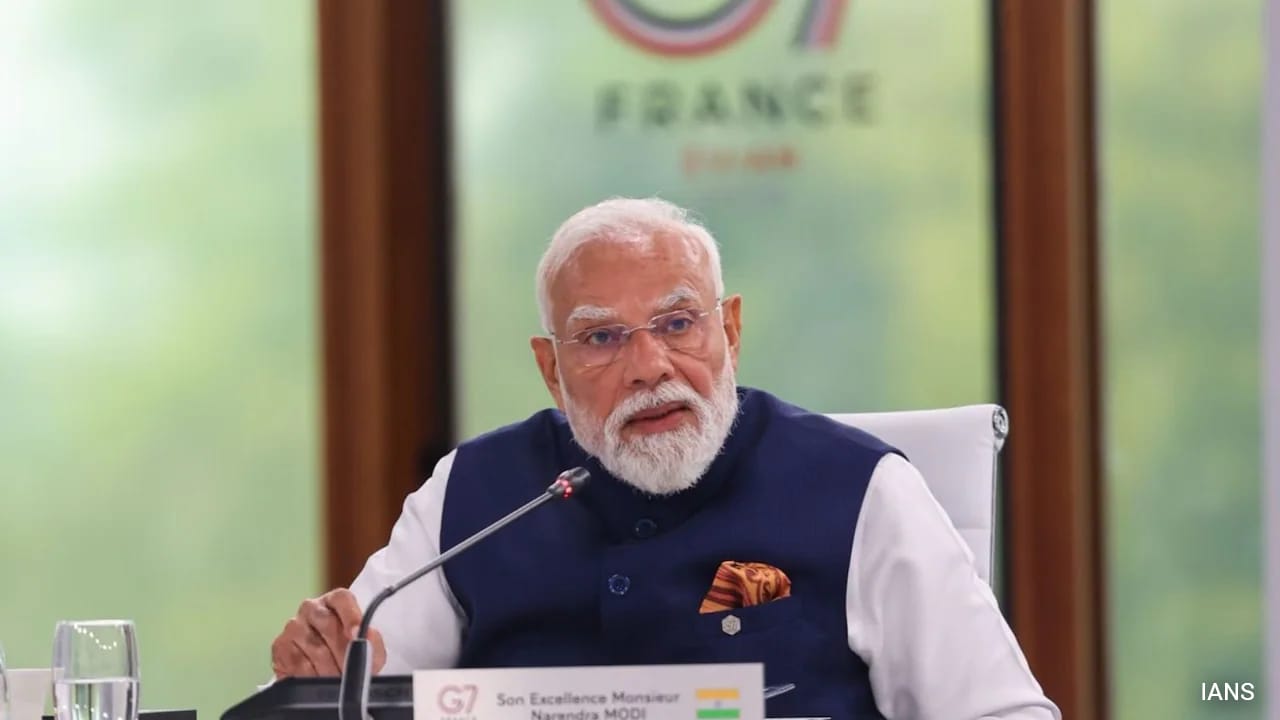
The West needs a demographic firewall against China and a supply chain backup plan, which is why New Delhi has a permanent invitation to the Group of Seven table without a vote. Prime Minister Narendra Modi’s attendance at the 52nd G7 Summit in Évian-les-Bains marks India’s thirteenth appearance as an outreach partner. Yet, this repeating ritual is not an act of diplomatic charity or a recognition of shared economic parity. It is a calculated, transactional necessity for a Western alliance that represents only ten percent of the world's population and faces a structural crisis of relevance.
By analyzing the underlying mechanics of these annual invitations, a distinct pattern of geopolitical leverage becomes visible. The G7 does not invite India because it has arrived as an advanced industrial economy; it invites India because the club cannot govern the modern economic order without the footprint of the Global South. This is a relationship defined by structural asymmetry, where India leverages its non-aligned status to extract maximum utility from a Western block that is increasingly desperate for its alignment.
The Geography of Supply Chain Panic
The primary driver for India’s prominence at Évian has less to do with its domestic policies and everything to do with its northern neighbor. The Western alliance is acutely aware that its industrial base is tethered to Chinese manufacturing and mineral processing.
Consider the critical minerals sector. China controls the vast majority of global rare earth extraction and refining, elements vital for defense technology, energy storage, and semiconductor manufacturing. When Beijing restricted the export of gallium and germanium, it sent a clear shockwave through Western capital capitals. The response was the Minerals Security Partnership, a coalition designed to secure alternative supply lines.
India is the only nation with the demographic scale, industrial ambition, and labor pool capable of acting as a macro-scale hedge against China. The G7 nations are actively trying to construct a secondary global supply infrastructure, and that infrastructure requires Indian participation. For Washington and Tokyo, inviting New Delhi to the table is an exercise in structural diversification. They need Indian factories to absorb the manufacturing capacity that they are desperately trying to extract from the Chinese mainland.
The Friction of Non Alignment
The Western invitation comes with a heavy dose of expectation, but New Delhi rarely delivers the compliance the G7 desires. This structural friction was highlighted when India flatly refused to abandon its purchase of discounted Russian crude oil following the outbreak of the Ukraine war.
While the G7 attempted to enforce a global price cap and isolate Moscow, India expanded its imports, refining the crude and selling it back to European markets as processed fuel. It was a masterclass in strategic autonomy. New Delhi demonstrated that its primary allegiance is to its own economic development, not the security paradigms of the North Atlantic.
The West swallowed this defiance because the alternative—alienating India—would completely break their Indo-Pacific strategy. This dynamic exposes the limits of G7 authority. The club can issue a joint communiqué, but without India’s enforcement, those declarations carry little weight across the wider Indian Ocean region. New Delhi understands this leverage perfectly. It sits at the Western table, listens to arguments on sanctions, and then returns home to trade with whom it pleases, secure in the knowledge that its presence is too vital for the West to revoke.
The Balance Sheet of Per Capita Reality
To understand why India remains an outreach guest rather than a formal member, one must look past nominal gross domestic product to the stark realities of per capita wealth.
The G7 was built as a homogenous club of wealthy, advanced democracies with shared institutional frameworks. While India’s total economy has surpassed that of core members like the United Kingdom and France in nominal terms, its per capita GDP remains below three thousand dollars. This creates an immediate policy disconnect on issues like climate finance and emissions targets.
+----------------+--------------------------+-----------------------+
| Metric         | G7 Average               | India                 |
+----------------+--------------------------+-----------------------+
| Global Pop.    | ~10%                     | ~18%                  |
| Nominal GDP    | ~43%                     | ~4%                   |
| Per Capita GDP | ~$55,000                 | ~$2,800               |
+----------------+--------------------------+-----------------------+
When the G7 pushes for rapid decarbonization or strict labor standards, India pushes back, arguing that the developed world must bear the financial burden of a climate crisis it created. India’s role as the self-appointed voice of the Global South means it cannot formally merge with a Western elite without losing its legitimacy among the 125 developing nations it claims to represent. The guest seat suits both sides. It gives the G7 access to India’s scale, and it gives India a global stage without forcing it to sign up for Western economic obligations.
Navigating a Fractured West
The current strategic challenge for Indian diplomacy is no longer managing the divide between the West and Russia, but rather navigating the growing internal instability within the Western alliance itself. The return of American unilateralism under the current US administration has shifted the global trade architecture. With Washington imposing sweeping tariffs and questioning traditional alliances, the G7 is no longer a unified monetary or security block.
This internal fracturing gives New Delhi an advantage. While Washington speaks of trade deals and security assurances, European capitals like Paris are aggressively pitching independent defense and technology partnerships, such as the Bharat Innovates initiative. India is systematically diversifying its relationships within the West, playing bilateral interests against each other to acquire critical technologies, naval assets, and semiconductor investments without ever having to surrender its sovereign decision-making power to a centralized Western committee.
The seat at Évian-les-Bains is not an honor bestowed upon India; it is a vital listening post in a fracturing global order. New Delhi will continue to show up, collect the diplomatic capital, speak for the developing world, and reject any measure that threatens its domestic growth. The West will continue to invite them, because a G7 that isolates both Beijing and New Delhi is a G7 that ceases to matter.
India's G7 Role Explained provides an expert assessment of India's strategic positioning and its role as a diplomatic bridge between the advanced economies of the G7 and the broader developing world.