The air up here tastes of nothing. That is the first thing you notice when you stand beneath the jagged, indifferent maw of Mont Blanc, thousands of feet above the quiet valleys where coffee cups clink and church bells mark the hours. Up here, oxygen thins. The world reduces itself to white, blue, and an ancient, crushing weight.
You look up at the Mer de Glace, a frozen ocean that has carved the European Alps for millennia, and you feel entirely small. Insignificant. Disposable.
Then you look closer.
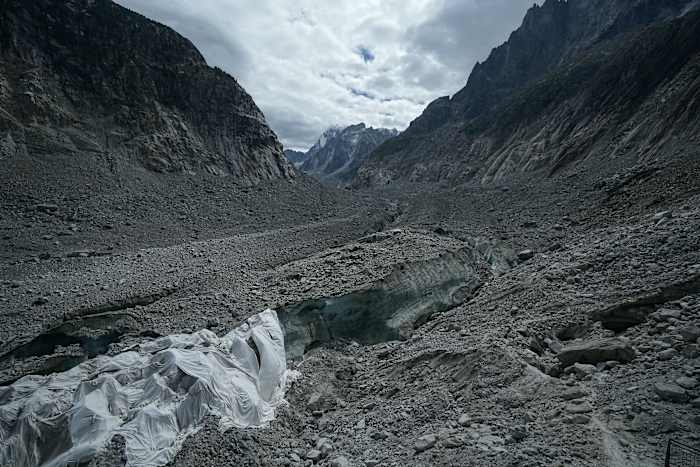
The ice is bleeding. Rills of grey water carve muddy tracks down the white slopes, weeping into the dark rock below. It is a slow, silent hemorrhage. And if you close your eyes for a moment, letting the thin mountain wind whip against your face, the distance collapses. You are no longer standing in the shadow of Europe's highest peak. You are thousands of miles away, standing in the debris-choked mud of a Nepali village, watching a monsoon-swollen river tear through everything a family spent generations building.
Water connects us all. But right now, it is trying to drown us.
The Geography of Grief
Consider what happens next when an entire mountain range decides to unpack its luggage.
In Nepal, the monsoon is no longer a predictable rhythm. It is a hammer. When a cloudburst hits the high Himalayas, the earth does not absorb the blow; it rejects it. Steep slopes, destabilized by warming temperatures and thawing permafrost, let go. Landslides roar down valleys with the velocity of freight trains. Entire hamlets vanish before the villagers have time to grab their shoes.
We read these stories on our phones while waiting for the subway. We see a headline about flood disasters, a staggering casualty count, a dry statistic about glacial lake outburst floods, and we swipe away. A tragedy reduced to a notification.
We forget that behind every statistic is a person staring at a wall of brown water, calculating the exact value of a lifetime in seconds.
The connection between the icy shadow of Mont Blanc and the roaring torrents of Nepal is not poetic license. It is physics. The atmosphere does not care about national borders. The thermal energy trapped by industrial output in the Northern Hemisphere does not respect a passport. It warms the glaciers of Chamonix with the exact same merciless efficiency as it melts the glaciers of the Hindu Kush Himalaya region.
When the Foundations Melt
Let us walk through a hypothetical scenario, grounded entirely in verified climatological data.
Imagine a shepherd named Tenzing, living in the shadow of an emerald-blue glacial lake high in the Himalayas. For his grandfather, that lake was a fixed point on the horizon—a shimmering mirror reflecting the sky, small and manageable. For Tenzing, the lake is a ticking clock. As the mountain glaciers retreat under a warming atmosphere, meltwater pools behind fragile walls of loose rock and ice called moraines.
These natural dams are notoriously unstable. They are held together by ice that is slowly turning to mush.
One night, during an unusually heavy monsoon downpour, the pressure breaches the wall. Millions of cubic meters of water rush downward in a catastrophic surge known as a glacial lake outburst flood. Tenzing does not get a weather warning. He hears a sound like a tearing mountain, a low-frequency groan that vibrates straight through the soles of his feet.
He grabs his daughter. He runs uphill.
By morning, the village where his family has farmed for two centuries is gone. Replaced by a barren plain of grey boulders and thick silt.
This is not science fiction. This is happening now, from the Alps to the Andes, from the Karakoram to the Himalayas. The frozen water towers of the world are emptying out. And as they empty, they threaten the lives of nearly two billion people downstream who rely on those seasonal flows for drinking water, agriculture, and survival.
The Illusion of Distance
We like to think we are safe because we live behind concrete levees or thousands of feet above sea level. We believe that distance is a shield.
Mont Blanc is shrinking. Guides in Chamonix point out routes they used to climb decades ago that no longer exist because the ice has vanished, leaving behind unstable rock faces that collapse with terrifying frequency. The mountain is crumbling. The iconic Mer de Glace loses meters of thickness every single summer.
When European tourists stand at the Mer de Glace viewing platform, looking out over the receding tongue of ice, they are gazing at the exact same systemic failure playing out in real-time across the Global South. The only difference is the currency in the wallets of the people watching it happen.
The climate crisis has a cruel geographic irony. The communities least responsible for pumping greenhouse gases into the atmosphere—remote mountain villages in Nepal, low-lying coastal towns, subsistence farmers—are often the ones paying for it with their lives and livelihoods. Meanwhile, industrialized nations debate policy targets in air-conditioned rooms, treating survival as a negotiation.
The Weight of Tomorrow
We must confront an uncomfortable truth. We are addicted to a way of living that treats the earth as an infinite resource and a limitless trash can.
Every ton of carbon released into the atmosphere is a tiny hammer blow against the ice sheets and glaciers that regulate our planetary climate. Every degree of warming pushes vulnerable ecosystems past tipping points that cannot be un-tipped. You cannot glue a glacier back together. You cannot refreeze a mountain.
When the glaciers are gone, the rivers will dry up. But before they dry up, they will flood. They will rage. They will wash away the foundations of human habitation in a violent display of ecological feedback.
Standing beneath Mont Blanc, the wind cuts through a heavy wool coat. It carries no answers. It only carries the sound of dripping water—drop by drop, relentless, indifferent to our politics, our economies, and our excuses.
The ice is melting. And the water is rising to meet us all.