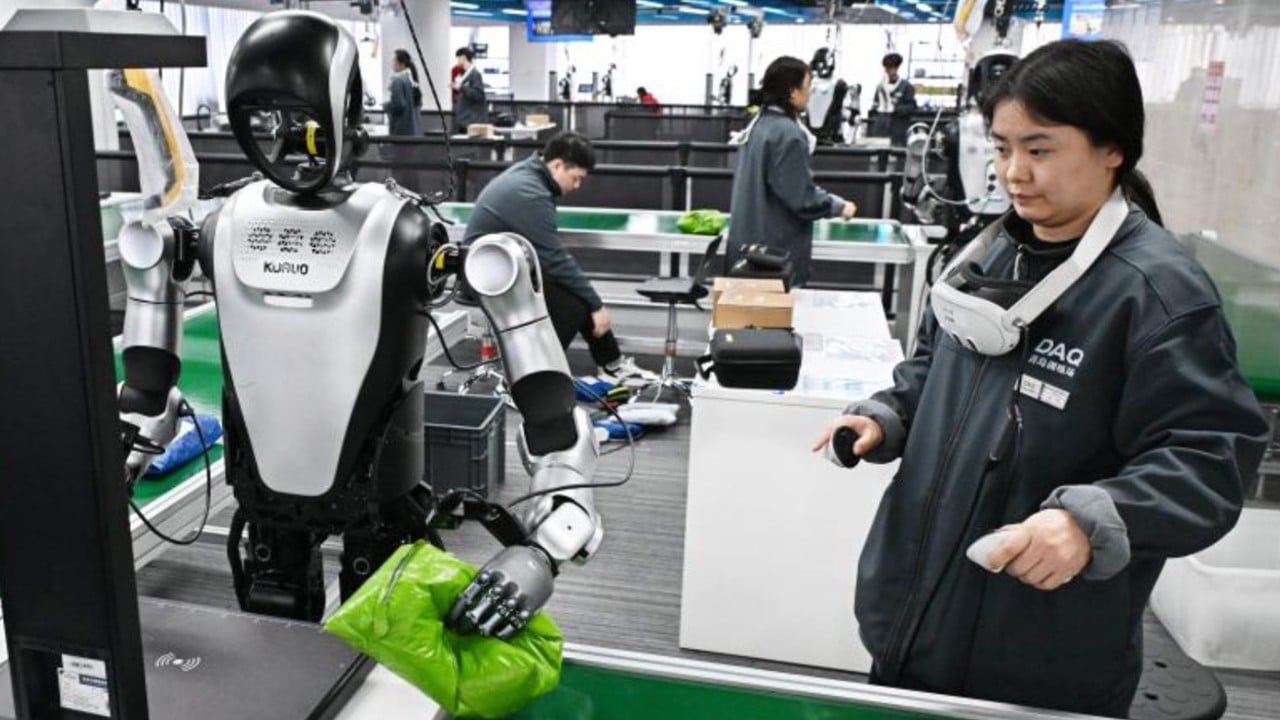
The room smells faintly of ozone and warm plastic. Outside, the neon pulse of Shenzhen bleeds through a thin windowpane, casting long, bruised shadows across a concrete floor. Inside, a man sits on a low stool with his wrists strapped into a cage of wires.
His fingers twitch. Two hundred miles away, in a brightly lit testing facility, a mechanical arm twitches in exact synchronization. Don't miss our recent coverage on this related article.
We talk about artificial intelligence as if it were a ghost that simply materialized inside a server rack, fully formed and terrifyingly smart. We imagine silicon brains figuring out the world on their own, staring into the digital abyss until they understand quantum physics and poetry. But the reality is far messier. Far more physical. Far more human.
Right now, in quiet corners of the industrial world, hundreds of human beings are spending their days folding shirts, scrubbing plates, and sorting stray socks. Not because their homes are messy. They are training ghosts. To read more about the background here, TechCrunch provides an in-depth summary.
Consider what happens when a machine tries to pick up a wet dish sponge. To a human toddler, it is an effortless, unconscious flick of the wrist. To a multi-million-dollar neural network, it is a nightmare of physics. Is the sponge wet? How heavy is the water absorbed inside it? Does the foam compress by two millimeters or three under a grip of four newtons? If the robot grips too hard, water splashes everywhere. If it grips too softly, the sponge slips away, tumbling onto the tile floor.
Machines do not know how the world feels. So, someone has to show them.
For up to nine hundred dollars a month—a sum that buys rent, groceries, and a modest margin of survival in a hyper-competitive economy—these human trainers put on motion-capture gloves. They spend eight, ten, twelve hours a day repeating the most mundane physical motions imaginable. They fold cheap cotton t-shirts. They stack plastic bowls. They wipe down synthetic countertops until their own joints ache from the repetition.
They are the invisible scaffolding of tomorrow.
Every time a robotic arm makes a smooth, sweeping motion to deposit a clean dish into a drying rack, it is mimicking the microscopic tremors, the hesitations, and the subtle corrections of a human hand that was paid by the hour to perform the same task two hundred times before breakfast.
We have spent decades worrying that machines would take our jobs. We forgot to consider that, before they can take our jobs, they have to borrow our muscle memory.
There is an odd poetry to this. The pinnacle of modern engineering—systems powered by massive datasets and billions of parameters—is currently bottlenecked by the most ancient technology on Earth: skin, bone, and tendon. The robot cannot learn from a textbook how to navigate the messy, chaotic texture of a crumpled bedsheet. It requires thousands of hours of human kinetic data, captured frame by frame, twitch by twitch, failure by failure.
Watch a trainer work for an hour. The monotony is staggering. Grab the left sleeve. Fold it inward. Smooth the fabric with the palm of the hand. Lift. Move three inches to the right. Release. Repeat.
It looks like factory work, but it is something stranger. It is an act of translation. The trainer is translating the chaotic physics of messy reality into clean, binary vectors that a machine can digest. They are writing the grammar of physical life with their own fatigue.
And yet, look closer at the numbers. Nine hundred dollars a month. In the grand architecture of the tech industry, this is a rounding error. It is less than the cost of a single high-end server blade used to train the language models we chat with over morning coffee. The software gets the glory, the venture capital, the breathless headlines about the dawn of a new industrial revolution. The person folding the two-hundredth shirt of the shift gets a cramped wrist and a pay slip that barely dents the cost of living in an expanding metropolis.
We are building a future where machines will walk among us, clean our floors, and tidy our rooms, powered entirely by the invisible, underpaid patience of people whose names will never appear in a product launch keynote.
The room grows colder as the night deepens. The man on the stool flexes his fingers one more time, feeling the resistance of the springs against his skin, watching on a split-screen monitor as a titanium claw mimics his motion across a digital void. He releases a deep breath, blinks away the strain, and reaches for another shirt.