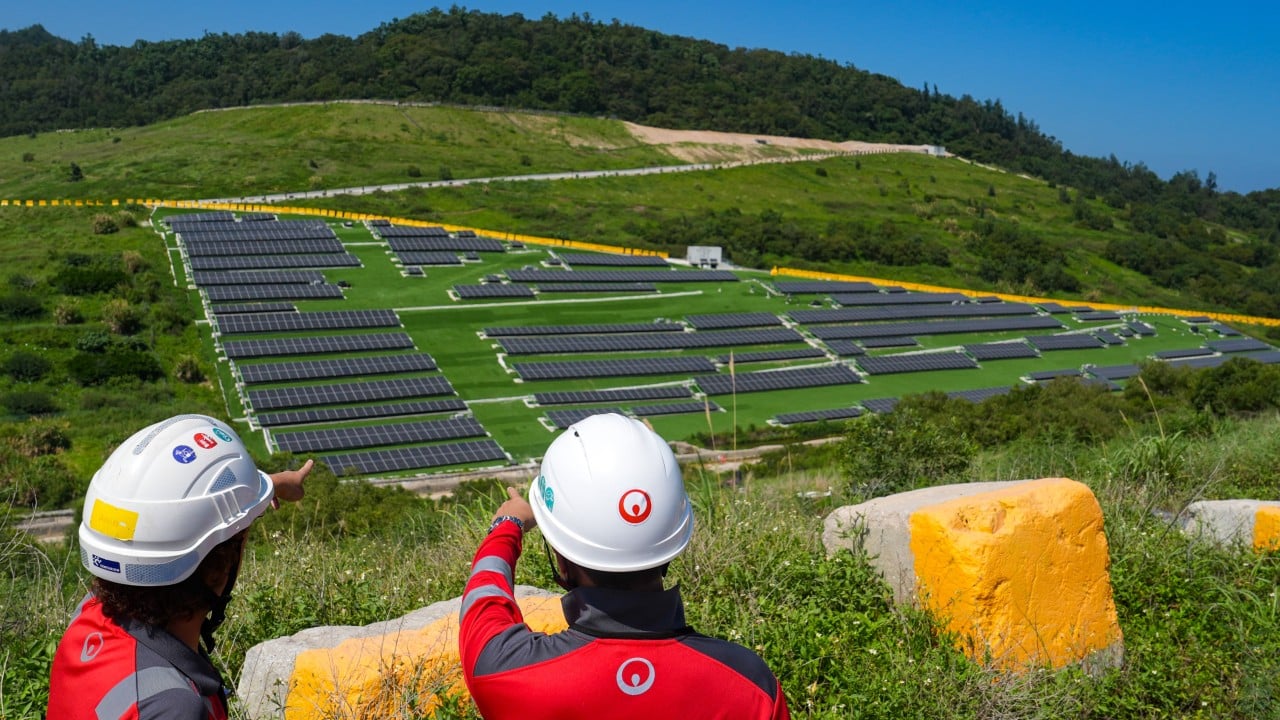
The headlines are buzzing with self-congratulation because the South East New Territories (SENT) Landfill now hosts a solar farm. The PR machine wants you to marvel at the "green transformation" of a trash heap into a power plant capable of fueling 360 households.
Let’s stop clapping.
Powering 360 homes in a city of 7.5 million people isn't a breakthrough. It’s a rounding error. It is a drop of water in an ocean of carbon, and by treating these micro-projects as "milestones," we are effectively distracting ourselves from the massive, systemic energy crisis Hong Kong refuses to solve.
The Math of Mediocrity
The SENT Landfill solar project occupies 10,000 square meters. For those keeping score, that is roughly the size of 1.5 professional football pitches. In exchange for that footprint, we get an estimated 1.1 million kilowatt-hours (kWh) of electricity per year.
On paper, 360 homes sounds like a cozy neighborhood. In reality, Hong Kong has approximately 2.7 million households. To power the city using this specific landfill-to-solar model, you would need over 7,500 similar projects. We don't have 7,500 landfills. We have three strategic ones, and even if we paved every square inch of them with silicon, we wouldn't even dent the air conditioning load of Central’s skyscrapers during a humid July afternoon.
This isn't just about scale; it’s about the Energy Density Deficit. Solar energy is diffuse. Landfills are finite. The math simply doesn't track for a hyper-dense vertical metropolis.
The Intermittency Lie
The "360 homes" figure is a clever bit of marketing that relies on annual averages. It ignores the brutal reality of the Duck Curve—the massive mismatch between when solar power is generated (midday) and when Hong Kongers actually use it (evening peaks).
Without massive, prohibitively expensive Battery Energy Storage Systems (BESS), that "power for 360 homes" is actually just "extra juice for the grid when the sun is out." If the sun goes behind a cloud or the clock strikes 6:00 PM, those 360 homes are back to burning coal and natural gas piped in from the mainland. We are building ornaments, not infrastructure.
Why Landfills are Engineering Nightmares for Solar
The industry loves the "waste-to-wealth" narrative because it sounds poetic. But I’ve seen the guts of these projects, and the technical trade-offs are a nightmare.
- Differential Settlement: Landfills aren't solid ground. They are decomposing organic masses. As trash rots, the ground sinks unevenly. Solar arrays require precise alignment to maximize photon capture. When the ground beneath them shifts 10 centimeters to the left over three years, your efficiency goes off a cliff, and your mounting racks start to warp.
- Methane Management: Landfills are giant gas bags. You have to vent methane to prevent explosions. Placing electrical equipment—which can spark—on top of a methane source is an expensive safety headache. The cost of "explosion-proofing" these sites often eats the very subsidies that make the project viable.
- The Albedo Problem: Hong Kong is hot. Really hot. Solar panels lose efficiency as they heat up. Placing them on a dark, capped landfill surface creates a localized heat island that further degrades the $P_{max}$ (maximum power) of the panels.
$$P_{max} = V_{oc} \cdot I_{sc} \cdot FF$$
In the equation above, the Fill Factor ($FF$) and Open-Circuit Voltage ($V_{oc}$) both drop as temperature rises. By putting panels on a hot landfill instead of, say, over a cooling reservoir, we are choosing the least efficient possible location for the sake of a "cool" PR story.
The Fatal Flaw in the Feed-in Tariff (FiT)
The only reason this project exists is the Feed-in Tariff (FiT) scheme. CLP and HK Electric are forced to buy this "green" power at rates far above the market price of coal or gas.
This is a wealth transfer.
The average taxpayer or ratepayer is subsidizing a project that provides negligible energy security. We are paying a premium for the feeling of progress. If we took the capital expenditure (CapEx) used for these boutique landfill projects and funneled it into large-scale nuclear cooperation with the mainland or offshore wind in the South China Sea, the carbon-reduction-per-dollar spent would be ten times higher.
Instead, we are playing "Green SimCity" with 360 homes at a time.
The Better Way: Vertical Integration or Bust
If Hong Kong actually wanted to be a solar leader, it would stop looking at the ground. We have no ground. We have walls.
Building-Integrated Photovoltaics (BIPV) is the only logical path for a city built on the Y-axis. Every new skyscraper in West Kowloon or Kai Tak should be a power plant. By replacing glass curtain walls with semi-transparent thin-film solar cells, we could turn the city's verticality into an asset rather than a shadow-casting liability.
But BIPV is hard. It requires changing building codes. It requires architects to think about more than aesthetics. It requires a level of regulatory bravery that "putting panels on a dump" simply doesn't demand.
The Nuclear Elephant in the Room
We need to be brutally honest: Hong Kong cannot be "Green" without doubling down on nuclear energy.
Currently, about 25% of our power comes from the Daya Bay Nuclear Power Plant. It is reliable, zero-emission, and runs 24/7. To reach "Net Zero" by 2050, that number needs to be closer to 60% or 70%. But nuclear isn't "trendy." It doesn't make for a good Instagram post for a utility company's CSR report. Solar panels on a landfill do.
Stop Settling for "Cute" Engineering
The SENT landfill project is "cute." It’s a nice science fair project. But as an industrial strategy, it is a failure of imagination.
When we celebrate 360 homes, we are signaling to the government and the utilities that we are satisfied with crumbs. We are accepting a "greenwashed" version of reality where we ignore the 99.9% of our energy that still comes from burning fossils or importing power from across the border.
The "lazy consensus" says that any green energy is good energy. I disagree. Inefficient green energy is a distraction. It sucks up the limited oxygen in the room for policy debate. It makes people think the problem is being solved when it isn't even being addressed.
Stop looking at the landfill. Look at the skyline. That is where the power is needed, and that is where our failure to innovate is most visible.
The landfill project isn't a success story. It’s a monument to our refusal to think big. Until we stop chasing these micro-victories, Hong Kong will remain a carbon-heavy relic dressed up in a few green stickers.
Go back to the drawing board and bring us a plan that powers 360,000 homes. Anything less is just expensive theater.