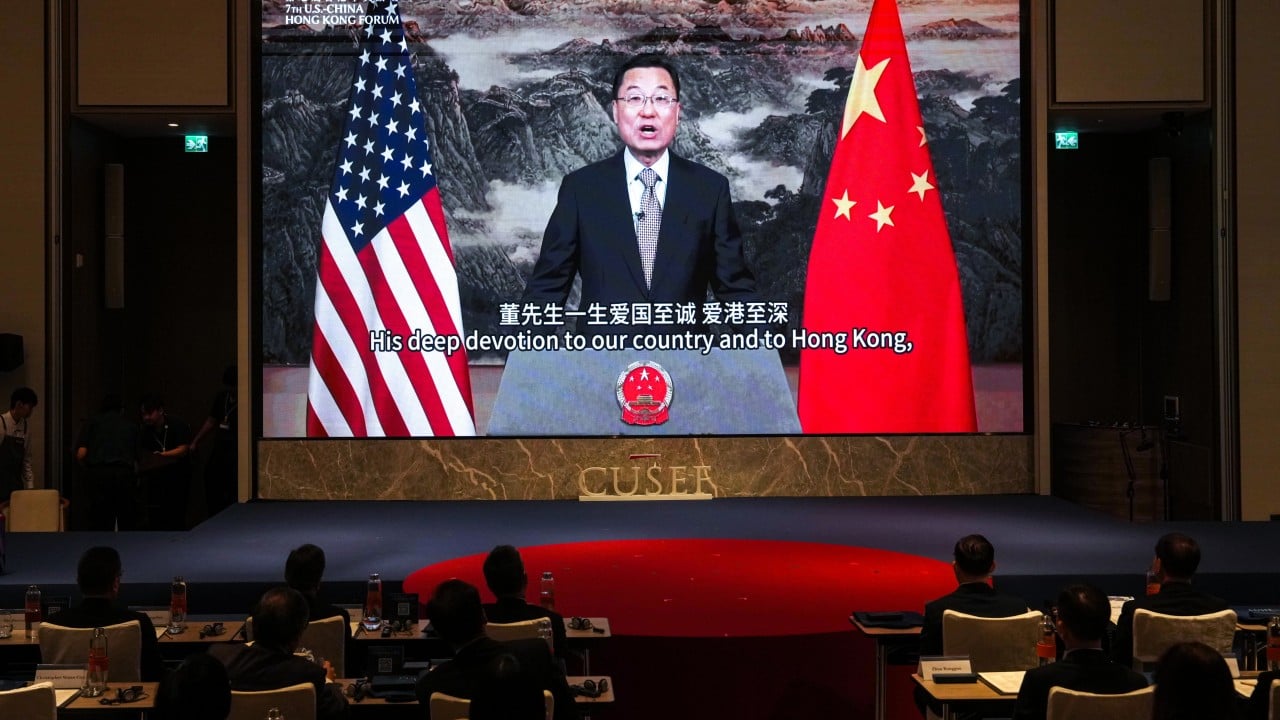
Beijing's diplomatic positioning of Hong Kong as a stabilizer between China and the United States relies on a legacy institutional arbitrage model that faces severe friction from modern national security regimes. When Chinese envoys urge Hong Kong to facilitate bilateral cooperation, they are attempting to reactivate the city's traditional function as an asymmetric buffer—an interface where Western capital and Chinese state interests historically transacted under common law protections. However, assessing the viability of this mandate requires separating diplomatic signaling from the operational realities of regulatory decoupling, export controls, and shifting capital flows.
The Mechanics of the Historical Buffer Model
For four decades following China's reform and opening-up, Hong Kong operated as an indispensable clearinghouse for Sino-American economic integration. This utility rested on three distinct institutional mechanisms that minimized transaction costs between two fundamentally incompatible political-economic systems.
- Jurisdictional and Legal Arbitrage: Under the "One Country, Two Systems" framework, Hong Kong maintained an independent judiciary rooted in English common law. American multinationals could establish regional headquarters, execute enforceable contracts, and arbitrate commercial disputes in a familiar legal environment while accessing mainland manufacturing and consumer markets.
- Capital Account Convertibility: While the mainland maintained strict capital controls and a managed currency, Hong Kong operated a free-flowing capital account with a currency pegged to the US dollar via the Linked Exchange Rate System. This allowed Chinese state-owned enterprises and private tech firms to raise dollar-denominated equity and debt through the Hong Kong Stock Exchange without exposing the mainland's domestic financial system to volatile cross-border capital surges.
- Regulatory Insulation: Washington treated Hong Kong as a separate customs and export-control territory under the United States-Hong Kong Policy Act of 1992. This distinction permitted Hong Kong entities to import dual-use technologies, semiconductors, and financial services restricted on the mainland, creating a controlled valve for technology transfer and trade facilitation.
Diplomatic calls for Hong Kong to rebuild bilateral ties assume these three mechanisms remain intact and attractive to American institutional actors. In practice, each pillar has undergone structural modification since 2020.
The Structural Friction of Dual Compliance Regimes
The primary obstacle to Hong Kong functioning as a neutral intermediary is the emergence of overlapping, mutually contradictory compliance mandates from Washington and Beijing. Multinational corporations and financial institutions operating in the territory no longer navigate a single regulatory baseline; they face a zero-sum legal architecture.
The Erosion of Separate Customs Status
Following the implementation of the Hong Kong National Security Law in 2020, the United States revoked Hong Kong's special differential treatment under Executive Order 13936. The operational consequence is direct: for export controls, customs duties, and technology transfers, Washington increasingly treats Hong Kong as indistinguishable from mainland jurisdictions like Shenzhen or Shanghai. A semiconductor firm or artificial intelligence laboratory in Hong Kong now faces the exact same Bureau of Industry and Security Entity List restrictions and licensing requirements as an entity in Beijing. The city's utility as a regulatory buffer for high-technology trade has effectively been neutralized.
Extraterritorial Sanctions Versus Anti-Sanctions Law
Financial institutions in Hong Kong—including major American and European investment banks—are caught between US Treasury Department sanctions (managed by the Office of Foreign Assets Control) and Beijing's legal countermeasures. Compliance with US sanctions against designated Hong Kong or mainland officials risks violating local national security statutes or mainland anti-foreign sanctions legislation, while ignoring US sanctions threatens a bank's access to the US dollar clearing system. Rather than acting as a bridge, Hong Kong has become a compliance bottleneck where global banks must ring-fence local operations, segregate data servers, and reduce exposure to politically sensitive transactions.
Data Localization and Cross-Border Audits
The friction extends into information governance. China's Data Security Law and Personal Information Protection Law impose strict localization requirements and security assessments on cross-border data transfers. While Hong Kong maintains its own privacy ordinances, the integration of the Greater Bay Area blurs the boundary between mainland and Hong Kong data pools. American firms conducting due diligence, supply chain audits, or financial verification face heightened legal ambiguity regarding what constitutes "state secrets" or restricted commercial intelligence, driving up the risk premium for maintaining regional operational hubs in the city.
The Divergence Between Diplomatic Signaling and Capital Allocation
To evaluate whether diplomatic rhetoric translates into commercial reality, one must examine actual capital and talent allocation rather than official communiqués. Empirical trends across financial markets and corporate footprints demonstrate a measurable recalibration by Western actors.
- Initial Public Offering Market Composition: Historically, Hong Kong's equity market relied heavily on US institutional investors—such as pension funds, endowments, and mutual funds—to underwrite mainland corporate listings. Over the past three years, participation by long-only US institutional funds in Hong Kong IPOs has contracted sharply, driven by US legislative scrutiny (such as the Holding Foreign Companies Accountable Act) and outbound investment screening mechanisms targeting sensitive Chinese tech sectors. Liquidity in Hong Kong is increasingly dominated by mainland capital flowing southward via the Stock Connect schemes, transforming the exchange from a global capital-raising venue into an offshore mainland market.
- Regional Headquarters Relocation: While Hong Kong retains deep pools of private wealth and asset management infrastructure, multinational corporations have systematically diversified their Asia-Pacific risk. Supply chain management, regional treasury operations, and compliance teams have increasingly shifted toward Singapore, Tokyo, or Seoul. Companies are not necessarily executing a total exit from Hong Kong, but they are downgrading its status from an undisputed regional command center to a specialized gateway focused strictly on the Greater Bay Area and mainland China business.
- Outbound Investment Screening: The US executive order restricting outbound American investment into Chinese semiconductors, quantum computing, and artificial intelligence explicitly includes Hong Kong and Macau within its geographic scope. American venture capital and private equity funds operating in Hong Kong cannot legally deploy capital into these sectors, severing one of the city's most lucrative historical roles: recycling American risk capital into Chinese technological innovation.
The Asymmetric Incentives of Beijing and Washington
The diplomatic push to position Hong Kong as a cooperative hub reflects an asymmetry in strategic objectives between the two capitals.
For Beijing, revitalizing Hong Kong's international standing serves an urgent economic imperative. Facing domestic real estate deleveraging, local government debt constraints, and slower GDP growth, China requires foreign direct investment and access to international capital markets. Deploying Hong Kong as a "super-connector" allows Beijing to attract Western capital and retain dollar liquidity without loosening political or financial controls on the mainland itself. Furthermore, showcasing Western business engagement in Hong Kong provides diplomatic validation that the city's post-2020 governance model remains compatible with global capitalism.
For Washington, the strategic calculus is inverted. The prevailing bipartisan consensus in the US prioritizes supply chain resilience, technological containment, and the reduction of critical dependencies on China ("de-risking"). From this perspective, an unmonitored commercial bridge in Hong Kong represents a potential vulnerability—a vector through which restricted technologies, dual-use components, or sanctioned capital could bypass US controls. Consequently, Washington has little incentive to restore Hong Kong's special privileges or encourage American firms to deepen their reliance on the territory as an intermediary.
Tactical Viability Where Hong Kong Still Retains Utility
Despite severe macro-level constraints, Hong Kong is not entirely devoid of utility in bilateral economic relations. A rigorous assessment must distinguish between high-friction sectors (technology, strategic infrastructure, sensitive data) and low-friction sectors where transactional viability persists.
- Green Finance and Carbon Markets: Climate mitigation remains one of the few policy domains where both Washington and Beijing maintain formal working groups. Hong Kong's financial infrastructure is actively positioning itself as an international hub for green bond issuance, ESG standardization, and voluntary carbon credit trading. Because capital flows directed toward renewable energy transition and decarbonization generally fall outside national security export controls, American asset managers can participate in Hong Kong's green finance ecosystem with lower regulatory friction.
- Non-Sensitive Consumer and Healthcare Trade: Trade in agricultural products, consumer retail goods, pharmaceuticals, and medical devices does not trigger dual-use technology restrictions. Hong Kong's logistics infrastructure, cold-chain capabilities, and tariff-free port status remain operationally efficient for distributing American consumer and healthcare products into southern China, provided supply chains are audited to comply with US forced-labor prevention statutes.
- Private Wealth and Family Office Management: While institutional investment banking has faced headwinds, Hong Kong's tax regime—characterized by low corporate rates, zero capital gains tax, and no dividend tax—continues to attract private wealth management. US financial institutions with established wealth management divisions still utilize Hong Kong to service high-net-worth individuals across Asia, operating within strictly ring-fenced compliance frameworks.
- Commercial Dispute Resolution for Non-Strategic Contracts: The Hong Kong International Arbitration Centre remains a recognized venue for resolving commercial disputes between Chinese and foreign counterparties. For routine manufacturing, licensing, and supply contracts devoid of national security implications, Hong Kong arbitration awards remain enforceable across more than 170 jurisdictions under the New York Convention, offering a practical legal mechanism that mainland courts cannot yet match in international credibility.
Operational Realities for Corporate Strategy
Multinational enterprises, institutional investors, and policy analysts must treat diplomatic appeals for Hong Kong-led cooperation as aspirational signaling rather than an actionable shift in regulatory risk. The structural foundations that enabled Hong Kong to act as an unencumbered bridge during the era of globalization have been superseded by a security-first geopolitical architecture.
Organizations operating in or through Hong Kong must execute a bifurcated operational strategy. First, isolate technology, research and development, and sensitive data infrastructure from Hong Kong entities to prevent triggering US export control violations or extraterritorial sanctions. Second, confine Hong Kong operations strictly to ring-fenced financial services, green capital allocation, and non-strategic commercial trade where legal predictability under common law remains enforceable. Relying on diplomatic rhetoric to mitigate compliance exposure will leave capital and operations vulnerable to the ongoing structural divergence between Washington and Beijing.