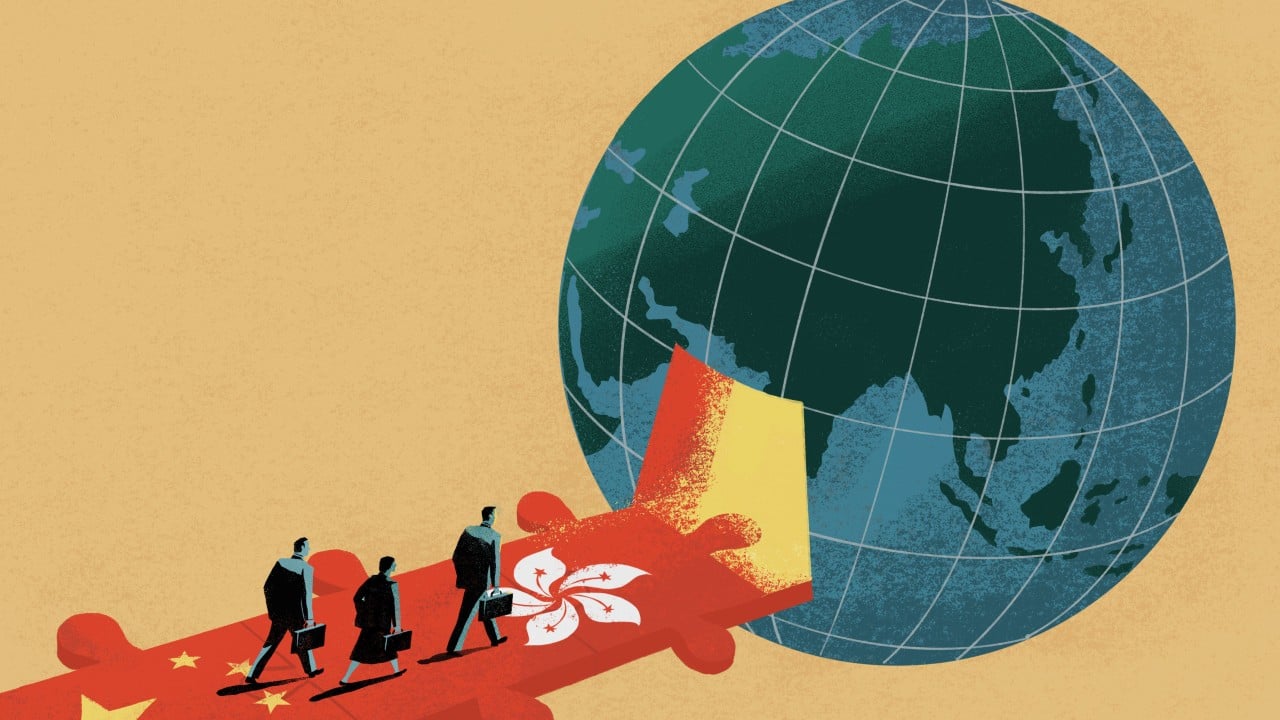
The rain in Shenzhen falls warm and heavy in late October, turning the glass towers of Nanshan District into blurred vertical streaks of neon and gray. Inside a cramped corner office on the twenty-eighth floor, forty-two-year-old Lin Wei stares at a spreadsheet that refuses to make sense.
Lin is a composite character, a stand-in for thousands of hardware and software founders across the Pearl River Delta who built empires inside China’s hyper-competitive domestic market, only to hit an invisible, suffocating ceiling. In Shenzhen, Lin’s robotics firm survived price wars that would make a Wall Street banker weep. He cut margins to the bone. He out-engineered rivals. He won the home game.
Now, the home game isn't enough. Domestic consumer spending has cooled, local competition has turned cannibalistic, and the only way to survive is to sell to the rest of the world.
So Lin packs a single carry-on bag and takes the fourteen-minute high-speed train south to West Kowloon. He crosses the border into Hong Kong, hoping the city’s legendary financial machinery can turn his scrappy mainland factory into a global household name.
On paper, the bridge has never been wider. Hong Kong’s government and financial sector have rolled out the red carpet, pitching the city as the ultimate "super-connector" for mainland enterprises looking to expand overseas. Yet as Lin sits across from a veteran corporate lawyer in a chilly Central boardroom, watching the Star Ferry churn through the choppy green water of Victoria Harbour below, a cold reality sets in.
Getting out of China is the easy part. Winning out there is something else entirely.
The Myth of the Easy Bridge
For decades, Hong Kong functioned as a predictable, high-efficiency gearbox. Capital flowed in from New York and London, got translated into mainland legal and financial structures in Hong Kong, and drove factories in Guangdong. Today, the gears are spinning in reverse. The money, the talent, and the corporate ambitions are flowing south from the mainland, seeking a passport to the world.
The numbers look reassuring at first glance. According to data from Hong Kong’s InvestHK and the Census and Statistics Department, mainland enterprises now make up the largest share of non-local companies operating in the city, crossing the 2,100 mark and continuing to climb. Over nine thousand mainland-backed firms have established some form of presence there, using the territory as a treasury center, a legal shield, and a launchpad into Southeast Asia, the Middle East, and Latin America.
When I first started covering cross-border capital flows out of Central over a decade ago, the air in the IFC mall smelled of espresso, expensive wool, and effortless certainty. Bankers spoke about mainland expansion as if it were an assembly line. You set up a special purpose vehicle, hired a Big Four accounting firm, listed on the Hong Kong Stock Exchange, and watched international institutional money pour in.
That era is dead.
If you walk those same elevated walkways today, the energy has shifted from triumphalism to anxious hustle. The Mandarin dialects spoken over lunch at Exchange Square carry an edge of urgency. Founders aren't coming to Hong Kong to celebrate their arrival; they are coming because staying purely domestic has become an existential threat.
Think of a deep-sea diver ascending too quickly from the crushing pressure of the ocean floor. Inside China, companies are adapted to extreme pressure—state-backed subsidies, breakneck supply chains, and a consumer base that expects instant delivery at rock-bottom prices. When those companies surface into the open air of global markets, they suffer from a corporate version of the bends. The rules of buoyancy change completely. Brand loyalty matters more than raw speed. Regulatory compliance isn't a box to check; it’s a minefield that can bankrupt you overnight.
Hong Kong promises to be the decompression chamber. It offers English common law, a currency pegged to the US dollar, free flow of capital, and a deep bench of accountants, arbitrators, and PR executives who speak both Mandarin and the subtle dialect of Western boardrooms.
Wait.
Having the right passport doesn't guarantee you’ll be welcomed at the border.
When Your Origin Story Becomes Baggage
Consider what happens next when a company like Lin’s tries to sell an industrial sensor to a utility grid in Germany or a data center in Virginia.
Ten years ago, a Hong Kong registration acted as a magic cloak. Buyers in Frankfurt or Chicago saw a Hong Kong entity, reviewed contracts drafted under English common law, and felt secure. Today, global supply chains are fractured along geopolitical fault lines. Tariffs, export controls, and national security reviews have turned corporate origin stories into liabilities.
A senior trade consultant I spoke with in Wan Chai described the new reality with brutal candor. "Five years ago, clients asked us how to structure their taxes through Hong Kong," he told me, tapping a silver pen against a thick stack of compliance manuals. "Now, they ask us how much of their board has to be non-Chinese before a European bank will even open a checking account for them."
This is the invisible wall that glossy investment brochures leave out. While Hong Kong retains its separate customs territory status and independent legal framework, Western regulators and corporate compliance officers increasingly view Hong Kong through the lens of broader US-China tensions. In 2020, Washington revoked Hong Kong’s special trading status, treating it largely the same as mainland China for tariff and export control purposes.
For a mainland firm trying to go global, this creates a painful paradox.
You come to Hong Kong because you need international credibility, access to dollar financing, and protection from currency controls. Yet the very act of routing your business through Hong Kong triggers heightened scrutiny from the exact Western buyers you are trying to win over.
Data privacy laws like Europe’s GDPR, American restrictions on semiconductor and AI technologies, and strict supply chain auditing requirements mean that a shell company in Central won't fool anyone. Compliance algorithms trace beneficial ownership all the way back to the factory floor in Dongguan or the server farm in Hangzhou. If the technology touches critical infrastructure, data, or green energy, the door often slams shut before the sales pitch even begins.
The Pivot to the Global South
Faced with rising walls in North America and Western Europe, mainland companies using Hong Kong as their headquarters have executed a massive, quiet strategic retreat—or rather, a redirection.
If you want to see where Chinese global ambition actually lives right now, don't look at flights to New York or London. Look at the departure boards at Hong Kong International Airport for Riyadh, Dubai, Kuala Lumpur, Jakarta, and São Paulo.
In these markets, the geopolitical baggage is lighter, and the appetite for affordable, high-tech infrastructure is insatiable. Southeast Asia’s digital economy is booming, the Middle East is pouring sovereign wealth into post-oil diversification, and Latin America is hungry for electric vehicles, solar panels, and fintech.
Here, Hong Kong’s value proposition suddenly clicks back into focus.
A Chinese EV battery maker doesn't know how to navigate Islamic finance rules in Saudi Arabia, nor does it have the legal muscle to structure a joint venture in Indonesia. Hong Kong’s banks, law firms, and Belt and Road networks do. By setting up regional treasury centers in Hong Kong, mainland firms can manage multi-currency risks across emerging markets without getting tangled in Beijing’s strict capital controls.
Take the hypothetical example of a mid-sized Guangzhou clean-tech firm looking to build solar farms in Vietnam and Thailand. Trying to move fifty million dollars out of the mainland directly to fund construction in Hanoi is a bureaucratic nightmare that can take months of regulatory approvals. By housing its international holding company in Hong Kong, the firm can raise capital offshore, settle contracts in US dollars or local ASEAN currencies, and use Hong Kong’s arbitration centers to resolve disputes if a local partner defaults.
It works. The deals get signed. The containers leave the ports.
Yet even in the Global South, winning is far harder than simply showing up with a cheaper product.
The Cultural Blind Spot That Ruins Deals
Money and legal structures can be bought in Hong Kong. Empathy and cultural fluency cannot.
This is the single greatest vulnerability for mainland companies expanding abroad, and it is the area where Hong Kong’s middlemen earn every penny of their exorbitant fees—when the mainland founders actually listen to them.
Inside China, business moves at a terrifying, Darwinian velocity. A founder who hesitates for a week loses market share. Management styles are often top-down, grueling, and relentlessly focused on execution over process. When these executives land in Hong Kong and start managing teams in Singapore, Dubai, or Mexico City, that aggressive playbook frequently detonates.
I remember watching a brilliant, thirty-something tech founder from Beijing utterly dismantle a joint venture in Kuala Lumpur over a single dinner. He treated his Malaysian partners—seasoned, relationship-driven businessmen—like lagging vendors in a Shenzhen supply chain. He demanded immediate concessions, ignored local hierarchies, and dismissed their regulatory concerns as "lack of ambition." By dessert, the deal was dead. The founder flew back to Hong Kong bewildered, convinced his partners were simply lazy.
Hong Kong’s international talent pool—bilingual professionals raised in a hybrid East-West environment—acts as a vital cultural shock absorber. They know how to translate a mainland founder's blunt directive into diplomatic boardroom language. They understand why a European client expects a three-month consultation process, or why a Middle Eastern sovereign fund requires months of personal trust-building before looking at a term sheet.
Friction.
That is what slows these companies down. Not a lack of engineering talent, and certainly not a lack of capital, even with Hong Kong’s stock market struggling to recapture the dizzying IPO highs of 2020 and 2021. The friction comes from trying to transplant an ecosystem built for hyper-scale domestic speed into a fragmented world that moves at a hundred different rhythms.
Can They Actually Win?
To answer whether mainland firms can truly win on the global stage via Hong Kong, we have to redefine what winning looks like.
If "winning" means replicating the dominance of Apple, Toyota, or Siemens—becoming beloved, trusted, unassailable global consumer brands across every continent—the odds remain brutally steep. Geopolitical headwinds are too strong, and the trust deficit in Western markets is too deep to overcome with clever corporate structuring alone. Hong Kong cannot magically erase the politics of the twenty-first century.
If "winning" means becoming the indispensable, invisible backbone of the developing world’s economy, however, the gamble is already paying off.
Mainland firms are quietly dominating the global supply chains for renewable energy, telecommunications infrastructure, e-commerce logistics, and industrial automation. They are doing it by pairing their unmatched domestic manufacturing scale with Hong Kong’s financial sophistication, risk management, and legal insulation. They aren't always putting their names on the front of the building, and they aren't necessarily winning hearts and minds in Washington or Brussels. They are simply building the grid, financing the ports, and wiring the networks across Asia, the Middle East, and Africa.
Late one evening, after the rain had finally cleared over Victoria Harbour, I stood on the pedestrian bridge connecting Central to the ferry piers. Below, streams of red taxis blurred along Connaught Road. Above, the illuminated logos on the skyscrapers told a story that no official policy speech ever could. Alongside the historic crests of British colonial banks and American investment houses, the sharp, minimalist emblems of mainland tech giants and state-backed financial conglomerates glowed against the night sky.
Back in that boardroom overlooking the water, our hypothetical founder, Lin Wei, finally closed his laptop. He wouldn't be launching his robotics line in California this year, and his European expansion would take twice as long and cost three times as much as he had budgeted. He had come to Hong Kong looking for a shortcut to the world, only to discover that the city couldn't shield him from the storm—it could only teach him how to navigate it.
He picked up his carry-on bag, stepped out into the humid night air, and walked toward the harbor, ready to place a much smaller, much smarter bet on the open water ahead.