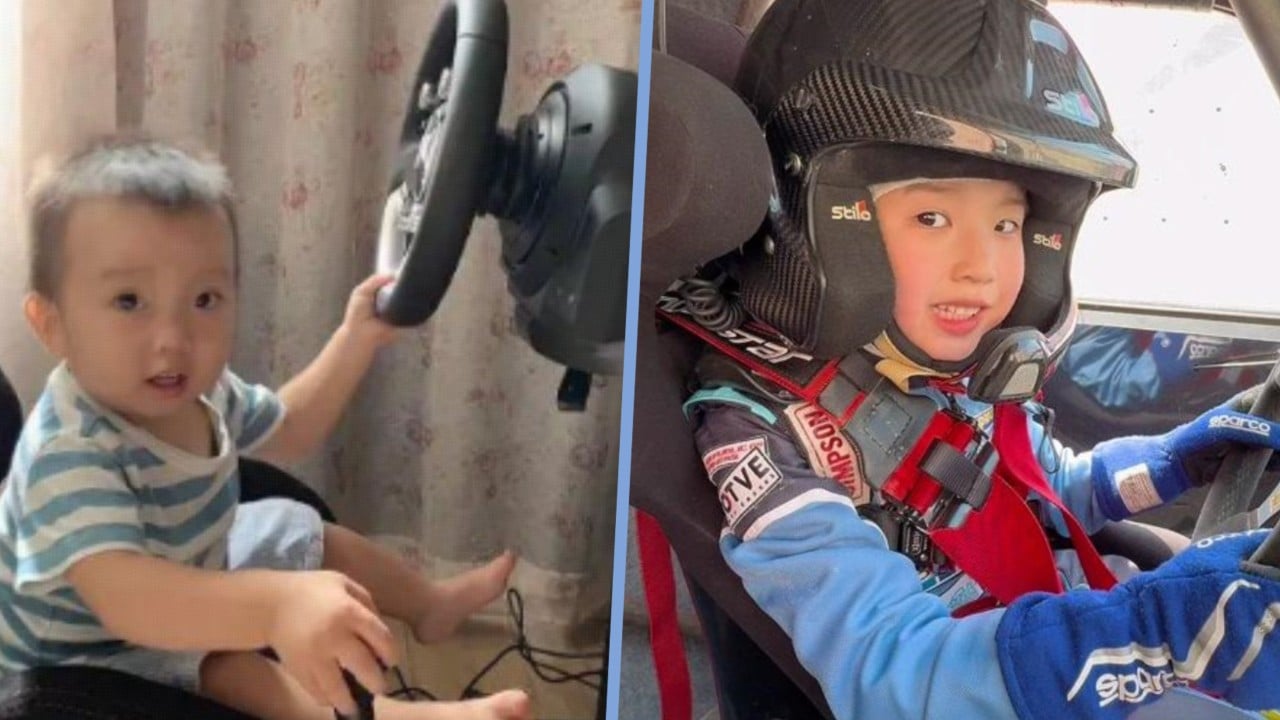
The sight of a child who hasn’t yet mastered long division sliding a modified rally car through a dirt hairpin at 60 kilometers per hour is no longer a fever dream in China’s burgeoning motorsport scene. Sun Ruohang, a seven-year-old from Zhejiang province, recently made headlines as the nation's youngest professional rally driver, having reportedly begun his journey behind the wheel at the age of one. While the viral clips of his precise steering and calm demeanor suggest a natural-born talent, they mask a massive, high-pressure industry that is fundamentally reshaping the concept of "youth sports" in the East.
Ruohang isn't an isolated fluke. He is the vanguard of a new generation of "racing babies" fueled by affluent parents and a state-backed push to turn China into a global motorsport powerhouse. To understand how a seven-year-old earns a professional license, you have to look past the cute racing suits and into the grueling mechanics of early-onset professionalization.
The One Percent Pipeline
The path to a professional rally license in China for a minor is not a matter of simply showing up at a track. It requires a staggering investment of both capital and time that separates the elite from the merely interested. For Sun Ruohang, the "career" started with electric toy cars before he moved into custom-built karts and eventually gasoline-powered rally vehicles modified with pedal extensions and raised seating to accommodate his small frame.
Industry insiders estimate that maintaining a competitive edge for a child driver at this level costs upwards of 700,000 to 1.2 million RMB ($100,000 to $165,000 USD) annually. This covers track fees, specialized coaching, vehicle maintenance, and travel across China’s vast geography to attend sanctioned events. The Federation of Automobile and Motorcycle Sports of China (CAMF) has increasingly lowered the barriers for entry-level licensing in controlled environments, allowing children to bypass the traditional age requirements found in public driving laws.
The motivation for parents is rarely just a hobby. In a society where academic competition is soul-crushing, motorsport offers a "blue ocean" strategy—a way for a child to stand out in a field where the competition, while wealthy, is numerically smaller than the millions vying for spots at top universities.
The Physics of a Seven Year Old Driver
There is a legitimate physiological concern when placing a child in a high-G environment. A seven-year-old’s skeletal structure is still maturing. Specifically, the cervical spine and neck muscles are not fully developed to handle the sudden lateral forces of a rally stage or the impact of a high-speed collision.
Engineers working with these young drivers have to get creative.
- Custom Cockpits: High-density foam inserts are used to wrap the child in the seat, ensuring they don't slide during heavy cornering.
- Modified Linkages: Throttle and brake sensitivity are often re-mapped to ensure a child's lower leg strength can actually trigger a full emergency stop.
- Weighted Steering: Power steering systems are tuned to be lighter, as the physical torque required to turn a rally tire on gravel can exceed a child’s upper body capacity.
The mental load is equally heavy. Sun Ruohang's training involves analyzing telemetry data—graphs showing braking points, apex speeds, and throttle percentages. This is a level of data literacy usually reserved for university students or professional engineers. While his peers are playing video games, he is living one, with real-world consequences for every miscalculation.
The Myth of the Natural Born Driver
We love the narrative of the "chosen one," the child who crawled toward a steering wheel instead of a rattle. However, the reality is far more clinical. Sun Ruohang’s father, a racing enthusiast himself, acted as the primary architect of his son’s environment. By the age of two, the boy was reportedly spending hours a day in a high-end simulator.
This isn't just "playing cars." It is deliberate practice, a psychological concept where every action is monitored and corrected. By the time Ruohang sat in a real car, he had already logged thousands of virtual kilometers. This "head start" creates a gap between him and other children that looks like magic but is actually just the result of a massive head-start in muscle memory.
Critics argue that this robs a child of their autonomy. If you start a career at age one, you haven't "chosen" it; you’ve been programmed for it. The counter-argument from the Chinese racing community is that this is no different from the elite gymnastics or diving programs that have produced Olympic gold medalists for decades. The car is simply the new balance beam.
Safety and the Regulatory Gray Zone
Rallying is inherently more dangerous than track racing. There are no gravel traps or runoff areas on a mountain pass. While Ruohang competes on closed circuits or "super special stages" designed for safety, the sport still carries a risk profile that makes some observers uneasy.
China’s current regulations for youth motorsport are a patchwork. While the CAMF provides a framework, the enforcement of safety standards at private tracks can be inconsistent. There is no long-term data on the impact of high-speed racing on the neurological development of children under ten. The adrenaline and cortisol spikes associated with competitive racing are significant, and we are effectively conducting a live experiment on a handful of young subjects.
The Numbers Behind the Trend
| Metric | Youth Karting (Standard) | Professional Youth Rally (Sun Ruohang Level) |
|---|---|---|
| Starting Age | 5-7 years | 1-3 years |
| Annual Budget | $15,000 - $30,000 | $100,000+ |
| Training Frequency | Weekends | 4-5 days per week |
| Support Staff | Parent/Mechanic | Dedicated Coach, Data Engineer, Manager |
The Commercial Engine
Why is this happening now? The Chinese automotive market is the largest in the world, but it lacks the "car culture" legacy of Europe or the United States. Domestic brands like Geely, BYD, and Lynk & Co are desperate to build a heritage. They need heroes.
A seven-year-old boy who can out-drive adults is a marketing goldmine. He represents the "New China"—tech-savvy, fearless, and globally competitive. Sponsors are already circling. The goal is to find the first Chinese Formula 1 champion or a WRC legend. By starting them at one year old, the industry is trying to compress thirty years of Western racing history into a single generation.
The pressure on these children is immense. In traditional sports, a mistake means a missed goal. In rally, a mistake can mean a rollover. Sun Ruohang has shown remarkable composure, but he is still a child who occasionally cries when he loses or gets frustrated with his performance. The line between "supportive father" and "demanding manager" is often blurred in the pits.
The Future of the Prodigy Model
As Sun Ruohang grows, his biggest challenge won't be the dirt tracks of Zhejiang, but the transition to the global stage. European and American racing ladders are unforgiving. Many "prodigies" burn out by age 14, exhausted by a decade of professional-level stress before they’ve even hit puberty.
The success of this model depends on whether the Chinese racing infrastructure can support these kids as they age out of the "cute" phase and into the hyper-competitive junior formulas. If the investment dries up when they are no longer a novelty, we are left with teenagers who have world-class driving skills but few other life experiences.
Watch the footage of Ruohang shifting gears. His hand barely reaches the lever. His eyes are fixed on the horizon, scanning for the next turn with a focus that most adults can't muster for five minutes, let alone an entire race. It is an impressive, terrifying, and quintessentially modern spectacle.
The racing world should stop looking at Sun Ruohang as a "cute kid" and start seeing him as a serious competitor in a high-stakes industrial strategy. Whether this leads to a podium in Monte Carlo or a cautionary tale about the limits of parental ambition remains to be seen.
Investigate the local karting tracks in your own region to see how the "prodigy" model is being adapted for local markets, as the shift toward younger and younger entry points is a global phenomenon that shows no signs of slowing down.