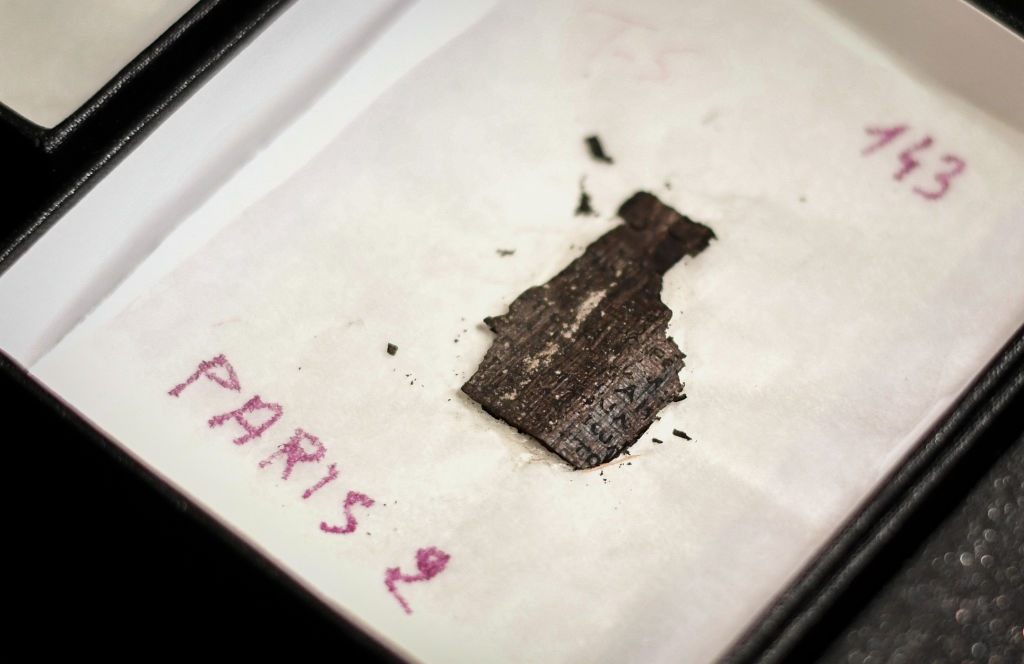
Academics are hyperventilating over a charred lump of carbonized ash.
The media calls it a triumph of multi-spectral imaging and machine learning. Virtual unwrapping technology, powered by particle accelerators and high-resolution CT scans, has allegedly cracked open the lost library of Herculaneum, buried by Mount Vesuvius in 79 AD. The consensus is deafening: we are on the verge of a cultural renaissance, rescuing lost classical philosophy from the dead hands of time.
It is a beautiful narrative. It is also an expensive delusion.
As someone who has spent two decades tracking the intersection of digital archaeology and classical historiography, I have watched institutions dump millions of dollars into reading these blackened papyri. The technical achievement of reading ink through layers of carbonized plant matter is undeniable. The actual ROI for human knowledge? Effectively zero.
We are spending bleeding-edge resources to read the ancient equivalent of a mediocre blog feed. It is time to pull the plug on the romantic hype and look at what these scrolls actually contain, why the technology is a distraction, and how our obsession with the Vesuvius scrolls is actively damaging our understanding of the ancient world.
The Echo Chamber of Philodemus
The foundational lie of the Herculaneum scroll hype is that we are unlocking a treasure trove of diverse ancient wisdom. We are not.
To understand why, you have to look at whose house actually burned down. The Villa of the Papyri belonged to Lucius Calpurnius Piso Caesoninus, Julius Caesar’s father-in-law. Piso had a live-in philosopher named Philodemus of Gadara. Philodemus was a mid-tier Epicurean intellectual. He was not Aristotle. He was not Sophocles. He was an academic bureaucrat who kept copies of his own dense, pedantic essays alongside a few standard texts by Epicurus and Metrodorus.
The scrolls recovered so far do not contain lost plays of Aeschylus or missing books of Livy. They contain Philodemus arguing about music theory, Philodemus complaining about rhetoric, and Philodemus sycophantically defending Epicurean theology.
- The "Discovery": Text discussing food, music, and physical pleasure.
- The Reality: It is a 2,000-year-old lifestyle column.
Imagine a catastrophic event burying a modern billionaire's mansion, and future archaeologists spending billions of dollars to meticulously reconstruct a hard drive containing nothing but 800 drafts of a single wellness influencer's Substack. That is the Villa of the Papyri. We are hyper-focusing on a single, highly biased, elite household library that represents an extreme minority view in the ancient Mediterranean.
The High Cost of Tech-Tourism in Archaeology
Silicon Valley loves the Herculaneum scrolls because they provide a perfect PR playground. You get to combine particle physics, AI competitions, and classical antiquity into a neat package that looks great in a pitch deck or a grant proposal.
But this is tech-tourism, and it creates a massive distortion in archaeological funding. While millions of dollars flow into training neural networks to detect micro-fragments of ink on a single carbonized scroll, actual physical heritage sites across the globe are collapsing from neglect.
Consider the trade-offs. The high-energy X-ray phase-contrast tomography required to scan these scrolls requires shipping artifacts to facilities like the European Synchrotron Radiation Facility (ESRF) in Grenoble. The data processing demands massive cloud computing budgets.
Meanwhile, thousands of uncatalogued, legible papyri sit rotting in museum basements in Cairo, Oxford, and Berlin. They do not need synchrotrons. They do not need AI competitions. They just need human eyes and standard translation, but they languish because translating a mundane 3rd-century tax receipt from Roman Egypt does not make for a viral tech headline.
We have elevated the method of discovery over the value of the discovery. The medium has completely swallowed the message.
The Premise of the "Lost Knowledge" Fallacy
People frequently ask: "But what if we find something world-changing hidden in the deeper layers?"
This question fundamentally misunderstands how ancient text transmission worked. The texts that truly shaped Western and Eastern thought did not survive by accident in a volcanic blast; they survived because generations of scribes deemed them important enough to copy, translate, and preserve.
The idea that a world-changing philosophical breakthrough was exclusively trapped in a single villa in Campania is a Hollywood plot device. If a philosophical school had ideas that were genuinely functional or disruptive, those ideas radiated outward into the broader intellectual ecosystem of the Roman Empire. Philodemus was preserved by disaster precisely because his work wasn't widely copied—it was a localized, stagnant collection.
Flipping the Script: Where the Real Data Sits
If the goal is to understand the ancient world as it actually was, we must stop looking at the top 0.01% of Roman high society. Philodemus's musings tell us nothing about the mechanics of the Roman economy, the lives of the enslaved populations who built the Villa of the Papyri, or the shifting cultural dynamics of the early Empire.
To get real data, you have to look where the tech companies aren't looking:
1. The Oxyrhynchus Papyri Trash Heaps
For over a century, the ancient garbage dumps of Oxyrhynchus, Egypt, have yielded private letters, grocery lists, court documents, and minor literary fragments. This is raw, unvarnished history. It tells us how much bread cost, how people divorced, and how diseases spread. Yet, funding for papyrology departments worldwide is shrinking, forcing experts out of academia while AI engineers play with volcanic charcoal.
2. Epigraphic Databases
Tens of thousands of stone inscriptions across the Mediterranean remain unanalyzed by modern data models. These inscriptions record the actual laws, building projects, and funerary sentiments of ordinary people. They are fully legible, sitting in the open air, weathering away while we obsess over Piso’s library.
The Technical Trap of Virtual Unwrapping
Let us look closely at the mechanics of the technology itself. The software relies on flattening a 3D volumetric scan of a warped, compressed, and distorted cylinder into a 2D plane.
This process requires a terrifying amount of algorithmic interpretation. The AI is trained to recognize patterns that resemble ink. In any machine learning model, when you train a system to find a specific pattern in high-noise data, it will find that pattern—even if it has to hallucinate parts of it to get there.
The potential for confirmation bias is staggering. When researchers are desperate to find text to win a global prize, the line between "discovering" a letter and "forcing" a letter through algorithmic smoothing becomes incredibly thin. We are trusting black-box models to reconstruct texts where a single misread character changes an entire verb tense or philosophical concept. It is a philological minefield built on top of a statistical guess.
Stop Scanning Ash
The Herculaneum scroll project is a masterclass in modern distraction. It satisfies our craving for technological novelty while offering the illusion of historical depth. It allows tech billionaires to feel like Medici patrons without requiring them to engage with the messy, unglamorous reality of systemic historical preservation.
We do not need more reconstructed fragments of Epicurean navel-gazing. We do not need another press release about a neural network reading the word "purple" through a burnt crust.
We have enough elite Roman philosophy. We have Seneca. We have Marcus Aurelius. We have Cicero. We know exactly how wealthy Romans justified their privilege and spent their leisure time. Reading Philodemus’s lecture notes will not change a single fundamental truth about human history.
Turn off the synchrotrons. Reallocate the grants. Send the engineers to digitize the millions of legible, crumbling documents we already have before they turn to dust naturally. Stop looking for answers in the ashes of a billionaire’s vacation home.


