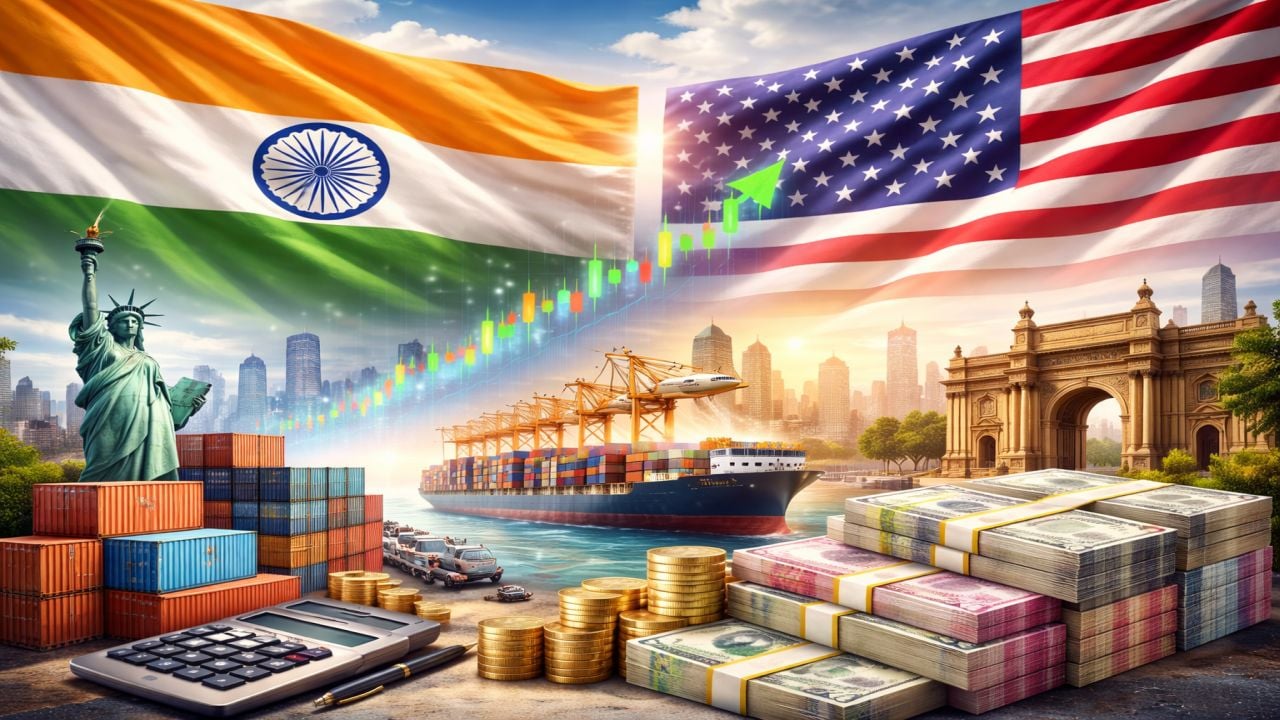
A cargo ship sitting in the harbor at Mumbai is not just a collection of steel and diesel. To the man standing on the pier, it is a promise. He is a small-scale textile exporter, perhaps named Arjun, who spent his youth watching his father struggle with the labyrinth of international tariffs. He remembers the old days when "preferential access" was a phrase whispered in government corridors but never felt in the bank account.
Now, the air feels different.
The news filtering out of the Ministry of Commerce isn't just about spreadsheets or diplomatic niceties. Piyush Goyal, India’s Commerce and Industry Minister, recently signaled that the first "tranche"—a clinical word for a very human slice of opportunity—of a trade deal with the United States is nearly finalized. For Arjun, this isn't data. It is the difference between hiring five new weavers or telling his cousin there is no work this winter.
The Invisible Walls We Build
We often think of trade as a simple exchange, like buying bread at a corner store. In reality, it is a series of invisible walls. These walls are built of taxes, quotas, and "most-favored-nation" clauses that sound friendly but often feel like a cold shoulder.
The United States and India have spent years circling one another like wary dancers. One is the world’s oldest democracy; the other is the world’s largest. They should be natural partners, yet for decades, the friction of protectionism kept them at arm’s length. When the U.S. removed India from the Generalized System of Preferences (GSP) years ago, it wasn't just a policy shift. It was a tax on the ambition of thousands of Indian entrepreneurs. It made their products more expensive for American families, and it made their dreams more expensive to maintain.
Goyal’s announcement that the focus is shifting toward "preferential access" suggests those walls are finally thinning.
Think of preferential access as a VIP pass to a global concert. While everyone else is waiting in the rain at the back of the line, those with the pass walk through the side door. In trade terms, it means lower duties on specific goods. It means an Indian-made leather jacket or a box of high-precision machine parts can compete on an even playing field with goods from countries that have had these deals for decades.
A Tranche of Reality
Negotiating a trade deal is a brutal, unglamorous slog. It happens in rooms where the coffee is stale and the stakes are measured in billions. The word "tranche" implies that the two nations have stopped trying to solve every problem at once. They have realized that perfection is the enemy of the good.
Instead of waiting for a grand, all-encompassing treaty that might take another decade to draft, they are carving out the wins they can achieve right now. This first slice focuses on the low-hanging fruit—the sectors where both sides can agree that more trade is better than less.
Why does this matter to someone living in a suburb of Chicago?
Consider Sarah. She’s a researcher at a pharmaceutical lab. To her, the "India-US trade deal" sounds like something she’d skip over in the morning paper. But if that deal includes easier access to active pharmaceutical ingredients (APIs) from India, the cost of the medicine she develops might drop. The supply chain that was so fragile during the pandemic becomes a bit more resilient. A deal between two ministers in Delhi becomes a lower medical bill for a family in the Midwest.
The connection is direct. It is visceral.
The Language of Trust
Trade is rarely about the things being traded. It is about trust. You do not sign a deal for a "first tranche" with someone you expect to disappear tomorrow.
India has been recalibrating its global position. The shift away from massive, multi-lateral blocks toward bilateral agreements—one-on-one deals—shows a new kind of confidence. It is a declaration that India is no longer just a "developing market." It is an indispensable partner.
Goyal’s optimism isn't just political theater. It reflects a shift in the global gravity of power. As companies look to diversify away from a single-source manufacturing base in East Asia, India stands as the logical alternative. But logic isn't enough. You need the paperwork. You need the legal framework that says, "Your investment is safe here, and your goods will move freely there."
The Friction of the Fine Print
Of course, there is hesitation. There is always hesitation.
Critics will point to the "sensitive sectors." Agriculture is the classic example. An Indian farmer tilling a small plot in Punjab looks at the industrial-scale farming of the American plains with a mixture of awe and terror. He wonders if a trade deal means his local market will be flooded with cheap, subsidized corn.
Conversely, an American tech worker might worry that "easier trade" is just a euphemism for outsourcing more jobs. These fears are real. They are the reason these negotiations take years.
But the "first tranche" strategy is a clever way to bypass the fear. By starting with areas where there is clear mutual benefit—like textiles, certain electronics, or specialized engineering—the two nations can build the muscle memory of cooperation. Success breeds success. Once the first slice of the deal is signed and the sky doesn't fall, the second slice becomes much easier to swallow.
The Human Cost of Delay
Every month that passes without these agreements is a month of lost potential.
We talk about "trade volume" as if it’s a volume knob on a stereo. Turn it up, the economy gets louder. Turn it down, it gets quieter. But for the people on the ground, that "volume" represents life choices.
It represents the daughter of a factory worker in Tamil Nadu who can now afford to go to university because her father’s factory secured a massive order from a retailer in New York. It represents the American small business owner who can finally afford to import the specific grade of steel he needs to build his custom bicycles, because the "preferential access" Goyal mentions finally became a reality.
The minister’s words were carefully chosen. He spoke of "finalising" and "focus." These are the words of a man who knows the finish line is in sight, but also knows how many people are counting on him to cross it.
Beyond the Ink
When the pens finally touch the paper, there won't be a sudden flash of light. The world will look much the same as it did the day before.
But slowly, the gears will begin to turn. A shipping container will move through customs a few hours faster. A tariff that used to be 10 percent will drop to 5 percent. A company in Bengaluru will decide to take a risk on a new product line because they know the American market is finally open to them.
This isn't just about "India-US trade."
It is about the slow, painful, beautiful process of knitting the world back together. It is about recognizing that in a world of rising walls, the most radical thing two nations can do is build a bridge.
The first tranche is just the first stone of that bridge. It is a small stone, perhaps. But it is a heavy one, and it is being placed with purpose.
The man on the pier in Mumbai watches the ship leave. He doesn't care about the term "bilateral trade mechanisms." He cares that the ship is full. He cares that there will be another one tomorrow.
He turns back to his office, picks up the phone, and starts a conversation he couldn't have had a year ago. That is the real trade deal. The one that happens in a thousand small offices, in two different languages, across twelve time zones, fueled by the sudden, startling realization that the wall is finally coming down.