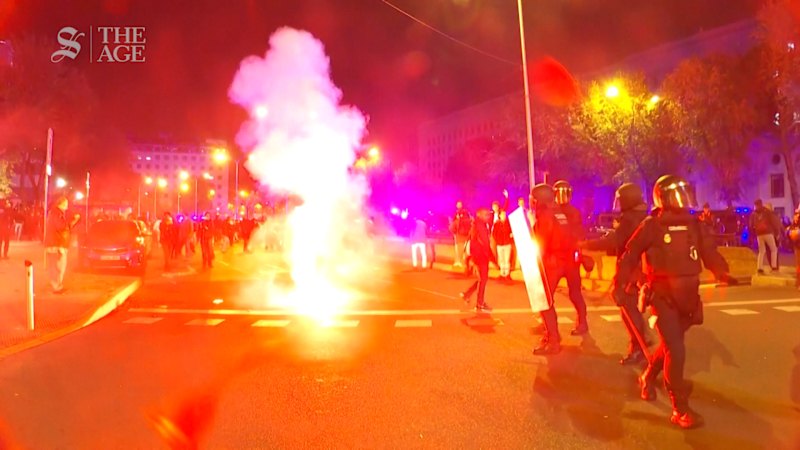
The smell of burnt rubber and tear gas does not wash out of wool easily. It clings to the fibers for days, a sour, metallic reminder of the night a vigil turned into a battleground.
If you stand near the Atocha station or the wide avenues of central Madrid in the aftermath of a public tragedy, you learn to read the temperature of the asphalt. You can feel it through the soles of your shoes before a single bottle is thrown. First comes the silence—that heavy, suffocating quiet that follows a catastrophic rail failure, when commuters stare at departure boards and calculate how many minutes separated them from the wreckage. Then comes the grief. And finally, if the air is thick enough with political desperation, come the men in black hoodies who didn't know a single soul on that train. Meanwhile, you can explore similar developments here: What Happens When a Medical Emergency Hits Pregnant British Expats in Dubai.
Consider a hypothetical commuter—let’s call her Elena, a nurse finishing a double shift in central Madrid, clutching a paper cup of lukewarm coffee as she walks past the police barricades. She isn't there to topple a government. She is there because she rides the Cercanías line every morning, because she trusts the steel tracks beneath her feet to carry her home, and because she wants to light a candle for the dead. When the first flare arcs over the riot shields and the sound of shattering glass replaces the murmur of prayers, Elena doesn't feel represented. She feels robbed.
That theft is the real story behind the recent clashes between far-right agitators and national police in Madrid following the deadly train crash. Standard news reports reduce the night to an equation of arrest counts, injured officers, and broken cobblestones. They treat the violence as an unfortunate byproduct of public anger. They miss the darker, more calculated reality: grief is the most vulnerable state a democracy can enter, and extremist groups treat national mourning like an open vault. To see the complete picture, we recommend the detailed report by The Washington Post.
The Anatomy of a Hijacked Vigil
To understand what happened on the streets of the Spanish capital, you have to understand how modern street agitation operates. It rarely starts with an explicit call to riot. Instead, it begins on encrypted messaging channels hours after the first emergency sirens fade at the crash site.
While rescue workers are still cutting through twisted aluminum and families are waiting in hospital corridors for identification lists, a parallel operation begins online. Accounts tied to ultranationalist and far-right networks begin circulating unverified rumors about the crash. They frame infrastructure failure not as a complex engineering or bureaucratic crisis, but as deliberate treason by the sitting government. They call for a "spontaneous" gathering in the heart of Madrid, using the language of solidarity, patriotism, and justice for the victims.
By the time evening falls, two entirely different crowds arrive at the same plaza.
The first group consists of ordinary citizens—commuters, neighbors, relatives, and union workers—drawn by shock and a need for collective mourning. They bring candles, flowers, and handwritten cardboard signs demanding accountability for rail safety. They stand still. They look at the ground.
The second group arrives in coordinated formations. Many wear face coverings, reinforced gloves, and dark clothing devoid of overt party logos, a deliberate tactic designed to blend into the periphery until the cameras turn on. They position themselves near the front lines of the police perimeter, directly across from the Unidad de Intervención Policial—Spain's riot control units, standing shoulder to shoulder in helmets and visors.
Violence.
It takes less than thirty seconds to transform a memorial into a melee. A barrage of rocks, flares, and metal barriers erupts from the front ranks of the agitators. When police charge to clear the perimeter, the extremists retreat directly into the crowd of peaceful mourners, using grieving citizens as human shields. Suddenly, the television helicopters overhead are no longer filming a nation mourning its dead; they are broadcasting a city descending into chaos.
Why Trains Carry the Weight of National Trust
Why does a rail disaster trigger this specific brand of volatility in Spain? The answer lies beneath the tracks, buried in collective memory.
In Spain, trains are never just transportation. Since the 2004 Madrid train bombings—an atrocity that killed 193 people and reshaped modern Spanish politics in seventy-two hours—and the devastating 2013 Angrois derailment near Santiago de Compostela, rail tragedies carry an almost unbearable psychological weight. A train is a social contract made of iron. You buy a ticket, step inside a sealed metal tube, and hand complete control of your survival to the state's engineering, maintenance protocols, and regulatory oversight.
When that contract breaks in a fatal crash, the public experiences a profound vertigo. People ask legitimate, urgent questions: Were the tracks inspected on schedule? Did budget cuts hollow out safety systems? Were warning signals ignored?
These questions demand technical investigations, black-box telemetry, and transparent parliamentary audits. They require patience, precision, and accountability.
Far-right groups despise patience because patience allows institutions to function. Their political survival depends on convincing the public that the entire democratic system is rotten beyond repair—that courts are rigged, journalism is fake, and infrastructure collapses because the state itself is an enemy of the people. A deadly train crash provides the ultimate visual metaphor for their worldview: the modern state literally derailing.
Think of a grieving crowd as a pressurized room filled with oxygen. The sorrow is real. The anger at administrative negligence is justified. All a bad-faith actor needs to do is strike a single match at the doorway, step back, and watch the explosion consume everything inside.
The Invisible Stakes of Street Chaos
It is tempting to look at street clashes in Madrid as a localized spectacle—a rough night for municipal cleanup crews and a talking point for morning radio shows. That perspective ignores the long-term damage inflicted on the survivors and the public sphere.
First, street violence suffocates genuine accountability. In the days following the Madrid protests, media coverage pivoted sharply away from rail safety protocols and ministry budgets. Instead of grilling transportation officials about signal maintenance and track sensors, journalists spent prime-time segments analyzing riot police tactics, counting burned dumpsters, and debating public order laws. For negligent bureaucrats, a far-right riot is an accidental gift; it changes the subject from their failures to the spectacle of street crime.
Second, it fractures the civic solidarity required to support victims. Associations of crash survivors and bereaved families frequently have to issue frantic statements distancing themselves from the violence committed in their names. Imagine burying a sibling on a Tuesday and spending Wednesday morning begging television anchors to clarify that your family does not endorse neo-fascist street brawlers throwing cobblestones at paramedics. It is a second victimization, quieter than the crash itself, yet devastatingly cruel.
Finally, these clashes test the restraint of democratic policing in ways that carry massive political risk. Riot officers in Madrid operate under intense scrutiny. If they hold back while projectiles rain down, extremists claim the state is weak and retreating. If they advance aggressively with batons and rubber bullets to disperse a crowd mixed with innocent bystanders, images of bruised civilians circulate globally, feeding the very narrative of state tyranny the agitators wanted to manufacture in the first place.
I have stood on the edge of these cordons in European capitals and watched the confusion in the eyes of young police officers barely out of their twenties, gripping shields while middle-aged citizens scream at them from one side and organized radicals hurl paving stones from the other. Nobody looks victorious when the smoke clears. Everyone looks exhausted, brittle, and slightly more afraid of their neighbors than they were the day before.
How Democracies Disarm the Spectacle
If extremists rely on the collision of genuine grief and manufactured rage, the antidote is neither censorship nor brute force alone. It is clarity—ruthless, rapid, and transparent institutional clarity.
When a catastrophe strikes, silence from official channels creates an information vacuum, and extremists are masters at filling vacuums with poison. Public authorities must release verified technical data, maintenance logs, and preliminary investigation timelines with unprecedented speed. When citizens see concrete evidence that an independent inquiry is underway, the conspiracy theories lose their oxygen.
At the same time, civil society—labor unions, neighborhood associations, and victim advocacy groups—must actively reclaim the physical spaces of mourning. Holding vigils during daylight hours, establishing clear marshal systems to isolate provocateurs, and physically separating memorials from political rallies denies extremists the cover they need to operate. In several Spanish cities, community organizers have learned to simply sit down on the pavement the moment agitators begin throwing objects, exposing the violent minority to cameras and police lines with surgical precision.
Journalism, too, carries a quiet responsibility here. Every time a news outlet leads with burning barricades rather than the names of the dead or the mechanical causes of a crash, it rewards the exact behavior the agitators came to perform. Showing the riot is necessary; letting the riot erase the tragedy is a choice.
After the Sirens Fade
Walk through central Madrid forty-eight hours after the clashes, and the city appears remarkably composed. Street sweepers have cleared the shattered glass. Municipal workers have scrubbed the soot from the granite facades. Commuters once again descend the escalators into the metro and rail stations, headphones on, eyes fixed on their phones, trusting the schedules and the steel beneath them.
Yet near the station entrance, tucked against a concrete pillar out of the wind, a small cluster of wax candles still burns beside a soggy bouquet of white lilies and a laminated photograph of a smiling young man who never made it home.
Nobody is shouting near the pillar. No cameras are rolling. An elderly woman pauses, crosses herself, adjusts a fallen flower stem, and walks quietly toward the platform—leaving the street to the living, and the truth to anyone patient enough to look past the smoke.


