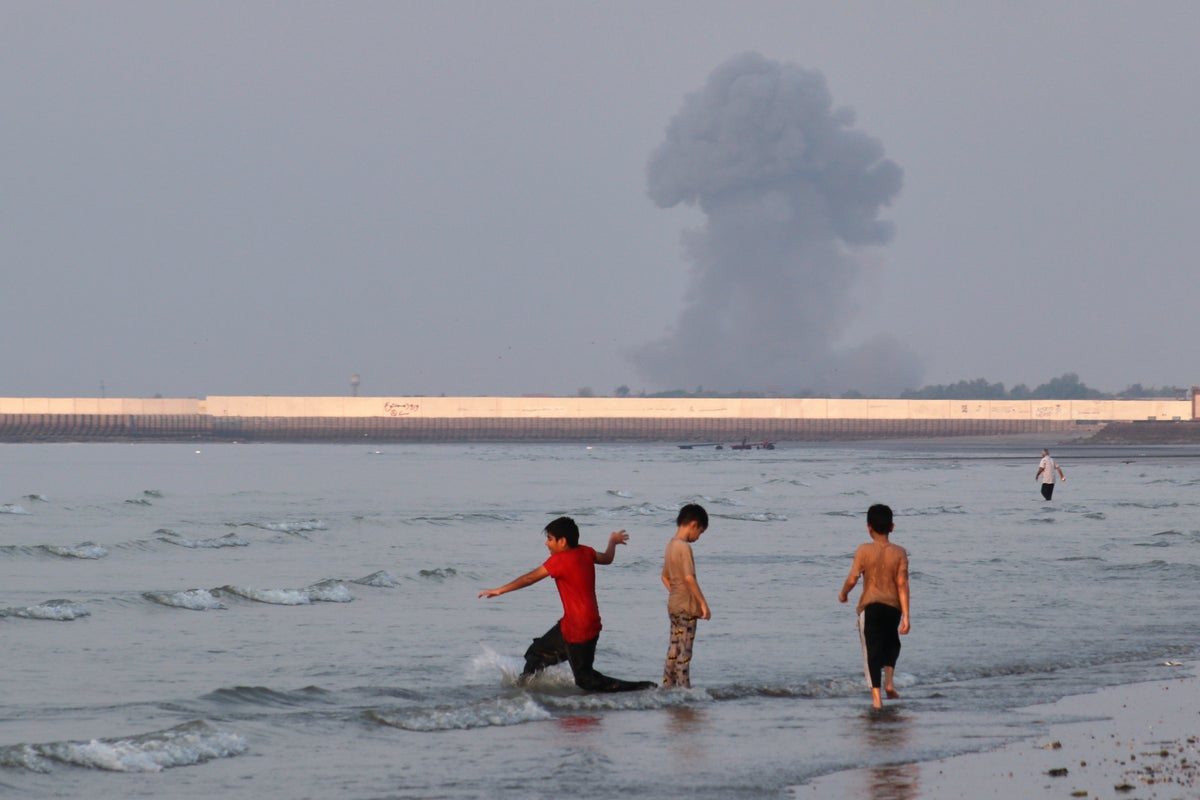
The sea is a silent witness to a very loud economic war.
For decades, the global energy market operated on a simple, fragile promise: that a twenty-one-mile-wide strip of water separating Oman and Iran would remain open. The Strait of Hormuz was the jugular vein of the modern world. One-fifth of the globe’s oil supply quietly drifted through its narrow lanes every single day.
But when regional hostilities erupted into active warfare, that promise dissolved.
Consider the perspective of a tanker captain idling in the Gulf of Oman. To the north lies a maritime graveyard of drone strikes, soaring insurance premiums, and naval blockades. To the south, a frantic, multi-billion-dollar engineering race is unfolding beneath the desert sands.
For the nations of the Gulf Cooperation Council, the current crisis has transformed a long-term strategic worry into an immediate battle for economic survival. The geography that made them wealthy has suddenly become their prison. Now, they are trying to drill, build, and pave their way out.
The Prison of Geography
Not all Gulf nations are trapped equally.
Look at a map of the Arabian Peninsula and the desperation of this race becomes clear. Countries like Kuwait, Qatar, and Bahrain are locked into the Persian Gulf. They have no alternative coastlines, no escape hatches.
When the conflict effectively choked off transit through the Strait, the economic shock was immediate. Kuwait, for instance, was forced to scale back its crude production to a mere quarter of its pre-conflict capacity. Its reservoirs, once the source of unimaginable national wealth, had to be shut in, left to settle and recharge underground because there was simply nowhere for the oil to go.
But on the outer edges of the peninsula, Saudi Arabia and the United Arab Emirates are attempting a colossal geographic bypass. They are rewriting the map.
The Long Desert Pipe
In Saudi Arabia, the answer to the Hormuz bottleneck is a 1,200-kilometer scar of steel cutting through the inhospitable Rub' al Khali desert.
This is the Petroline—the East-West Crude Oil Pipeline. Originally laid down during the geopolitical anxieties of the 1980s, the Petroline connects the massive Abqaiq processing complex in the east to the Red Sea port of Yanbu in the west.
In theory, the system can carry 7 million barrels of crude per day. In reality, the bottleneck has merely shifted from the water to the shore.
The port facilities at Yanbu were designed for normal, peacetime operations, not to absorb the entire weight of a global energy crisis. While the pipe underground can transport massive volumes, the loading terminals on the Red Sea can realistically only handle about 3 to 4 million barrels per day under wartime stress. Furthermore, Saudi Arabia must feed its own massive domestic refineries along the Red Sea before a single drop of export crude can even leave the dock.
Worse still, bypassing the Strait of Hormuz does not mean escaping geopolitical risk. It merely trades one danger zone for another.
Tankers leaving Yanbu must navigate the Red Sea and pass the Bab el-Mandeb strait, where Houthi militants continue to threaten commercial shipping. It is a grim game of geographical whack-a-mole. Every bypass has a blind spot.
The Choke Point on the Coast
On the eastern coast of the peninsula, the United Arab Emirates is pursuing its own parallel escape route.
The Habshan–Fujairah pipeline stretches 380 kilometers across rugged mountain terrain, carrying Abu Dhabi’s inland oil to the bustling port of Fujairah, situated safely outside the Persian Gulf.
Fujairah was supposed to be the ultimate safe haven. But the realities of modern warfare have punctured that illusion.
Pipelines are only as safe as the terminals at the end of them. If an adversary cannot easily block a deep-sea channel, they can launch low-cost drones at the compression stations and offshore loading buoys. Fujairah has already been targeted multiple times, proving that in the age of long-range precision strikes, "outside the Strait" is a relative term.
Despite the risks, the UAE is doubling down. The country recently took the historic, dramatic step of ending its 59-year membership in OPEC, freeing itself from production quotas so it can maximize its own strategic infrastructure.
Crown Prince Sheikh Khaled bin Mohamed bin Zayed announced the acceleration of a new West-East pipeline project, aiming to double Fujairah's export capacity. At the same time, DP World is quietly planning a massive new multipurpose port and terminal in Fujairah to alleviate pressure on Jebel Ali, the crown jewel of Dubai's trading empire that sits vulnerably inside the Gulf.
The ambition is clear: to bypass Hormuz completely. But the timeline is measured in years, not weeks.
The Brotherhood of the Pipeline
In the face of this existential threat, a strange new cooperative chemistry is forming among the Gulf states.
Historically, these monarchies have operated as fierce commercial rivals, competing for market share and global influence. Now, survival requires sharing.
Kuwait, entirely cut off from the sea, is actively negotiating with Saudi Arabia and the UAE to connect its northern fields to their southern bypass pipelines. The concept is simple but legally and logistically head-spinning: Kuwaiti crude would flow through Saudi and Emirati pipes to ports on the Red Sea or the Gulf of Oman.
Under an informal, reciprocal agreement known among GCC members, if one nation cannot export its oil, neighbors with spare capacity can export on their behalf and "tally it up" later.
But this system relies on the existence of excess capacity. Today, there is none. Every spare inch of pipeline is being utilized, and the engineering crews working in the midday desert heat are racing against a ticking geopolitical clock.
The Mirage of a Quick Fix
It is easy for distant analysts to look at these massive infrastructure projects and assume the problem is solved.
They point to conceptual designs of a trans-peninsular canal cutting through the Hajar Mountains, or speculative subsea pipelines running from Iraq to Oman’s port of Duqm.
But engineering at this scale cannot be rushed by political will alone. A pipeline is not just a pipe. It is a highly complex, pressurized system of massive turbines, valves, and compression stations.
If a missile strikes a section of steel pipe, it can be patched in forty-eight hours. But if a drone strikes a custom-built compression facility, replacing it requires sourcing highly specialized, long-lead industrial equipment that can take eighteen months to manufacture and deliver.
The true lesson of the great Hormuz bypass is that the global economy was built on a foundation of geographic trust that no longer exists. The Gulf countries are spending hundreds of billions of dollars not to grow, but simply to stay in place—to build a redundant, highly vulnerable shadow network of steel and concrete just to ensure that when the world turns on its lights, the power actually comes on.
The Strait of Hormuz may eventually become a relic of twentieth-century shipping maps, bypassed by overland corridors and deep-water ports facing the open ocean. But until those pipes are fully pressurized, the world remains tethered to a narrow strip of volatile blue water, waiting to see which side blinks first.

