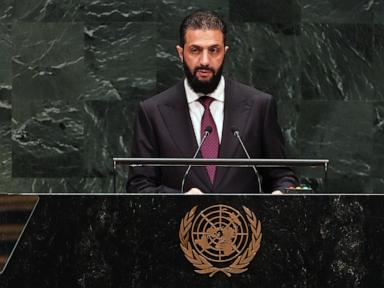
Every single year, the diplomatic circuit descends upon Turtle Bay for the United Nations General Assembly, and like clockwork, the ritualistic theater begins. A representative of the Syrian government steps up to the podium, launches into a fiery diatribe against Israel, and declares that the Golan Heights remains an inseparable, sacred fragment of the Syrian motherland. The international press corps dutifully transcribes the soundbites, academic analysts write solemn policy briefs on territorial integrity, and the global commentary machine hums along to its predictable rhythm.
It is a masterclass in collective delusion.
The lazy consensus in international relations holds that these speeches represent a principled stand for sovereignty, a legalistic battle cry demanding the return of occupied land under international law. This perspective treats geopolitics like a property dispute managed by a sluggish real estate board. It assumes that if you repeat a legal claim enough times, history will loop backward, borders will redraw themselves, and administrative reality will bend to fit a rhetorical template.
That view is dangerously naive. It completely misses the structural mechanics of modern authoritarian survival.
When a regime presides over a hollowed-out country shattered by more than a decade of civil war, economic devastation, and infrastructural collapse, it cannot offer its citizens electricity, currency stability, employment, or security. What it can offer is a villain. It can offer a grievance. The ritual invocation of the Golan Heights at the UN is not a serious diplomatic strategy aimed at territorial recovery; it is an internal pressure-release valve. It is domestic propaganda wrapped in diplomatic vocabulary, designed to direct popular frustration away from domestic misrule and toward an external scapegoat.
To understand why the conventional commentary is wrong, we have to look past the velvet-draped podiums of New York and examine how hard power actually operates on the ground.
The Fiction of Static Sovereignty
Let us define terms precisely. In international relations, sovereignty is often romanticized as an eternal, indestructible legal property. If you own the deed, nobody else can hold the title, regardless of what happens on the ground. But history operates on a different ledger. Sovereignty is sustained by institutional capacity, military deterrence, demographic integration, and economic gravity.
The Golan Heights was captured in 1967 and formally integrated into Israeli administrative law in 1981 through the Knesset's enactment of the Golan Heights Law. For over four decades, that territory has been woven completely into the economic, infrastructural, and strategic grid of a neighboring state. Water systems, agricultural cooperatives, electricity grids, and tourism infrastructure are fully synchronized with Tel Aviv, not Damascus.
When a Syrian official stands at the UN and speaks of an "inseparable part," they are describing a map that exists only in their imagination and in dusty diplomatic archives. They are ignoring the reality of hard power. A piece of land is defined by who builds the roads, who collects the taxes, who maintains the security architecture, and who projects power across its valleys. By those metrics, the separation is complete, irreversible, and has been for generations.
Yet, foreign policy pundits continue to treat these UN speeches as forward-looking policy statements rather than what they truly are: nostalgic fan fiction for domestic consumption.
The Economics of Manufactured Outrage
I have watched foreign policy analysts spend millions of dollars in research funding trying to decode the "strategic intentions" behind Damascus's foreign policy pronouncements, treating them like complex chess moves. They are not chess moves. They are defensive reflexes.
Consider the economic wreckage of Syria. The local currency has been battered into near-worthless paper. Basic commodities require ration cards or exorbitant black-market maneuvering. Millions of citizens are displaced, living either as refugees abroad or in precarious poverty at home. The state apparatus survives largely through illicit narcotics trafficking, foreign military patronage, and the systematic looting of institutional remnants.
In this environment, admitting failure is an existential threat. If the ruling elite in Damascus were to pivot toward pragmatic internal reconstruction, abandon obsolete ideological crusades, and acknowledge the permanent loss of the Golan, they would instantly strip away their primary ideological justification for absolute rule. Dictatorships built on emergency laws and perpetual states of war cannot afford peace. They require a perpetual state of resistance.
By keeping the ghost of the Golan alive in official rhetoric, the regime achieves two crucial goals. First, it binds national identity to an external struggle, making any domestic dissent look like treason. Second, it provides a convenient excuse for why the economy is failing. Every empty stomach, every rolling blackout, and every crumbling hospital is blamed not on corruption or catastrophic governance, but on the ongoing imperialist conspiracy and the theft of the southern heights.
It is a brilliant rhetorical shield. It costs nothing to deliver a fiery speech at the UN, but it pays massive dividends in shifting blame away from palace incompetence.
Dismantling the Legalistic Delusion
The standard counter-argument from institutional purists relies on United Nations Security Council Resolution 497, passed in December 1981, which declared Israel's decision to impose its laws, jurisdiction, and administration in the occupied Golan Heights null and void and without international legal effect.
Let us be brutally honest about the teeth of international law. Resolutions without enforcement mechanisms are nothing more than strongly worded pieces of paper. They do not alter military geography. They do not move armored divisions. They do not reverse demographic realities.
International law is not a moral universal code; it is a scoreboard reflecting the balance of power at a given historical moment. When a state loses a war of aggression that it initiated or joined—as was the case in 1967—the victor establishes facts on the ground. When decades pass without the defeated state possessing even a fraction of the military capability required to challenge those facts, the legalistic protestations become hollow performance art.
Continuing to validate this performance art does active harm. It encourages regional actors to live in a fantasy world where diplomatic communiqués can substitute for military deterrence or realistic statecraft. It traps generations of citizens in a cycle of grievance, teaching them that their misery is entirely the fault of external actors while shielding the actual architects of their ruin from accountability.
The Real Cost of Diplomatic Nostalgia
Clinging to this dead status quo comes with a devastating price tag. While Damascus wastes valuable diplomatic capital, ink, and airtime demanding the impossible return of a heavily fortified strategic plateau, the rest of the region is moving on.
Look at the shifting diplomatic realignments across the Middle East. Nations are pragmatically calculating their interests based on technology, trade, security cooperation, and economic corridors. They are building alliances based on shared futures rather than ancestral grievances.
By contrast, a state anchored entirely to a 1960s territorial dispute is structurally paralyzed. It cannot attract foreign investment because international capital abhors volatility and permanent hostility. It cannot modernize its economy because every resource is siphoned into maintaining a militarized security state built around a permanent phantom war.
The tragic irony is that the more the Syrian leadership shouts about the Golan at international forums, the further away they push any remote theoretical possibility of relevance in regional negotiations. They disqualify themselves as serious interlocutors. Realpolitik belongs to those who adapt to reality, not those who scream at mirrors.
The Uncomfortable Truth
The truth that nobody in the diplomatic echo chamber wants to admit is simple. The Golan Heights is not the central obstacle to peace or prosperity in Syria; it is the convenient smoke screen hiding the total institutional bankruptcy of the state.
The speech at the UN was never meant for Tel Aviv. It was meant for the impoverished citizen sitting in a dim room in Damascus, wondering why they cannot afford bread. It was designed to make them forget, if only for ten minutes, that the hand picking their pocket is not across the border, but sitting right at home.
Stop treating these pronouncements as serious geopolitical strategy. Start viewing them for what they are: the dying gasps of a rhetoric-dependent regime that has nothing left to sell its people except yesterday's borders.
The map has changed. The world has moved on. Only the speeches stay the same, echoing endlessly in an empty hall.


