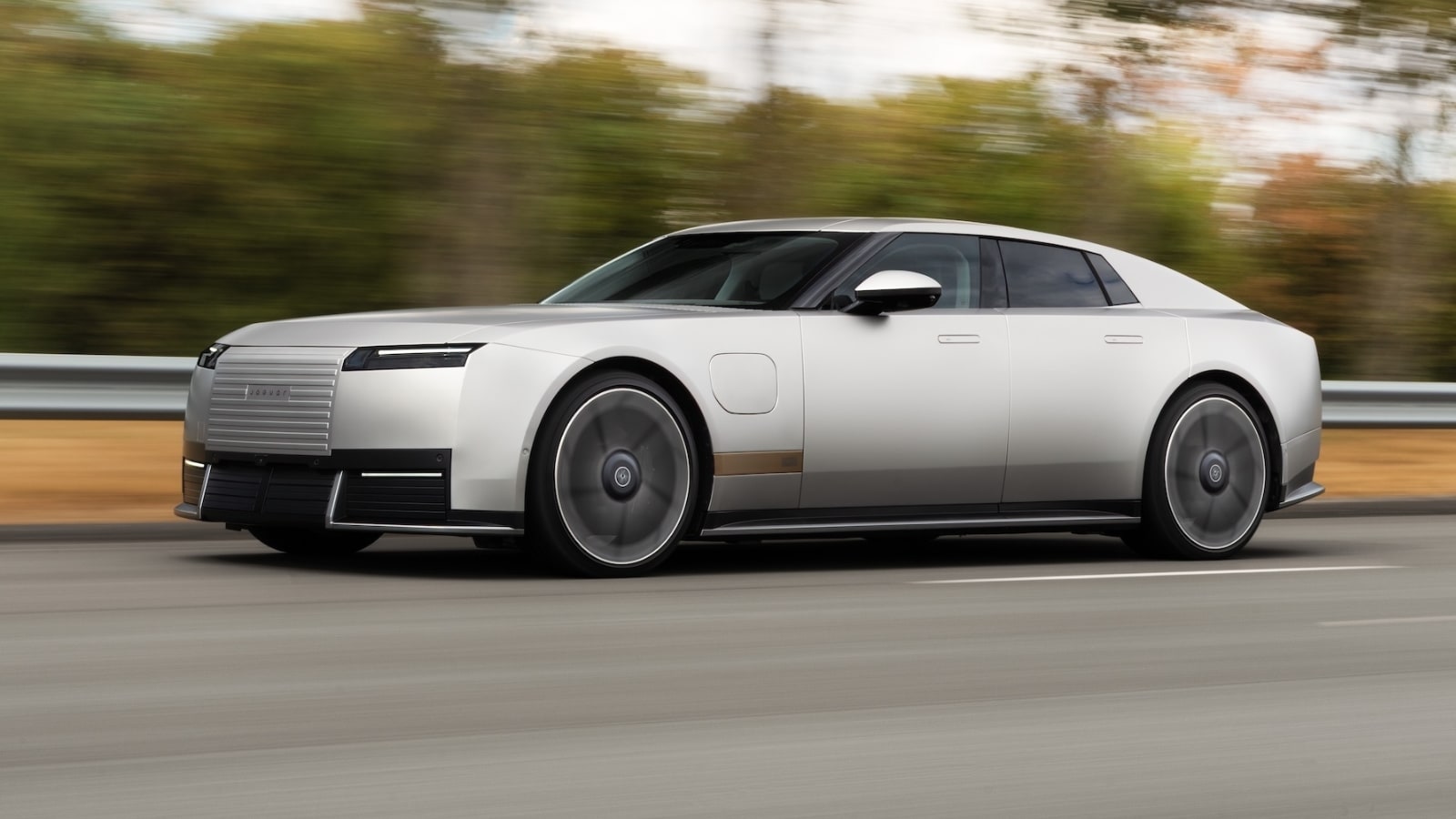
We spent a century learning how to look backward.
Every vehicle built for the mass market, from the Model T rattling down dirt roads to the chrome-laden cruisers of the mid-century, gave its driver a rearview mirror. We stared behind us. We watched the road we had already conquered, terrified of what might creep up from our blind spots. It became an instinct, hardwired into the act of driving: glance forward, check the sides, flick your eyes upward to make sure the past wasn't catching up.
Then came the Type 01.
Jaguar stripped the rearview glass entirely out of the equation.
Imagine standing at the curb on a Tuesday morning in London or Milan, watching this sleek, low-slung silhouette slide past. You look for the back window, expecting to see a reflection of the streetlamps or the faces of backseat passengers. There is nothing. Just a smooth, unbroken sweep of metal and aerodynamic contouring, curving cleanly from the roofline down to the rear bumper.
It feels unnatural. Almost unsettling.
Why build a car where you cannot see behind you?
Because the designers realized a quiet truth: we spend too much time looking where we have been, when the future is charging toward us at six hundred and forty-four kilometers on a single charge.
Let us talk about that number for a moment. Six hundred and forty-four kilometers. In miles, it hovers right around four hundred. For years, the great anxiety of electric vehicle adoption has not been the speed, nor the styling, nor even the price tag. It has been the blinking red light of range anxiety. It is the cold sweat of wondering if the charger three towns over actually works, or if you will end up stranded on a dark shoulder with a dead battery and a ruined evening.
Range anxiety is a psychological parasite. It changes how you drive. It forces you to turn off the climate control on a freezing winter night. It makes you bypass scenic detours because every extra kilometer feels like a gamble.
When a machine offers four hundred miles of battery range, the math of human travel changes. Suddenly, a road trip from Paris to the coast is not a logistics puzzle. It is just a drive.
To understand why this matters, we have to look at how we got here.
Early electric vehicles were compromises wrapped in plastic. They looked like oversized golf carts or awkward experiments engineered by accountants who hated cars. They shouted about their own efficiency, plastered with blue badges and leaf motifs, as if apologizing for existing. They were cars designed to be good for the environment while making you miserable on the inside.
The industry missed the emotional core of driving. We do not buy cars because we want to move molecules from point A to point B with maximum thermal efficiency. We buy cars because they are extensions of our personal freedom. They are metal cocoons of autonomy. When you turn the key or press the starter button, you are declaring independence from the schedule of the bus, the platform of the train, the boundaries of your immediate neighborhood.
The Type 01 attacks that freedom from a different angle. By erasing the rear window, it forces a complete rethinking of interior space. Cameras and digital displays take over the job of the human eye, projecting a crystal-clear, wide-angle view onto screens that never fog up, never get blocked by tall passengers, and never leave you blinded by the high beams of an aggressive truck behind you.
Technology, when it works best, gets out of the way.
Think about the first time you used a smartphone. At first, you noticed the glass, the pixels, the swipe mechanics. Now, you reach into your pocket and your mind extends straight into the network. The hardware disappears.
That is what is happening here. The removal of the rear glass is not a gimmick. It is an admission that the old ways of seeing are obsolete. Human eyes are wonderful tools, but they are easily blinded by glare, limited by the geometry of pillars and frames, and incapable of seeing in the dark. A digital sensor does not care about darkness. It does not squint.
Yet, looking at the machine, you cannot help but feel a slight ache for what is lost.
There is a romanticism in the analog world. The rattle of a combustion engine, the smell of warm oil, the simple physics of glass and steel working together. When we trade the physical glass mirror for a high-definition digital feed, we gain safety and clarity, but we step one step further away from the raw mechanics of our ancestors.
Progress is always an exchange. You give up the familiar to buy the possible.
Consider what happens next on our roads. As batteries become denser, charging networks denser, and design languages bolder, the aesthetic of the automobile is undergoing a Renaissance. We are shedding the aerodynamic restrictions dictated by massive internal combustion blocks under long hoods. Without an engine upfront or a fuel tank in the back, designers are free to sculpt space in ways we have never seen.
The cabin becomes a lounge. The exterior becomes a continuous ribbon of motion.
And that range. Six hundred and forty-four kilometers. Say it out loud. It is the distance between cities that used to require strategic planning, fuel stops, and coffee breaks dictated by necessity rather than desire. It is a leash so long you forget it is attached.
We are standing at the edge of a quiet revolution. Not the loud, flashing kind filled with hollow marketing hype, but the slow, inevitable shift in how humanity interacts with the ground beneath its wheels.
The glass wall is gone. The horizon is wide open.
And for the first time in a very long time, nobody is looking in the rearview mirror.