The water a mile down does not know the sun. It is heavy, black, and perpetually hovering just above freezing. For millions of years, this was a quiet kingdom. In that crushing darkness, slow-motion architects went to work, building ancient cities out of calcium and time. Gorgonian corals. They do not look like their tropical cousins flashing neon in shallow lagoons. They look like frozen lightning. They look like brittle antlers painted in shades of ghost white, burnt orange, and deep, bruised purple.
Some of them were alive when the Roman Empire fell. Some of them watched the continents drift by inches while they stood their ground against the abyssal currents.
Then came April 20, 2010.
Up on the surface, aboard the Deepwater Horizon drilling rig, a sudden, violent roar shattered the night. A geyser of methane gas tore through the floor, igniting into a pillar of fire that lit the Gulf of Mexico like a dying star. For eighty-seven days, the Macondo well bled crude into the dark. We watched it on television. We watched the live feeds of oil billowing like black smoke from the sea floor, turning pristine blue water into a toxic soup. We wrung our hands over pelicans coated in tar and dolphins choking on crude.
We worried about what we could see.
We forgot to look down.
The Midnight Rain
Imagine standing beneath a chimney that never stops smoking. Now imagine that chimney is a mile deep, and the soot is a thick, asphyxiating sludge of petroleum and chemical dispersants.
When the oil finally stopped gushing in July 2010, the disaster did not end. It simply sank. Marine scientists submersed robotic submersibles into the gloom near the blown-out wellhead and found a scene straight out of a planetary autopsy. They found fields of cold-water corals—specifically a species known scientifically as Paramuricea biscaya—covered in a greasy, brown bath of flocculent marine snow.
It was an underwater ash fall.
Consider what happens to a living lung when you fill it with wet cement. The corals did not drown instantly. They suffocated. Their delicate branches turned the color of ash. The tissue sloughed off their skeletons like wet paper, leaving behind naked, bleached calcium frames. Scientists documented colonies where over half the tissue was dead or dying, smothered by a toxic rain born thousands of feet above them.
It was quiet. No cameras were rolling down there. No weeping activists threw their hands up in despair. The destruction of a cathedral that took four thousand years to build happened in absolute, crushing silence.
The Long Arithmetic of Healing
Sixteen years.
That is how long it takes for a human child to grow from a wailing newborn into a driver with a learner's permit. That is how long it takes for a forest of pine trees to mature enough to build a house. For the deep-sea corals of the Gulf of Mexico, sixteen years is barely the blinking of an eye.
When the National Oceanic and Atmospheric Administration, working alongside academic partners and trustees, announced a sweeping multi-million-dollar effort to restore these damaged deep-sea ecosystems, the headlines barely made a ripple. Sixteen years is old news. The public has moved on. We live in a culture that hungers for instant restitution, for quick fixes, for the dopamine hit of a problem solved by next Tuesday.
Nature operates on a geological metronome.
Restoring a coral reef a mile beneath the ocean surface is not like planting petunias in a window box. You cannot simply swim down there with a bucket of fertilizer and a cheerful attitude. The pressure is equivalent to having an elephant standing on your thumb. The temperatures are near freezing. You are working in pitch blackness, relying on robotic arms manipulated by pilots sitting in air-conditioned control rooms on ships tossing on the surface waves.
To heal the deep, you have to become a deep-sea matchmaker and a precision gardener.
The Technicians of the Abyss
Dr. Cheryl Morrison and her colleagues faced a paradox that borders on the impossible. How do you rebuild a forest that grows at a rate of fractions of a millimeter per year?
First, you have to find the survivors. Not all the corals died. In pockets just beyond the primary plume of the oil spill, resilient colonies held on. Researchers using remotely operated vehicles pinpointed these healthy stands, treating them like living gene banks.
Then comes the delicate surgery.
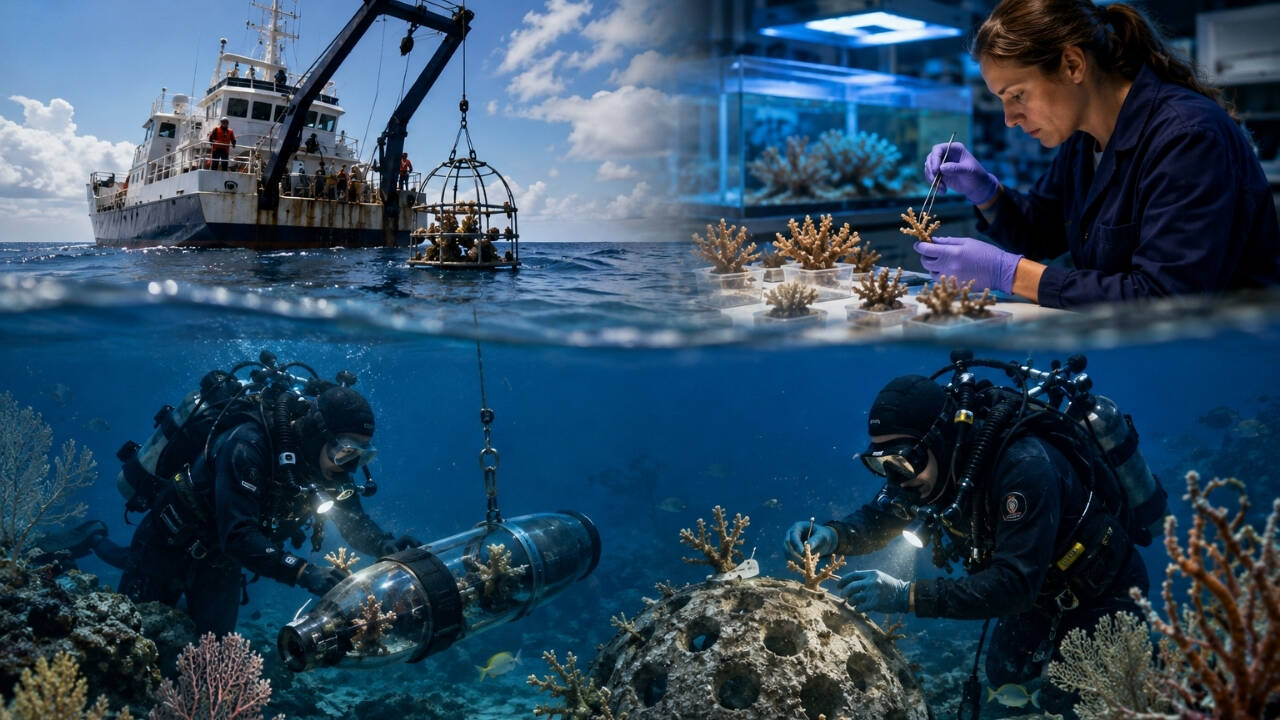
Using custom-designed titanium tools operated by robotic manipulators, technicians snip tiny, thumb-sized fragments from healthy colonies. These are not plucked haphazardly. Every cut is calculated to preserve the parent colony while harvesting enough material to propagate the species. These precious cuttings are placed in insulated, pressurized containers to prevent thermal shock and pressure drop as they are hauled up through a mile of water.
If they ascend too fast, the sudden change in pressure will cause the gases dissolved in their tissues to bubble out, ripping the coral apart from the inside out. It is the deep-sea equivalent of the bends.
Once safe on the deck of a research vessel, the fragments are transferred to specialized aquaria designed to mimic the exact conditions of the abyss—dark, cold, and hyper-pressurized.
The Garden Beneath the Waves
This is where human ingenuity meets humility. We broke it. We are trying, with agonizing slowness, to put it back together.
The cultivated fragments are attached to small weighted plates using marine epoxy. They are nursed in laboratories, fed microscopic nutrients, and monitored until they stabilize. Then, the real journey begins. The robotic submarines are launched once more. They descend back into the blackness, carrying trays of these fragile, human-reared corals back to the very sites where the oil storm raged a decade and a half ago.
The pilots maneuver the robotic arms with the precision of watchmakers. They wedge the weighted plates into the limestone outcroppings, placing each coral fragment where the currents are clean, where the food supply is adequate, and where the ghosts of the past can finally be laid to rest.
It is painstaking. It is expensive. It is a drop in the ocean compared to the millions of acres of seafloor scarred by human activity.
And yet, it matters.
The Weight of What Remains
We treat the ocean as an infinite sponge, a bottomless bin where we can dump our waste, our mistakes, our carbon, and our oil, expecting it to simply absorb the blow and smile back at us with a postcard-worthy sunset.
The deep sea is the Earth's memory. It holds the record of our industrial childhood, written in the chemical signatures trapped in the skeletons of corals that were ancient when pyramids were being stacked in the sand. When we kill those corals, we erase pages from a book we barely know how to read.
Sixteen years later, NOAA's restoration efforts are not a celebration. They are an admission of guilt paired with an act of penance. They are proof that accountability does not expire just because the news cycle has shifted to a new crisis.
Down there, a mile beneath the sparkling, indifferent waves of the Gulf, a tiny white polyp spreads its microscopic tentacles into the current. It catches a passing speck of organic snow. It feeds. It grows. Not by inches, but by fractions of a millimeter. It is blind, it is ancient in its lineage, and it is alive.
It stands as a testament to the stubborn, irrational persistence of life in a place that should have been nothing more than a graveyard.
The oil is gone from the surface. The television crews packed up years ago. But in the crushing dark, the work of resurrection has only just begun.