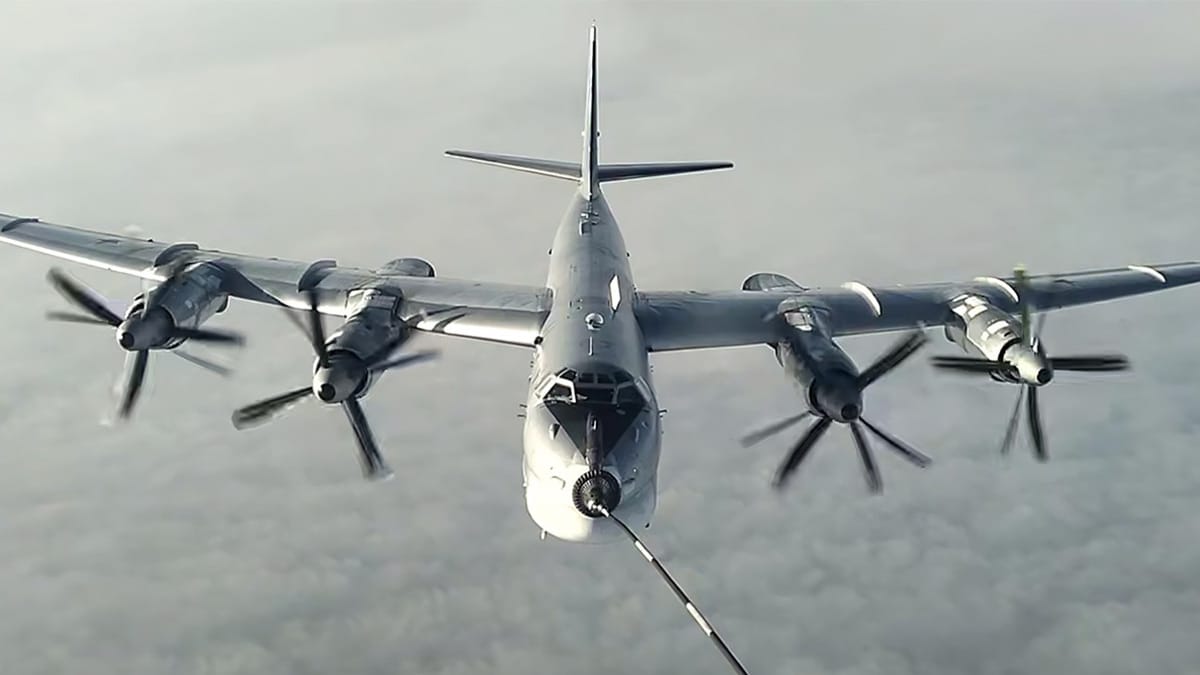
At 35,000 feet above the Sea of Japan, the cold does not bite; it simply erases. Inside the pressurized, rattling belly of a Tupolev Tu-95 strategic bomber—a massive, swept-wing relic of the Cold War affectionately and ominously known to NATO pilots as the "Bear"—the roar of four Kuznetsov turboprop engines vibrates through the soles of a crewman's boots, up his shins, and straight into the base of his skull.
Silence is impossible here. You do not speak; you shout into a throat mic. You do not look out at a romantic expanse of clouds; you stare at glowing green cathode-ray tubes, fuel flow gauges, and the endless, featureless gray of the western Pacific.
Yet, when a formation of these Russian heavy bombers—joined by Chinese H-6K strategic bombers in a stunning display of coordinated audacity—carved an unusual, deliberate path southward, skirting the edges of South Korean, Japanese, and Taiwanese air defense zones, the loudest sound wasn't the contra-rotating propellers. It was the sudden, collective intake of breath inside darkened radar rooms from Tokyo to Taipei.
"Moscow must have known."
That phrase, uttered by defense analysts and military officials in the wake of the joint patrols, sounds deceptively simple. On a standard news ticker, it reads like bureaucratic boilerplate—just another diplomatic chess move in an era thick with geopolitical friction. Cold facts. Coordinates. Intercept scrambles. F-15s lifting off from Naha Air Base in Okinawa, their afterburners tearing holes in the humid night air, racing to meet uninvited guests lingering just outside sovereign territory.
To understand why those four words carry the weight of a shifting world order, you have to step out of the briefing room and put yourself inside the flight suit of a twenty-six-year-old interceptor pilot sitting on five-minute alert.
The Anatomy of a Midnight Scramble
Consider a hypothetical scenario, grounded in the daily reality of the Japan Air Self-Defense Force (JASDF) and Taiwan’s Republic of China Air Force (ROCAF).
Imagine Kenji. He is twenty-seven, drinks too much canned black coffee from the vending machine outside the ready room, and has spent the last four hours trying to read a paperback novel while wearing a G-suit that pinches his thighs whenever he shifts his weight. Outside the reinforced concrete hangar in southwestern Japan, the Pacific night is thick with salt air and cicadas.
Then the klaxon screams.
There is no dramatic countdown. Within ninety seconds, Kenji is strapped into the cockpit of an F-15J Eagle, his ground crew pulling chocks while twin Pratt & Whitney engines whine up to a deafening shriek. He doesn't know yet whether this is a routine probe, a navigation error by a lost civilian cessna, or the opening tremor of a regional crisis. He only knows the vector given to him by Ground Control Intercept: south-southwest, over the East China Sea, toward the Miyako Strait—a narrow, vital chokepoint of international water separating the Ryukyu Islands from Taiwan.
When Kenji finally punches through the cloud deck and levels off at altitude, his radar locks onto targets that shouldn't be flying together. Not here. Not on this trajectory.
Long-range Russian Tu-95MS bombers, designed in the 1950s to carry nuclear payloads across the Arctic Circle to North America, are cruising in tight formation alongside People’s Liberation Army Air Force H-6K bombers. They are flanked by Russian Su-30SM and Su-35 fighter jets. They have turned off their transponders—the electronic beacons that tell civilian air traffic controllers who they are and where they are going. They have filed no flight plans.
They are flying dark.
Think of an Air Defense Identification Zone—an ADIZ—not as a brick wall, because international law grants no nation ownership of the sky beyond its twelve-nautical-mile territorial limit. Instead, think of an ADIZ as a long, gravel driveway leading up to your front porch at two in the morning. Anyone is legally allowed to walk down a public road, and stepping onto the edge of the driveway isn't a crime. But when two neighbors who used to despise each other suddenly walk down your gravel driveway together in the dead of night, carrying heavy backpacks and refusing to answer when you flick on the porch light, you don't go back to sleep. You stand at the window with your hand on the deadbolt.
A Pattern Written in Jet Fuel
For decades, the airspace around Japan and Taiwan followed a predictable, almost ritualistic choreography. Russian bombers would fly down from bases in the Far East—places like Ukrainka in the Amur region—testing Japanese radar response times around Hokkaido and Honshu before turning back. Chinese aircraft would probe the waters around Taiwan, flying predictable loops in the southwest corner of Taipei’s ADIZ.
The two nations operated in separate lanes. History saw to that. For much of the late twentieth century, Moscow and Beijing were bitter ideological rivals who fought a bloody border conflict along the Ussuri River in 1969 and stationed hundreds of thousands of troops along their shared frontier.
That world is gone.
Look at the flight paths recorded by Japan's Ministry of Defense and Taiwan's Ministry of National Defense over the past several years, and a stark geographical story emerges. In 2019, Russian and Chinese bombers conducted their first-ever joint strategic patrol over the Sea of Japan and the East China Sea—an event that stunned Seoul so badly that South Korean fighter jets fired hundreds of warning shots after a Russian A-50 early warning aircraft violated airspace over the disputed Dokdo/Takeshima islets.
By 2022, the patrols had grown bolder, occurring even as President Joe Biden sat in Tokyo meeting with leaders of the Quad alliance. Then came the flights that pushed further south than ever before—passing through the Miyako Strait, skirting the eastern flank of Taiwan, and even crossing into airspace where Russian aircraft had rarely, if ever, ventured in tandem with Beijing. In one particularly tense sequence, Russian and Chinese aircraft operated so close to both Japanese and Taiwanese boundaries that defense ministries in both capitals had to scramble jets simultaneously, tracking heavy bombers capable of carrying long-range cruise missiles just off their coastlines.
"Moscow must have known."
Why do intelligence officials repeat this? Because a strategic bomber flight involving two nuclear-armed states is not an impulsive road trip. You do not accidentally fly a forty-year-old turboprop bomber three thousand miles from home, rendezvous mid-air with a foreign air force speaking a different language, execute aerial refueling over open ocean, and thread the needle between two of the most heavily militarized islands on Earth.
Every gallon of aviation fuel burned on that flight was approved weeks in advance by the General Staff in Moscow and the Central Military Commission in Beijing. Every turn radius was plotted on digital maps. Every reaction from Tokyo, Taipei, Seoul, and Washington was war-gamed before a single propeller spun.
Moscow knew that flying along Taiwan’s eastern coastline—historically the island's shielded "back door," where Taipei plans to preserve its surviving air and naval forces in the event of a Chinese invasion—would send a chilling message. It signaled that Russia is willing to lend its strategic reach to complicate Taiwan's defense, effectively threatening the island from a direction Beijing once struggled to reach on its own.
The Invisible Exhaustion of the Gray Zone
Having watched military escalations unfold across the Indo-Pacific from the vantage point of defense journalism and regional security analysis, I have noticed a dangerous blind spot in how the public consumes this news. We look at a map with red and blue arrows, read that "no territorial airspace was breached" (or that a brief, technical incursion occurred over outlying islands), and conclude that nothing really happened. Nobody fired a missile. Nobody died. We move on to the weather report.
That is a profound misreading of modern conflict.
Military strategists call this "gray-zone warfare"—coercion that lives in the murky space between peacetime diplomacy and open war. Its deadliest weapon isn't high explosives; it is attrition.
Consider what happens every time a Russian Tu-95 and a Chinese H-6K lumber toward the Miyako Strait. To the average citizen eating ramen in downtown Taipei or commuting on the Yamanote Line in Tokyo, the sky looks completely normal. Blue, peaceful, empty.
Down at the airbases, however, a quiet bleeding is taking place.
Every scramble burns tens of thousands of dollars in jet fuel. It eats away at the finite structural lifespan of aging airframes. An F-15J or an F-16V is not a commuter car that you can drive for twenty years with routine oil changes; every high-G turn, every supersonic dash, and every salt-water landing puts microscopic stress fractures into titanium spars and wing roots. When a smaller air force like Taiwan's—which possesses a fraction of China’s aircraft inventory—is forced to scramble fighters hundreds of times a year to shadow Chinese and now Russian intruders, its fleet ages in dog years.
More importantly, the pilots age too.
I once spoke with a retired fighter pilot who flew patrols over the Taiwan Strait during periods of heightened tension. He didn't talk about dogfights or glory. He talked about sleep deprivation. He talked about the creeping psychological numbness that sets in when you spend months waking up at three in the morning to intercept an adversary who knows your exact response protocols, tests your radar frequencies, records your radio chatter, and turns away at the very last second—only to come back tomorrow night.
"The point isn't to shoot at you," he told me, rubbing the bridge of his nose as if the glare of the high-altitude sun still lingered behind his eyes. "The point is to make you tired. To make your mechanics sloppy. To make your radar operators start thinking, Oh, it's just the Russians and Chinese doing their Tuesday loop again. Because the day you treat a real strike package like a routine Tuesday loop is the day you lose your air force on the ground."
The Myth of the "No Limits" Partnership
To grasp why Russia is suddenly burning precious aviation resources in the western Pacific—even while bogged down in a grinding, resource-draining land war in Ukraine—you have to strip away the romantic propaganda both Moscow and Beijing love to broadcast.
In February 2022, Vladimir Putin and Xi Jinping stood together and declared a partnership with "no limits." Western headlines immediately conjured images of a monolithic Eurasian superpower, a reborn Cold War bloc marching in lockstep to topple the American-led order.
The reality is far colder, far more transactional, and honestly, a little desperate.
Russia and China do not trust each other. In the sparsely populated expanses of Siberia and the Russian Far East, local officials still quietly worry about Chinese economic dominance and demographic weight across the Amur River. Beijing, meanwhile, has been careful not to trigger catastrophic Western secondary sanctions by openly shipping lethal weapons to Moscow for use in Ukraine, even as it keeps the Russian economy afloat by buying discounted oil and supplying dual-use microchips.
So why fly bombers together over Japanese and Taiwanese waters?
Because in the brutal arithmetic of power politics, weak spots create strange bedfellows. Moscow is isolated from Europe, its economy warped into a wartime machine, its leverage over Beijing shrinking every month. Offering its long-range strategic aviation—one of the few military assets Russia still possesses that hasn't been chewed up in the mud of eastern Ukraine—gives Putin a bargaining chip. It tells Xi Jinping: Look, we can still project power in your backyard. We can force the United States and Japan to divide their attention.
For Beijing, the calculus is equally pragmatic. China’s military has modernized at breathtaking speed, churning out stealth fighters, aircraft carriers, and ballistic missiles at a pace that alarms the Pentagon. Yet the People's Liberation Army hasn't fought a major war since 1979. Russia, for all its glaring tactical blunders in Ukraine, possesses decades of institutional muscle memory in long-range strategic bomber operations, electronic warfare, and complex command-and-control over vast oceans.
When Chinese H-6K pilots fly wing-to-wing with Russian Tu-95 crews, they aren't just posing for cameras. They are taking notes. They are learning how to coordinate multi-axis strikes across international waters, how to integrate different radar networks, and how to operate in a contested electromagnetic environment where American satellites and Japanese Aegis destroyers are watching every move.
The Human Margin for Error
There is a terrifying vulnerability buried inside all this geopolitical posturing—one that rarely makes it into official defense white papers.
Complex military choreography relies on human beings not making mistakes when they are exhausted, scared, or blinded by ego.
History is littered with moments where cold calculation collided with a panicked finger on a trigger. In 1983, Korean Air Lines Flight 007 strayed into Soviet airspace near Sakhalin Island during a period of acute Cold War paranoia; a Soviet Su-15 interceptor pilot, believing he was tracking an American RC-135 spy plane, fired two air-to-air missiles, killing all 269 people aboard, including a sitting U.S. congressman. In 2001, a Chinese J-8 interceptor collided with a U.S. Navy EP-3 surveillance plane over the South China Sea, killing the Chinese pilot and forcing the crippled American crew to make an emergency landing on Hainan Island, sparking an eleven-day diplomatic standoff that brought Washington and Beijing to the brink.
Now, picture the skies over the East China Sea today.
The airspace is vastly more crowded than it was in 2001. Commercial airliners carrying hundreds of tourists and business travelers cruise along corridors connecting Tokyo, Seoul, Taipei, Shanghai, and Manila. Beneath them, naval destroyers bristle with surface-to-air missiles. Above them, uncrewed reconnaissance drones hum silently in the stratosphere.
Into this tightly packed corridor fly Russian and Chinese bombers with their transponders switched off, escorted by high-performance fighter jets, intercepted by Japanese and Taiwanese scrambles, all while American intelligence aircraft loiter nearby to vacuum up electronic signals.
If a hydraulic line snaps on a thirty-year-old Russian bomber, forcing an unscheduled turn toward Taiwanese airspace; if an overzealous fighter pilot misinterprets a radar lock in the dark; if a mistranslated radio warning sparks a game of chicken at 600 miles per hour—there is no diplomatic hotline sitting between Taipei and Moscow to defuse the crisis in time.
None.
Taipei and Moscow do not have formal diplomatic relations. They barely have an unofficial backchannel capable of handling a fast-moving military emergency. When Russian aircraft skirt Taiwanese airspace, they are playing with fire in a room with no fire exits.
A New Map of Vulnerability
For decades, security in East Asia rested on a neat geographic division of labor. Europe worried about Russian tanks and bombers; Asia worried about North Korean missiles and the Taiwan Strait. Tokyo viewed Moscow primarily as a northern problem, centered on the disputed Kuril Islands (which Japan calls the Northern Territories) north of Hokkaido. Taipei barely thought about Russia at all, except as an arms supplier to Beijing.
That mental map is obsolete.
The flight path of those bombers drew a thick, unmistakable line connecting the war in Europe to the flashpoints of the Indo-Pacific. It demonstrated that security in the twenty-first century is indivisible—that an artillery barrage in Donbas and an airspace breach off Okinawa are two chapters of the exact same book.
Japan has already begun rewriting its postwar pacifism in response, doubling its defense budget, acquiring counterstrike cruise missiles, and deepening military integration with Washington, Seoul, and Canberra. Taiwan is pouring billions into asymmetric defenses—mobile anti-ship missiles, sea drones, hardened radar sites—knowing that an attack might no longer come solely from across the narrow Taiwan Strait, but from the open Pacific to its east.
Still, hardware and budgets can only solve half the equation. The harder work is psychological. It requires democracies to recognize that intimidation doesn't always arrive wearing a uniform and kicking down the front door. Sometimes, it arrives quietly at high altitude, lingering just outside the window, waiting to see if you will blink first.
High above the Pacific, the Russian bombers eventually bank northward, their contra-rotating propellers chewing through the thin air on the long, cold journey back to Siberia. The Chinese aircraft peel off toward the mainland. Down in Okinawa and Taiwan, the F-15s and F-16s touch down on rain-slicked runways, their brake parachutes blooming briefly in the dark before collapsing onto the asphalt.
The pilots climb down the boarding ladders, unclip their helmets, and walk back into the neon-lit hum of the ready rooms. The radar screens go clear. The news tickers move on to tomorrow's headlines.
Yet out over the dark water, nothing is quite the same—because once someone proves they know how to walk right up to your door in the dark, you never really stop listening for footsteps.