Silence.
In the Bell Centre, silence is never an accident; it is a physical weight, twenty-one thousand people holding their collective breath so tightly you can hear the hum of the overhead Zamboni lights and the scrape of a single skate blade carving into fresh ice. For a hockey player returning to Montreal wearing the wrong sweater, that silence is the only thing heavier than the noise that precedes it.
Artturi Lehkonen stood near the blue line, his stick resting across his knees, watching the scoreboard flicker. Every time he comes back to this building, the arena tries to swallow him whole with memory. He spent six seasons bleeding for the bleu, blanc et rouge, scored the overtime goal on Saint-Jean-Baptiste Day in 2021 that sent the Canadiens to the Stanley Cup Final, and became the kind of blue-collar folk hero Montrealers name their dogs after. Then, in the cold mathematics of a March rebuild, he was traded away to the Colorado Avalanche—where he promptly scored the Stanley Cup-winning goal three months later.
On the other end of the sheet, ninety feet of scratched, snow-dusted ice away, stood Mackenzie Blackwood. If Lehkonen was a ghost returning to haunt his old house, Blackwood was a man trying to prove he wasn't a ghost at all. For years, Blackwood’s career had been a cautionary tale whispered in goalie union meetings—a once-heralded prospect in New Jersey whose body betrayed him, whose confidence eroded behind porous defenses, and whose name became shorthand for "what if" before Colorado gambled on him to stabilize a creaking, desperate crease.
When the Colorado Avalanche skated past the Montreal Canadiens, the box score reduced sixty minutes of violent, breathless poetry into a cold, tidy headline. Two names. One result. A routine road victory in a long winter schedule.
Box scores lie. They tell you what happened, never what it cost.
The Architecture of a Homecoming
To understand why a mid-season hockey game in Quebec felt like a Shakespearean tragedy staged on frozen water, you have to understand the psychology of the "revenge game"—a term sports media loves to throw around, though players almost universally despise it.
Revenge implies hatred. Artturi Lehkonen does not hate Montreal. If you have ever sat in the upper bowl of the Bell Centre on a Tuesday night in January, smelling wet wool, stale Molson, and hot pretzels, you know that Montreal doesn't breed hatred in its departed sons; it breeds an ache. When the Canadiens traded Lehkonen in 2022, it wasn't because he failed. It was because he was too valuable to keep on a sinking ship. He was currency.
Imagine, for a moment, a hypothetical master carpenter who spends six years framing a house in the dead of winter, hammering nails with frostbitten fingers, only for the owners to sell him to a neighbor the week before the roof goes on. When that carpenter walks past the finished porch years later, he doesn't want to burn the house down. He just wants to test the floorboards to see if they still hold his weight.
That was Lehkonen on the ice against Montreal.
From the opening faceoff, the Canadiens played with the frantic, unscripted energy of a young team trying to impress an older brother. Montreal’s rebuild, spearheaded by speedsters like Cole Caufield and Nick Suzuki, thrives on chaos—stretching the neutral zone, turning hockey into a track meet, and forcing veteran defenses into panic. In the first period, the Bell Centre roared with every zone entry, the crowd rising like a single wave every time a red jersey crossed the blue line with speed.
Lehkonen didn't match their flash. He never has.
Watching Lehkonen play hockey is like watching a locksmith work while everyone else is trying to kick down the door. While superstars curl into open ice waiting for tape-to-tape passes, Lehkonen lives in the dirty, unglamorous square footage within six feet of the opposing net. He absorbs cross-checks to the lower back that leave bruises the size of dinner plates. He tips pucks moving at ninety miles an hour with the casual precision of a chef flipping an omelet.
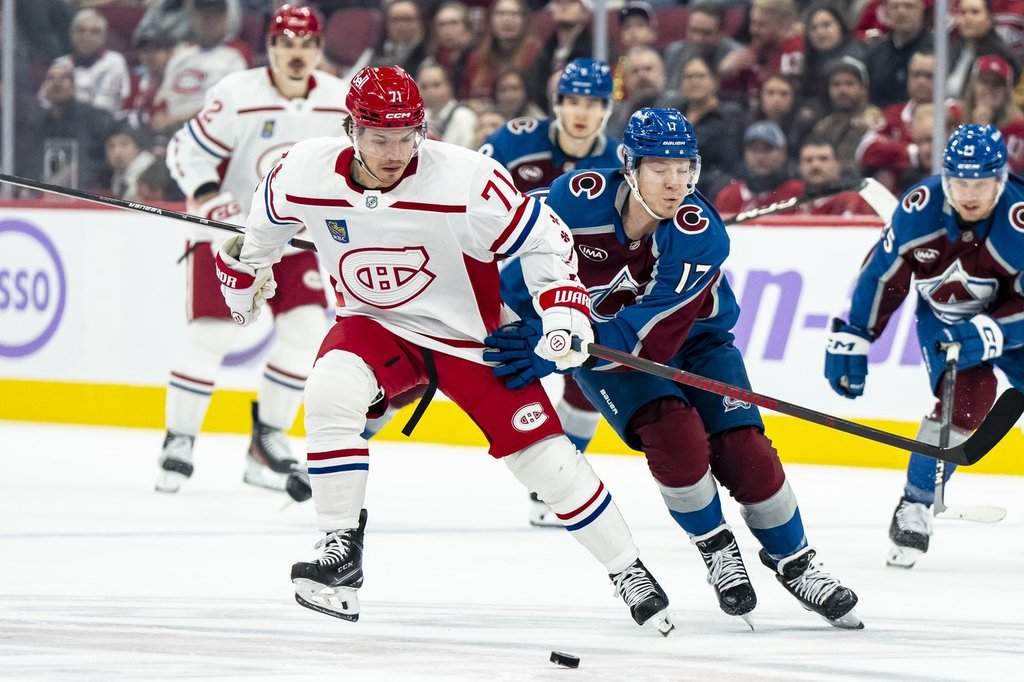
When he struck against his former club, there was no theatrical celebration. No cupping of the ear to the crowd. Just a brief, tight-lipped nod, a glove tap with Nathan MacKinnon, and a skate back to the bench. Yet in that single moment, the oxygen left the building. The Avalanche didn't just take a lead on the scoreboard; they reminded a young Montreal roster of the unforgiving gap between promising talent and championship muscle.
The Lonely Geometry of the Crease
If Lehkonen provided the dagger, Mackenzie Blackwood built the shield.
Goaltending is the most psychologically isolated profession in team sports. A forward can make three terrible turnovers in a shift, hop over the boards, sit on the bench, and let his teammates erase the mistake. A goaltender’s errors are illuminated by a red light and accompanied by a deafening horn that echoes through the rafters while twenty thousand strangers mock his name.
I remember standing behind the glass during morning skate at an NHL arena a few winters ago, watching a backup goalie work with his coach twenty minutes after everyone else had left the ice. The drills weren't glamorous. No sprawling glove saves. Just butterfly slides, post integrations, and tracking dull black rubber through screens of wooden sticks. Every time a puck slipped under his arm, he slammed his paddle against the ice with a crack that sounded like a gunshot in the empty bowl. That is the invisible grind of the position: fighting your own nervous system to stay completely still while objects hurtling at highway speeds fly at your throat.
For years, Blackwood’s nervous system had been under siege. Ankle injuries, heel issues, inconsistent mechanics—the kind of slow, creeping doubts that turn a 6-foot-4 athlete into a hesitant spectator in his own crease. When Colorado acquired him, critics called it a lateral move, a band-aid slapped over a championship window that was rapidly closing.
Against Montreal, Blackwood looked like a man who had finally silenced the static in his head.
Consider what happens when a young, aggressive offense like Montreal’s gets frustrated: they stop passing and start shooting from everywhere. In the second and third periods, the Canadiens threw waves of rubber at the Colorado net—one-timers from the high slot, deceptive wrist shots through traffic, and desperate rebound scrambles in the blue paint.
A nervous goalie fights those pucks. He lunges forward, over-commits to the first shooter, and leaves an empty net for the trailer. Blackwood didn't lunge. He played with a heavy, quiet economy of motion. When a shot hit his chest, it died there, absorbed into his pads without giving up a rebound. When a deflected puck threatened to skip past his post, his skate blade was already sealed against the iron.
Think of an elite goaltender not as an acrobat, but as a chess grandmaster playing speed-blitz while someone throws bricks at his head. He isn't reacting to the shot; he is erasing the angles before the shooter even decides to pull the trigger. By midway through the third period, you could see the realization settle onto the faces of Montreal’s forwards as they skated back toward center ice, heads tilted back, staring at the rafters. They weren't beating themselves. They had run into a wall.
The Invisible Stakes of February Hockey
Why does a single game in the grinding middle stretch of an eighty-two-game season matter so much?
To casual observers, winter hockey is an endurance slog—a blur of charter flights, hotel room service, and bruised ribs before the real drama begins in April. Inside the dressing rooms, however, these are the nights that decide whether a franchise survives the spring.
For the Avalanche, the victory was proof of concept. Championship windows do not close with a dramatic slam; they rust shut one inch at a time. Injuries, salary cap casualties, and the sheer physical toll of deep playoff runs had hollowed out Colorado’s depth over the previous two years. Relying solely on generational superstars like MacKinnon and Cale Makar is a recipe for an early summer exit. Winning in Montreal required the exact blueprint Colorado had paid heavily to assemble: a relentless, defensively responsible winger who thrives in traffic, backed by a rejuvenated goaltender capable of stealing momentum when the legs feel heavy at the end of a road trip.
For Montreal, the loss was a necessary bruise. Rebuilds are seductive because they allow a city to fall in love with potential. Every slick pass looks like the future; every overtime win feels like arrival. Then a heavyweight walks into your building, absorbs your best punches without flinching, and beats you with structure, patience, and a former fan favorite who knows every crack in your foundation.
The Last Echo
With under two minutes remaining, Montreal pulled its goaltender for an extra attacker. The Bell Centre came alive one final time, a desperate, ragged roar vibrating through the concrete floors. Six skaters swarmed the Colorado zone, cycling the puck along the boards, searching for a seam, a bounce, a miracle.
The puck squirted loose near the half-wall. Before a Montreal defenseman could pinch down to keep it in, Artturi Lehkonen was already there—stick on the ice, body angled low, absorbing a heavy hit along the glass just long enough to chip the rubber safely into the neutral zone.
No highlight reel will lead with that play. Nobody buys a jersey because a winger chipped a puck out of his own zone at 18:45 of the third period.
Seconds later, the final horn blared. Blackwood tapped his pads with his stick, exhaled a long plume of mist into the cold arena air, and glided toward the corner to bump fists with his teammates. Lehkonen lingered near center ice for a fraction of a second, raising one gloved hand toward the stands where he had once been worshipped, before disappearing down the tunnel into the quiet concrete belly of the arena.