Silence.
That is the first thing you notice when a franchise cornerstone sits in street clothes instead of full goalie gear, watching his teammates take warmups from the dark tunnel. You do not hear the sharp, rhythmic thud of vulcanized rubber slamming into dense foam pads during the pre-game skate. You do not see the familiar, twitchy head-snaps of Connor Hellebuyck tracking pucks through traffic before the anthem even begins. Don't miss our recent coverage on this related article.
Instead, you feel a subtle, creeping anxiety settle over the lower bowl like frost on the glass.
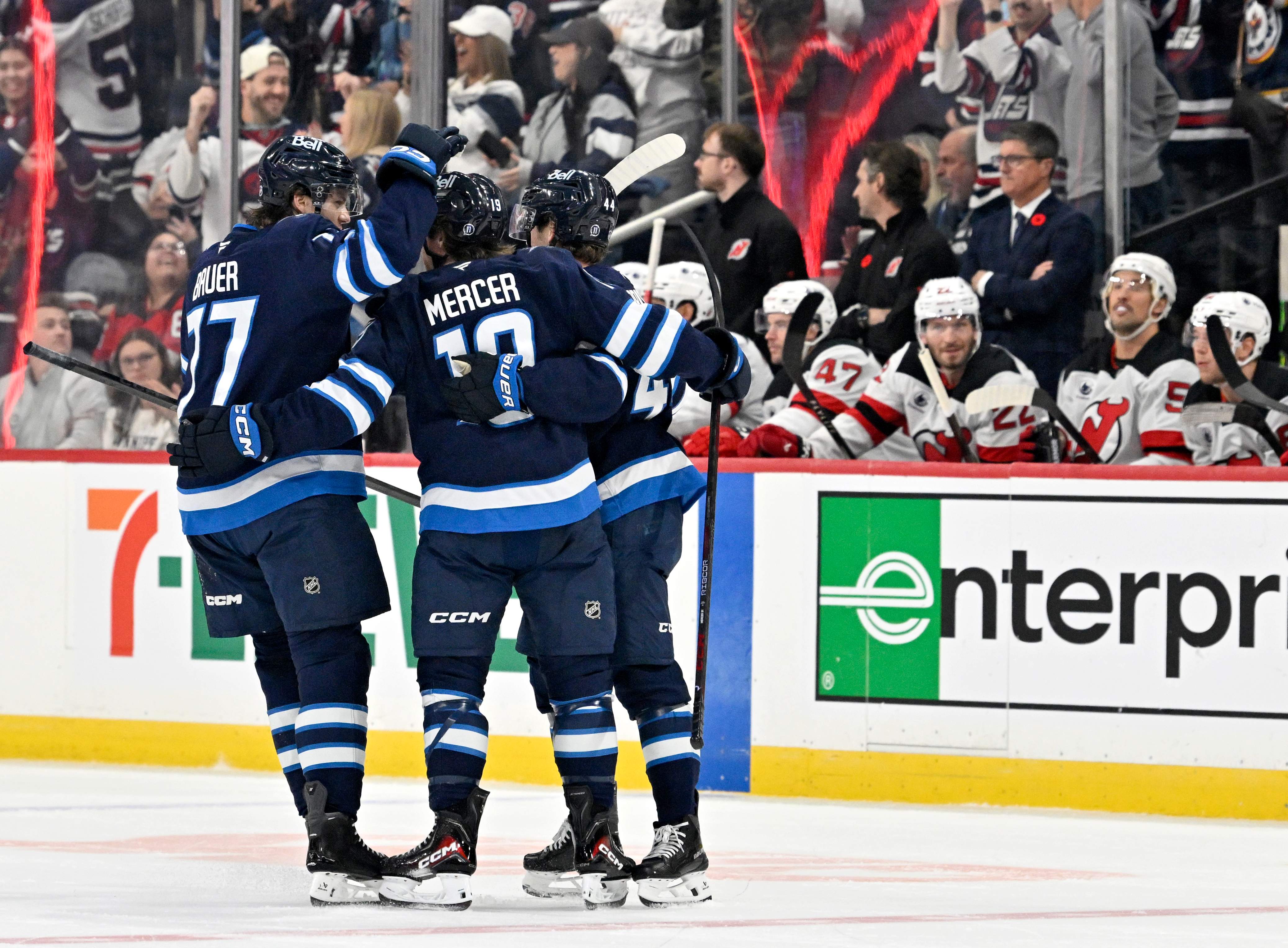
The scoreboard at the end of the night will tell you a deceptively simple story. It will tell you that the Winnipeg Jets doubled up the New Jersey Devils by a final count of 4-2. It will note in the box score that Dawson Mercer scored twice in a losing effort, and that Winnipeg managed to survive without their Vezina-caliber anchor in net. If you only read the wire reports, you will think this was just another Tuesday night in an eighty-two-game grind—a routine road win or home stand, two points banked, move on to the next city. If you want more about the history of this, The Athletic offers an in-depth breakdown.
You would be completely wrong.
Hockey is a sport obsessed with structure, systems, and predictability, yet its outcomes are almost entirely dictated by psychological fractures. When a team loses its starting goaltender—especially one whose reputation precedes him into every rink in North America—the entire geometry of the ice changes. Defensemen hold their sticks an inch tighter. Forwards hesitate for a fraction of a second before pinching along the half-wall. Every dump-in feels heavier, and every odd-man rush carries the faint, metallic taste of panic.
To understand what actually happened on the ice during those sixty minutes, you have to strip away the sterile language of sports journalism and look at the human beings trying to hold their nerve when the safety net disappears.
The Weight of the Empty Crease
Imagine, for a moment, a hypothetical tightrope walker named Arthur who has spent five years crossing a canyon with a massive, reinforced Kevlar net stretched ten feet below his boots. Over time, Arthur stops looking down. He runs across the wire. He tries backflips. He takes risks because the consequence of falling is merely a bounce and a bruised ego. Then, one windy evening, the crew rolls the net away before he steps onto the platform. The wire is the exact same width. The wind is blowing at the exact same speed. Nothing physical has changed, yet Arthur’s knees suddenly feel like wet cardboard.
That is the invisible tax a hockey team pays when its elite netminder is scratched from the lineup.
For years, Winnipeg has operated with one of the thickest safety nets in modern professional sports. When breakdowns happen in the defensive zone—and in a league this fast, breakdowns happen every ninety seconds—the default reaction on the Jets' bench is a collective exhale, because the guy wearing the mask usually erases the mistake. You can cheat for offense when you know the door is locked behind you. You can take a gamble at the offensive blue line, hoping to spring a breakaway, because the worst-case scenario is a routine pad save and a whistle.
Without that presence, the ice tilts.
Early in the first period, you could see the Jets testing the waters, almost tentatively, like swimmers dipping a toe into an unheated pool. Passes that normally snapped tape-to-tape bounced off skates. Clearing attempts rimmed halfway up the boards before getting picked off by aggressive New Jersey forecheckers. The Devils smelled blood in the water immediately. They did not care about Winnipeg's reputation or their place in the standings; they saw a backup netminder staring down a barrage of high-danger chances, and they decided to turn the crease into a demolition derby.
I have sat in press boxes and corner seats for decades, watching hundreds of games where a backup gets the nod against a desperate opponent. You can always tell within the first five minutes whether the team in front of him is going to rally or retreat. If they retreat, the backup gets hung out to dry by the ten-minute mark, staring at the rafters while the red light flashes behind him.
Winnipeg bent. They bent hard.
New Jersey came at them in waves, utilizing the kind of suffocating neutral-zone speed that makes opposing defenders look like they are skating through wet cement. When the Devils established zone time, they did not settle for harmless perimeter shots from the point. They drove the middle. They layered screens in front of the paint, forcing Winnipeg’s blue-liners to choose between blocking shooting lanes or clearing bodies out of the crease.
And right in the middle of that chaos stood a twenty-something forward from Newfoundland who refused to let the night slip away quietly.
The Relentless Pulse of Dawson Mercer
If you want to understand why New Jersey remained dangerous until the final horn, you have to watch Dawson Mercer when he does not have the puck.
Most casual fans watch hockey the way they watch a tennis match, their heads swiveling back and forth to follow the black dot as it zips across the white surface. Watch Mercer instead, and you see an entirely different game. You see a player who treats every square inch of ice like contested territory that someone is trying to steal from his family. He does not glide. He churns. His stride is short, choppy, and furiously persistent, powered by a motor that seems completely detached from the scoreboard.
Mercer scored twice in this game, and both goals were monuments to stubbornness rather than highlight-reel wizardry.
Consider how most goals happen in the National Hockey League today. They are engineered in video rooms, practiced on whiteboards, and executed through cross-ice seam passes that leave goaltenders lunging at empty air. Mercer’s offense, by contrast, is forged in the trenches. On his first tally, he fought through a tangle of sticks and hip checks in the dirty areas near the hash marks, refusing to be moved off his spot until a rebound squirted loose into the slot. He did not wind up for a cinematic slap shot. He simply snapped his wrists, beating the netminder clean before the defense could even register where the puck had gone.
The building erupted, and for a brief, electric stretch, the narrative of the night seemed entirely locked in. New Jersey had the momentum, the crowd, and the tactical advantage of facing a shorthanded roster.
But hockey rarely rewards the team that simply wants it more; it rewards the team that refuses to panic when the plan catches fire.
Surviving the Storm in the Second
There is a specific kind of quiet that falls over an NHL locker room between periods when a team knows it is getting outplayed. Nobody yells. Throwing trash cans and screaming about effort is something coaches do in movies, not in the modern league. Instead, veteran players sit on the benches, unbuckle their helmets, stare at the rubber matting between their skates, and breathe.
They talk about inches.
"Get it past the first layer," a center will mutter to his winger, tapping his shin pad with his stick. "Stop trying to make the cute play at their blue line. Put it behind their defense and make them turn."
It sounds painfully mundane, almost boring compared to the poetry we attach to championship sports, yet that shift in mentality is what separates pretenders from teams built for May and June. When Winnipeg emerged for the second period, they stopped trying to play like a team with an All-Star goalie bailing them out. They accepted their reality. If they were going to win without Hellebuyck, they were going to have to build a wall out of bodies, blocked shots, and bruised ankles.
Watch what happens next: the Jets abandon the middle of the ice entirely to New Jersey's rush, forcing the Devils to the outside walls where angles shrink and desperation shots die in defenders' shin pads.
Every time a New Jersey defenseman cocked his stick at the point, a Winnipeg winger threw himself directly into the firing line. You could hear the dull, sickening thud of frozen rubber striking unprotected muscle all the way up in the rafters. Nobody flinched. Nobody turned away. Slowly, imperceptibly, the frustration began to migrate from the visitors' bench to the home side.
When you fire thirty-five shots toward a net and half of them never even reach the goaltender because guys are diving headfirst in front of them, doubt creeps into your hands. You start aiming for corners instead of shooting on instinct. You hold the puck a heartbeat too long, looking for a prettier pass, and suddenly that tiny window closes.
Winnipeg capitalized on that hesitation with surgical cruelty.
They did not dominate possession, nor did they win the beauty contest. Instead, they waited for New Jersey to overextend—to push one defenseman too deep into the offensive zone in search of the go-ahead goal—and then they struck like a coiled wire snapping back. Two quick transitions. Two clinical finishes past a Devils netminder who had spent long stretches standing idle, trying to stay warm while his teammates buzzed at the other end of the rink.
There is no harder job in sports than playing goalie for a team that controls the puck for seventy percent of the night. You stand alone in a freezing box, watching the action two hundred feet away, your muscles cooling down, your focus drifting for half a second. Then, out of nowhere, two elite shooters come flying down the ice on a two-on-one break, and you are expected to perform a miracle from a dead stop.
Winnipeg exploited that exact vulnerability. They turned New Jersey's aggression into a weapon against them.
The Anatomy of a Comeback Attempt
Down two goals in the third period, a lesser team folds. They take lazy hooking penalties out of frustration, start chirping at the referees, and mentally pack their bags for the post-game meal.
New Jersey did not fold, largely because Dawson Mercer refused to let them.
With the clock bleeding down and the urgency reaching a fever pitch, Mercer found the back of the net for the second time, breathing life back into a building that had started to brace for disappointment. Watching him celebrate that second goal, you saw pure, unfiltered defiance—a fist pump aimed not at the cameras, not at the crowd, but straight into the chest of his own bench, begging them to believe they still had enough time to steal the night back.
For three breathless minutes following that goal, the ice tilted violently once again. The Devils pulled their goaltender for the extra attacker, turning the final stretch into a chaotic six-on-five scramble where structure ceased to exist. Sticks clashed like swords around the crease. Pucks bounced off skates, goalposts, and helmets. Every clearance by Winnipeg barely missed the empty net by inches, icing the puck and dragging exhausted defenders back into their own zone without a line change.
Your lungs burn in those moments. Your legs turn to lead after ninety seconds on the ice, your vision narrows to a tunnel, and every breath tastes like copper. One missed assignment, one lost faceoff, and the entire night unravels into overtime.
Winnipeg won the draw.
They did not try to clear it gently off the glass. They won the puck cleanly back to the point, absorbed one final, desperate body check along the boards, and chipped it cleanly into the neutral zone where a streaking forward buried the empty-netter to seal the 4-2 victory.
What the Box Score Leaves Behind
Tomorrow morning, the standings will show two points for Winnipeg and zero for New Jersey. Analysts will dissect the special teams percentages, argue over ice time allocations, and debate what Hellebuyck's absence means for the upcoming road trip.
Let them have the spreadsheets.
The truth of that game lives in the bruises forming under Winnipeg's equipment right now, and in the quiet fury sitting behind Dawson Mercer’s eyes as he unlaces his skates in a silent locker room. Hockey is not played on paper, and it is never won by reputation alone. Sometimes, the most revealing night of a long season is the one where your best player never even touches the ice, forcing everyone else in the room to discover what they are actually made of when the dark closes in.
The red light flickered off, the Zamboni doors swung open, and the ice was wiped clean before the fans even reached their cars.


