Walk into a hyperscale data center at three in the morning, and the first thing that hits you is not the noise. It is the cold.
A dry, relentless chill blasts up through perforated floor tiles, carrying the faint metallic tang of ozone and the steady, low-frequency hum of ten thousand cooling fans spinning in unison. Beneath the glare of overhead LEDs, rows of matte-black server cabinets stretch toward the back wall like silent monoliths. This is where artificial intelligence actually lives. Not in the sleek, glowing interfaces on your phone screen, and not in the breathless keynote speeches out of Silicon Valley, but right here—in concrete warehouses tucked into rural Virginia, central Ohio, and the Oregon desert, where megawatts of electricity are converted into pure computation and vast amounts of waste heat.
For years, anyone walking these aisles looked at the glowing logos on the front of the server racks and assumed the whole machine was built by American hands. Nvidia chips. Intel processors. Microsoft or Google badges bolted onto the steel doors.
Look behind the racks, though. Trace the thick copper power cables down to the uninterruptible power supplies. Follow the overhead coolant pipes back to the chillers. Check the serial plates on the high-voltage transformers, the liquid-cooling manifolds, and the base-level network switches that keep the whole facility from melting into slag.
A massive portion of that nervous system was engineered, manufactured, or assembled in China.
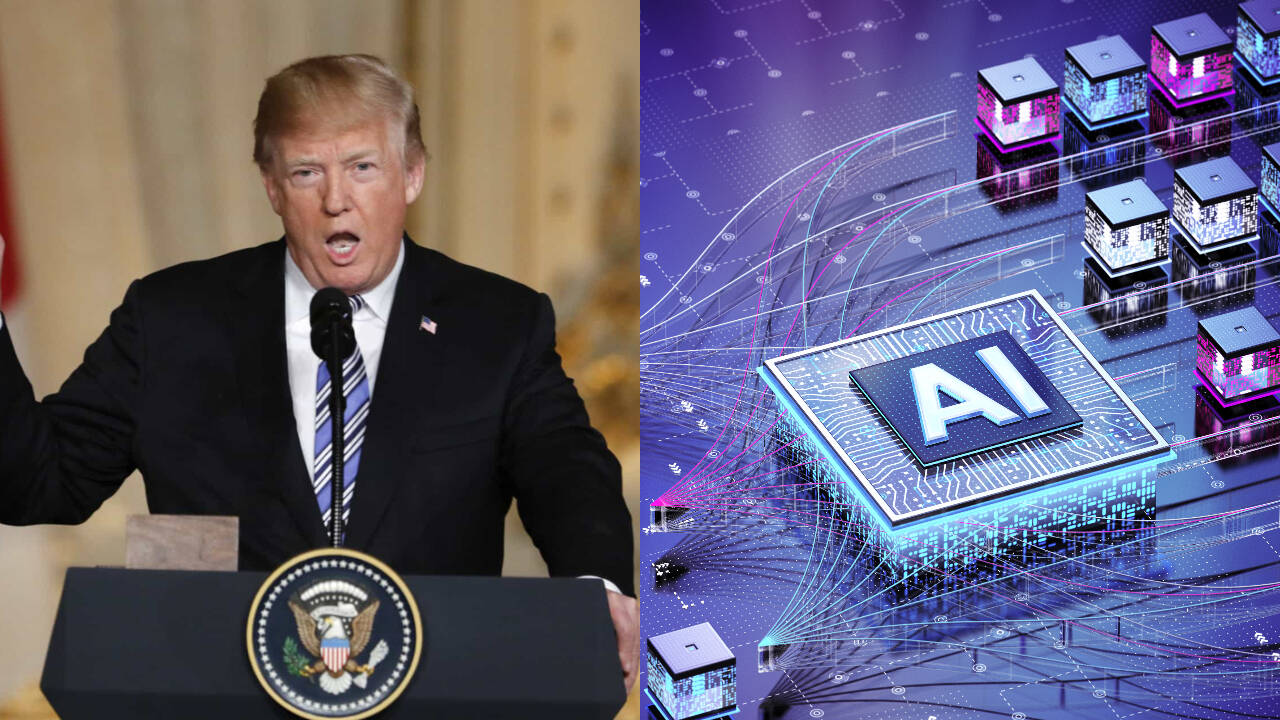
And right now, a high-stakes battle over those invisible components is tearing a quiet rift between the White House and the richest technology companies on earth. According to recent policy reports and industry briefings, President Donald Trump has been pushing aggressive federal measures to ban Chinese-made equipment and infrastructure gear from American AI data centers—moving forward despite fierce, behind-the-scenes pushback from major U.S. tech giants.
To understand why a dispute over power converters and cooling valves has boardrooms in Washington and Cupertino locked in a standoff, you have to step away from the headlines and look at the physical reality of building the future.
The Anatomy of a Modern Brain
Let us create a hypothetical character to ground what happens on the ground when geopolitics collides with electrical engineering. Call him Marcus. He is a forty-two-year-old facilities director overseeing the construction of a new 150-megawatt AI campus outside Columbus, Ohio.
Marcus does not care about political punditry. He cares about lead times, thermal load, and whether the local utility grid can deliver enough juice before his company’s next-generation training cluster falls six months behind schedule. When Marcus orders the ultra-expensive graphics processing units that actually train large language models, those chips are designed in California and fabricated in Taiwan. Those are the rock stars of the data center.
Everything else in the building is the road crew. And without the road crew, the rock stars never take the stage.
Modern AI chips run hotter than anything commercial computing has ever seen. Traditional air conditioning can no longer keep up, forcing facilities like Marcus’s to adopt direct-to-chip liquid cooling—a complex web of pumps, cold plates, and heat exchangers that circulate fluid directly over silicon running near the boiling point. Alongside the cooling gear sit massive battery backup systems, switchgear, optical transceivers, and power distribution units.
For the past decade, global supply chains optimized for one metric above all else: speed at scale. Chinese manufacturers, backed by massive industrial capacity and mature electronics ecosystems in Shenzhen and Suzhou, became the undisputed world leaders in producing these foundational components cheaply and quickly. When an American cloud provider needed five thousand custom power shelves or specialized liquid-cooling manifolds delivered in twelve weeks instead of eighteen months, Chinese suppliers—or multinational suppliers relying heavily on Chinese sub-components—were often the only ones on earth who could fulfill the order.
Now, picture Marcus sitting in his trailer at the edge of a muddy construction site in Ohio, staring at a procurement spreadsheet. If federal regulators suddenly blacklist every piece of Chinese-origin data center hardware, his delivery timelines do not just slip by a few weeks. They fracture.
Two Competing Fears
On the surface, the clash between the Trump administration and Silicon Valley looks like a classic fight between national security hawks and profit-minded corporations. Look closer, and you realize both sides are acting out of genuine, deeply rational terror. They are simply terrified of two completely different nightmares.
Inside the White House and across national security agencies, the nightmare is structural vulnerability.
Intelligence officials and defense planners look at the rapid construction of gigawatt-scale AI clusters across the United States and see critical national infrastructure—no different from the electrical grid, water treatment plants, or telecommunications networks. As artificial intelligence becomes woven into military logistics, cybersecurity defense, pharmaceutical discovery, and financial markets, the physical buildings housing those models become prime strategic targets.
Security hawks point to a stark reality: modern data center hardware is no longer dumb metal. Almost every power supply, cooling controller, and network switch contains embedded firmware—tiny, programmable microchips that monitor voltage, regulate temperature, and communicate over internal management networks. National security officials argue that allowing hardware manufactured under the jurisdiction of Beijing’s national intelligence laws into the physical foundation of American AI creates an unacceptable risk of hidden backdoors, remote kill switches, or covert data exfiltration.
To the administration, building the crown jewels of American technological dominance on top of Chinese power and cooling infrastructure is like building a fortified bank vault and letting a rival nation wire the alarm system. The push for a sweeping ban is meant to sever that dependency before these massive campuses are poured in concrete and locked into twenty-year operational lifecycles.
Down in Silicon Valley and Seattle, tech executives are staring at an entirely different nightmare: losing the AI race because they cannot plug in their servers.
When industry lobbyists and tech executives push back against an immediate, sweeping ban on Chinese data center gear, their argument comes down to basic industrial math. You cannot conjure a domestic transformer and liquid-cooling manufacturing base out of thin air overnight. Building new factories in the United States, permitting them, training specialized machinists, and qualifying new components to meet hyperscale reliability standards takes years.
Tech giants argue that an abrupt ban would choke off the physical expansion of U.S. compute capacity right at the moment global competition is fiercest. If American cloud providers are forced to mothball planned data centers while waiting three years for domestic alternatives to power supplies and optical cables, rivals abroad will keep building without interruption. In the eyes of tech leaders, a ban intended to protect American AI leadership could accidentally kneecap it—handing global market share and compute dominance to foreign competitors while U.S. facilities sit half-built in the dark.
Both arguments carry real weight. That is what makes this standoff so volatile.
The Invisible Web Inside the Supply Chain
Anyone who has ever tried to audit a modern hardware supply chain knows how quickly clean political lines dissolve into messy reality.
Take a single server rack. Suppose an American tech giant buys that rack from a trusted vendor headquartered in Taiwan, Europe, or even the American Midwest. On the invoice, the country of origin looks completely benign. Yet open the chassis and trace every capacitor, printed circuit board, copper busbar, and thermal sensor back to its source, and the trail almost inevitably winds through mainland China.
Even when final assembly happens in Mexico, Vietnam, or Malaysia—a common workaround companies have used since the first wave of tariffs years ago—the raw sub-components often originate in the exact same Chinese industrial hubs.
I remember talking to a hardware engineer a few years back who spent six months trying to build a completely "clean" server prototype for a government contract, free of any components sourced from restricted jurisdictions. By month four, his team realized they could not even source the tiny brushless fans mounted inside the power supplies without tracing the rare-earth magnets back to a single processing facility in northern China. Every time they thought they had closed a loop, another hidden dependency surfaced two tiers down the bill of materials.
That is the headache keeping procurement chiefs awake right now. A ban on "Chinese AI data center gear" sounds straightforward in a press release. In practice, defining where Chinese hardware ends and global hardware begins is a forensic nightmare.
Does a ban apply only to finished equipment sold by Chinese-headquartered firms like Huawei or Inspur, much of which is already heavily restricted? Or does it reach deeper into the bill of materials—banning American and allied vendors from using Chinese-made power modules, printed circuit boards, battery cells, and cooling pumps inside their own systems?
If Washington draws the line loosely, security hawks argue the ban becomes theater, leaving the exact same vulnerabilities intact behind rebranded labels. If Washington draws the line strictly, tech giants warn that entire supply chains could freeze overnight, triggering massive cost spikes that ripple down to every startup, hospital, and university renting cloud compute.
The Weight of Concrete and Copper
To understand why this moment feels different from past trade disputes, look at the sheer physical scale of what is being built in 2026.
Five years ago, a large data center consumed thirty or forty megawatts of power—roughly enough to supply a mid-sized town. Today, tech giants are breaking ground on single AI campuses demanding five hundred megawatts to over a gigawatt of continuous electricity. That is the output of a dedicated nuclear power plant channeled into a single cluster of buildings.
At that scale, everything becomes extreme. The copper wiring inside a single facility weighs thousands of tons. The backup battery rooms look like warehouse stores stacked floor-to-ceiling with lithium-iron-phosphate cells—a battery chemistry in which Chinese manufacturers command overwhelming global market dominance. The optical transceivers that shuttle data between thousands of GPUs at light speed rely on specialized lasers and packaging heavily concentrated in Asian supply hubs.
When you spend fifty billion dollars a year on capital expenditures, as the largest cloud providers now do, you cannot simply pivot your sourcing strategy with a memo. Contracts are signed years in advance. Utility substations are custom-engineered around exact electrical specifications.
Imagine being back in that construction trailer in Ohio with Marcus. Half of your high-voltage switchgear is sitting on a container ship crossing the Pacific. Your battery backup modules are scheduled to roll off an assembly line in Guangdong next month. Your investors are demanding to know when the new AI cluster goes live so they can start recouping tens of billions of dollars in capital outlay.
Then, a regulatory rule lands on your desk requiring you to rip out and replace every component with a Chinese supply-chain footprint—or risk losing federal cloud contracts and facing stiff compliance penalties.
Ripping out installed power and cooling infrastructure is not like uninstalling a software app. It means taking jackhammers to concrete pads, draining thousands of gallons of specialized coolant, rewriting electrical permits, and absorbing hundreds of millions of dollars in stranded assets.
Between Speed and Sovereignty
Step back from the immediate fight between the White House and Big Tech, and a larger historical pattern comes into focus.
Every transformative infrastructure wave in modern history—from transcontinental railroads and telegraph lines to electrical grids and 5G wireless networks—has followed the exact same arc. In the early boom phase, builders prioritize speed, cost, and scale above all else. They buy whatever steel, copper, or electronics lets them lay track fastest. Only after the network becomes indispensable to national survival do governments step in and realize they have outsourced the physical foundations of their sovereignty.
We saw this play out with 5G telecom equipment over the past decade, when Western governments spent billions of dollars ripping and replacing Chinese base stations from rural cell towers after realizing how deeply embedded that gear had become. That cleanup took years, blew past budgets, and left rural carriers scrambling for replacement parts.
AI data centers are 5G on a vastly larger, more expensive, and more consequential scale.
The Trump administration’s push to ban Chinese data center gear is an attempt to force that reckoning now, while the concrete is still wet, rather than ten years from now when the infrastructure is too entrenched to touch. From a pure national security perspective, waiting makes the problem exponentially harder to solve. Every month that passes without clear restrictions locks billions more dollars of foreign-sourced hardware into the physical core of the American economy.
Yet the tech giants’ pushback reveals the unavoidable price of that urgency. Reshoring industrial manufacturing is slow, expensive, and messy. You can pass an executive order in an afternoon, but it takes three to five years to build a factory that winds high-voltage electrical transformers or fabricates precision liquid-cooling cold plates at scale.
In the gap between the stroke of a pen and the opening of a domestic factory lies a dangerous vacuum—a period where supply tightens, prices surge, and projects stall.
What Happens When the Dust Settles
No one outside the inner circles of Washington and Silicon Valley knows exactly where the final compromise will land, and pretending otherwise would be dishonest. Trade policy in this era moves in sudden bursts, shaped by geopolitical brinkmanship, lobbyist pressure, and shifting diplomatic talks.
What seems clear, however, is that the era of frictionless, globalized data center construction is over.
Even if tech giants successfully negotiate phased timelines, waivers for non-sensitive components, or transition windows that give domestic suppliers time to scale up, the direction of travel is unmistakable. Every major cloud provider is already quietly scrambling to map its supply chain down to the raw silicon and copper, offering lucrative multi-year purchase guarantees to any manufacturer willing to build power, cooling, and networking gear in North America or allied nations.
For decades, software engineers lived under the comforting illusion that the digital world floated above geography—weightless, borderless, and immune to the messy politics of physical trade. Artificial intelligence shattered that illusion. AI is heavy. It eats electricity, drinks water, radiates heat, and rests on millions of tons of steel, copper, and silicon.
Walk back into that data center at three in the morning. Stand in the cold blast of air rising through the floor tiles and listen to the low roar of the cooling fans. The code running inside those servers may feel like magic, pure thought captured in light.
But look down at the cables snaking beneath your boots, and remember what they really are: the physical battleground of the twenty-first century, bolted straight into the concrete floor.


